
Find the mirror image of the given figure if the mirror is placed at MN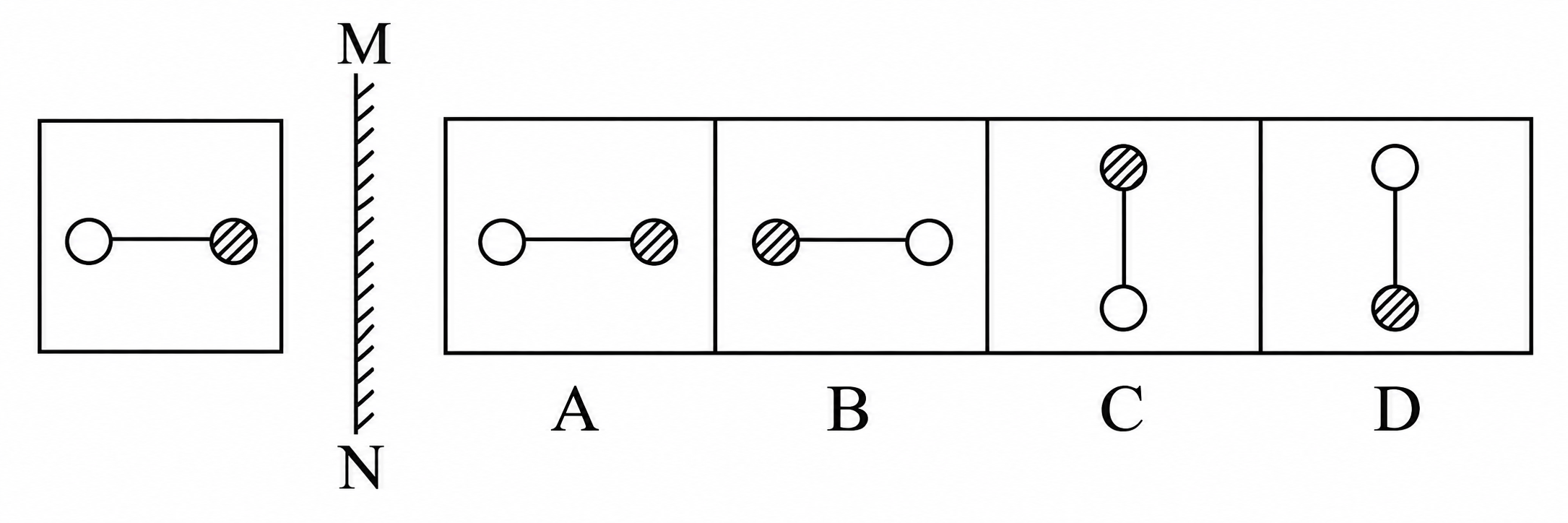
To find the mirror image of a figure, we need to reflect the elements of the figure across the mirror line, which is given as MN in the diagram. This involves reversing the orientation of the elements horizontally.
Correct Option: B) The mirror image correctly swaps the positions of the circles while maintaining the horizontal line.
This problem involves calculating the work done by pipes filling a cistern. We will determine the individual filling rates of Pipe A and Pipe B, then calculate the amount of cistern filled by Pipe A alone, and finally, the time taken by both pipes together to fill the remaining portion.
Pipe A can fill the cistern in 4.5 hours.
\[ \text{Rate of Pipe A} = \frac{1}{\text{Time taken by A}} = \frac{1}{4.5} = \frac{1}{9/2} = \frac{2}{9} \text{ cistern/hour} \]Pipe A and Pipe B together can fill the cistern in 2.25 hours.
\[ \text{Combined Rate (A+B)} = \frac{1}{\text{Time taken by A+B}} = \frac{1}{2.25} = \frac{1}{9/4} = \frac{4}{9} \text{ cistern/hour} \]The rate of Pipe B is the combined rate minus the rate of Pipe A.
\[ \text{Rate of Pipe B} = \text{Combined Rate (A+B)} - \text{Rate of Pipe A} = \frac{4}{9} - \frac{2}{9} = \frac{2}{9} \text{ cistern/hour} \]Pipe A is turned on for half an hour (0.5 hours).
\[ \text{Amount filled by A} = \text{Rate of Pipe A} \times \text{Time} = \frac{2}{9} \times 0.5 = \frac{2}{9} \times \frac{1}{2} = \frac{1}{9} \text{ of the cistern} \]After half an hour, Pipe B is also turned on, so both pipes work together.
\[ \text{Time taken by A+B} = \frac{\text{Remaining portion}}{\text{Combined Rate (A+B)}} = \frac{8/9}{4/9} = \frac{8}{9} \times \frac{9}{4} = 2 \text{ hours} \]Total time is the initial time Pipe A worked alone plus the time both pipes worked together.
\[ \text{Total Time} = 0.5 \text{ hours} + 2 \text{ hours} = 2.5 \text{ hours} \]2.5 hours is equal to 2 hours and 30 minutes.
A) 2 hours and 30 minutes
At the 14th edition of the Mumbai International Film Festival held in 2016, renowned wildlife filmmaker Naresh Bedi was honored with the Shantaram Award. In which category was he awarded?
Best Cinematography
Lifetime Achievement
Best Documentary
Best Direction
The question asks about the specific award category in which renowned wildlife filmmaker Naresh Bedi was honored at the 14th Mumbai International Film Festival (MIFF) in 2016. This is a factual question related to awards and honors in the field of cinema, particularly documentaries and wildlife filmmaking.
Correct Option: B) Lifetime Achievement. Naresh Bedi was conferred with the V. Shantaram Lifetime Achievement Award at the 14th Mumbai International Film Festival (MIFF) in 2016 for his pioneering work in wildlife filmmaking and significant contributions to the documentary genre.
Choose the correct picture that will fit in the blank space in the following series: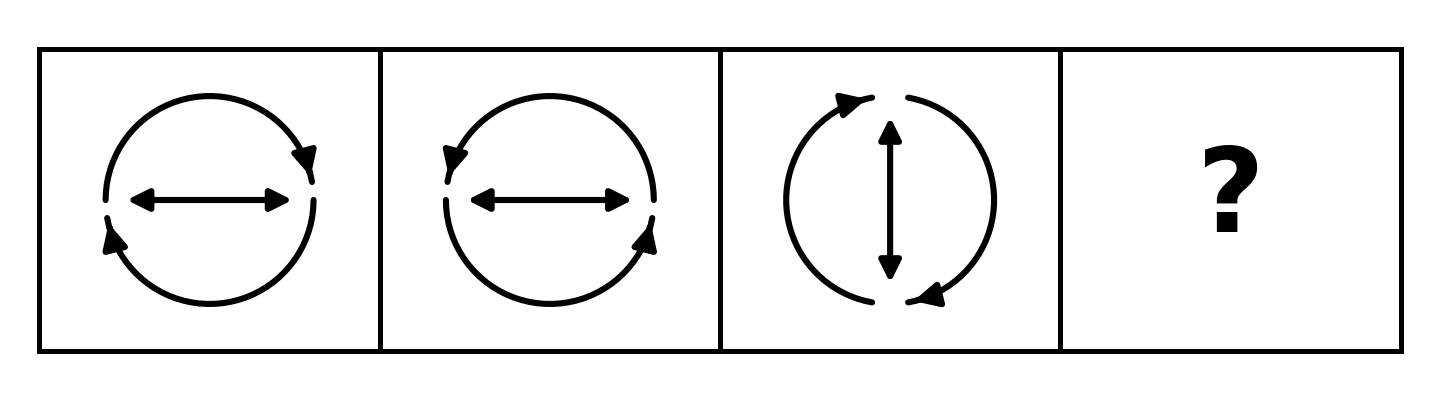
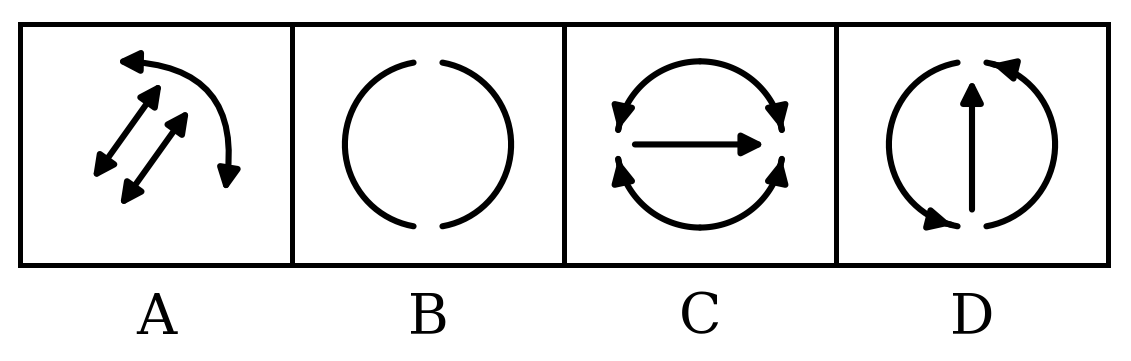
To solve this problem, we need to identify the pattern in the given series of diagrams and choose the option that correctly continues this pattern.
Correct Option: C) The arrows are correctly oriented horizontally and rotated as per the pattern.
The question asks for the maximum age for joining the National Pension Scheme (NPS) as of 2018. This requires knowledge of the eligibility criteria for NPS during that period.
Correct Option: C) 65
As of 2018, the maximum age for joining the National Pension Scheme (NPS) was 65 years. This change was implemented by the PFRDA in 2017 to allow more individuals to join the scheme and plan for their retirement.
To determine the concentration of a solution in terms of mass percent, we need to calculate the ratio of the mass of the solute to the total mass of the solution, and then multiply by 100. The total mass of the solution is the sum of the mass of the solute and the mass of the solvent.
The total mass of the solution is the sum of the mass of the solute and the mass of the solvent.
\[ \text{Total mass of solution} = \text{Mass of solute} + \text{Mass of solvent} \] \[ \text{Total mass of solution} = 31 \text{ g} + 320 \text{ g} = 351 \text{ g} \]The formula for mass percent concentration is:
\[ \text{Mass percent} = \frac{\text{Mass of solute}}{\text{Total mass of solution}} \times 100\% \]Substitute the values:
\[ \text{Mass percent} = \frac{31 \text{ g}}{351 \text{ g}} \times 100\% \] \[ \text{Mass percent} \approx 0.088319 \times 100\% \] \[ \text{Mass percent} \approx 8.83\% \]Correct Option: A) 8.83%
_______ is the common name for Ascaris
The question asks for the common name of the parasitic nematode Ascaris. This requires knowledge of common biological names and their scientific counterparts, specifically in the context of parasitic worms.
Correct Option: D) Roundworm is the common name for Ascaris. Ascaris lumbricoides, for instance, is a large intestinal roundworm that infects humans.
If a + \( \frac{1}{a} \) = -\( \sqrt{3} \), find the value of a3 + \( \frac{1}{a^{3}} \)
The problem asks us to find the value of \(a^3 + \frac{1}{a^3}\) given the equation \(a + \frac{1}{a} = -\sqrt{3}\). We can solve this by cubing the given equation and using the algebraic identity for the cube of a sum.
The identity for the cube of a sum is \((x+y)^3 = x^3 + y^3 + 3xy(x+y)\).
Let \(x = a\) and \(y = \frac{1}{a}\). Then, the given equation is \(x+y = -\sqrt{3}\).
Cubing both sides of the given equation \(a + \frac{1}{a} = -\sqrt{3}\):
\[ \left(a + \frac{1}{a}\right)^3 = (-\sqrt{3})^3 \]We know that \(a + \frac{1}{a} = -\sqrt{3}\). Substitute this into the expanded equation:
\[ a^3 + \frac{1}{a^3} + 3(-\sqrt{3}) = (-\sqrt{3})^3 \]Calculate \((-\sqrt{3})^3\):
\[ (-\sqrt{3})^3 = (-\sqrt{3}) \cdot (-\sqrt{3}) \cdot (-\sqrt{3}) \]\[ = (3) \cdot (-\sqrt{3}) \]\[ = -3\sqrt{3} \]Substitute the calculated value back into the equation:
\[ a^3 + \frac{1}{a^3} - 3\sqrt{3} = -3\sqrt{3} \]Add \(3\sqrt{3}\) to both sides of the equation:
\[ a^3 + \frac{1}{a^3} = -3\sqrt{3} + 3\sqrt{3} \]\[ a^3 + \frac{1}{a^3} = 0 \]A) 0 — By cubing the given expression \(a + \frac{1}{a} = -\sqrt{3}\) and using the algebraic identity \((x+y)^3 = x^3 + y^3 + 3xy(x+y)\), we found that \(a^3 + \frac{1}{a^3} = 0\).
Each question given below consists of a statement, followed by two arguments numbered I and II. You have to decide which of the arguments is a 'strong' argument.
Statement:
Should table etiquettes be a part of kindergarten curriculum?
Arguments:
I. Yes, enforcing good etiquette gives children a sense of responsibility.
II. No, etiquettes are meant only for adults not for children.
Only argument II is strong
Neither I nor II is strong
Both I and II are strong
Only argument I is strong
The question asks us to evaluate the strength of two arguments regarding whether table etiquette should be part of a kindergarten curriculum. We need to determine which argument is 'strong', meaning it is logical, relevant, and persuasive.
Correct Option: D) Only argument I is strong
The question asks for India's rank in the 2017 Global Hunger Index (GHI) among 119 countries. To answer this, one needs to recall the specific GHI report for the year 2017 and India's position in it.
Correct Option: C) 100