
Mr. Z is standing facing towards the east. He takes a left turn and walks 5 km to reach point A. Then he takes a left turn and walks 4 km to reach point B. Then he takes a right turn and walks 3 km to reach point C. Then he takes a right turn and walks 10 km to reach point D.
In which direction is Mr. Z facing now at point D?
This problem involves tracking changes in direction based on turns. We need to visualize Mr. Z's initial facing direction and then sequentially apply each turn (left or right) to determine his final facing direction.
Therefore, at point D, Mr. Z is facing East.
D) East. After all the turns, Mr. Z ends up facing East.
The question asks for the term that describes an object's resistance to changes in its state of motion or rest. This is a fundamental concept in classical mechanics, specifically related to Newton's First Law of Motion.
Correct Option: D) Inertia
The following figure gives the percentage distribution of sales of a small home-based business over the past 5 years. The total sales during these five years were Rs. 20,00,000.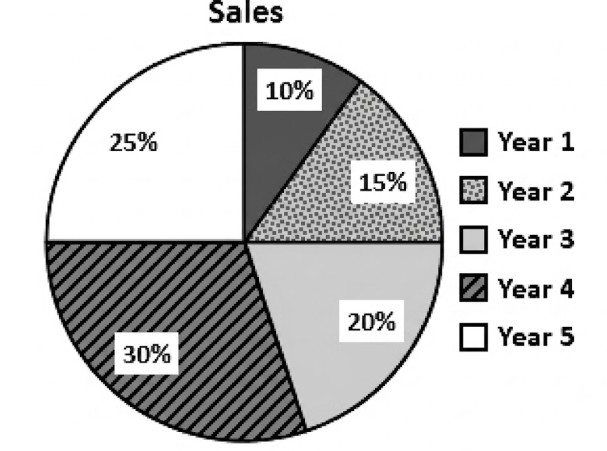
What is the difference between the sales of year 1 and year 5?
To find the difference between the sales of Year 1 and Year 5, we need to calculate the sales for each year using the percentage distribution provided in the pie chart and then find the difference.
Correct Option: B) Rs. 3,00,000
Find the odd one out from the following: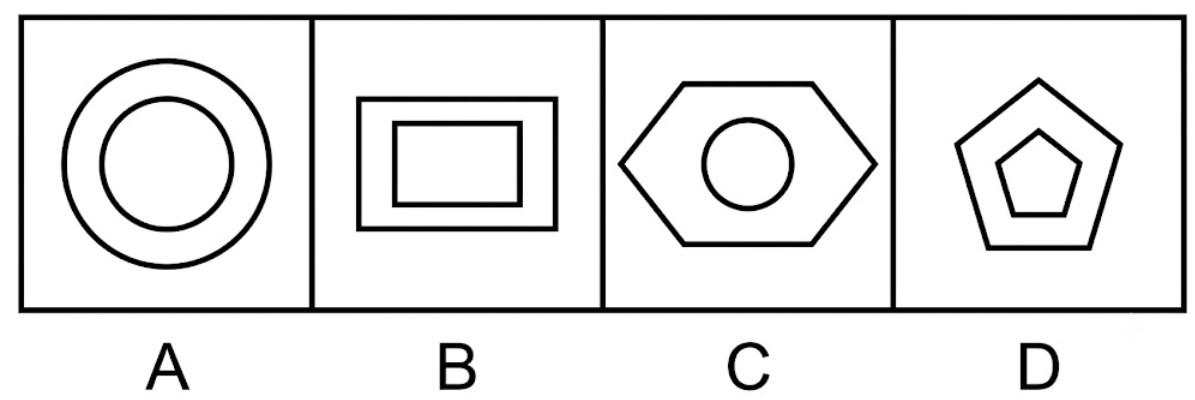
To find the odd one out, we need to identify a pattern or commonality among the majority of the options and see which one does not fit this pattern.
Correct Option: C) Option C is the odd one out as it does not follow the pattern of having a smaller version of the same shape inside.
The question asks to identify the kingdom that includes multicellular organisms without cell walls. This requires knowledge of the fundamental characteristics used to classify organisms into major kingdoms.
A) Animalia is the kingdom characterized by multicellular, eukaryotic organisms that are heterotrophic and lack cell walls. This perfectly fits the description in the question.
The simple interest on a certain sum of money is \( \frac{9}{4} \) of the principal amount. If the number of years and the rate of interest are the same, then for what period was the amount deposited?
The question involves calculating the time period for which a sum of money was deposited at simple interest. We are given that the simple interest is \(\frac{9}{4}\) of the principal amount and that the numerical values of the rate of interest and the time period are equal. We can use the simple interest formula, substitute the given relationship, and solve for the time period.
Identify the given information:
Recall the simple interest formula:
Simple interest is calculated using the formula:
\[ SI=\frac{P\times R\times T}{100} \]Where:
Express the simple interest in terms of the principal:
According to the question, the simple interest is \(\frac{9}{4}\) of the principal amount.
\[ SI=\frac{9}{4}P \]Apply the condition relating rate and time:
The question states that the numerical values of the rate of interest and the number of years are equal.
\[ R=T \]Substituting \(R=T\) into the simple interest formula:
\[ SI=\frac{P\times T\times T}{100} \] \[ SI=\frac{PT^2}{100} \]Equate the two expressions for simple interest:
Since both expressions represent the same simple interest:
\[ \frac{PT^2}{100}=\frac{9P}{4} \]Cancel the principal amount \(P\) from both sides:
\[ \frac{T^2}{100}=\frac{9}{4} \]Solve for the time period:
Multiply both sides by 100:
\[ T^2=\frac{9}{4}\times100 \] \[ T^2=225 \]Taking the square root of both sides:
\[ T=\sqrt{225} \] \[ T=15 \]Since the time period must be positive, the required time is 15 years.
Verify the result:
Since the numerical values of the rate and time are equal:
\[ R=15\%,\quad T=15\text{ years} \]Substituting into the simple interest formula:
\[ SI=\frac{P\times15\times15}{100} \] \[ SI=\frac{225P}{100} \] \[ SI=\frac{9P}{4} \]This matches the given condition that the simple interest is \(\frac{9}{4}\) of the principal amount. Therefore, the calculated time period is correct.
Correct Option: C) 15 years — Using the simple interest formula \(SI=\frac{PRT}{100}\), along with the conditions \(SI=\frac{9P}{4}\) and \(R=T\), we obtain \(T^2=225\). Therefore, \(T=15\) years. Hence, Option C is the correct answer.
A) 12 years: This is incorrect because if the time period were 12 years, the annual rate of interest would also be 12%. The simple interest would then be:
\[ SI=\frac{P\times12\times12}{100} =1.44P \]This is not equal to the given simple interest of \(2.25P\).
B) 5.5 years: This is incorrect because if the time period were 5.5 years, the annual rate would also be 5.5%. The simple interest would be:
\[ SI=\frac{P\times5.5\times5.5}{100} =0.3025P \]This is much less than the required simple interest of \(2.25P\).
D) 7.5 years: This is incorrect because if the time period were 7.5 years, the annual rate would also be 7.5%. The simple interest would be:
\[ SI=\frac{P\times7.5\times7.5}{100} =0.5625P \]This does not satisfy the given condition that the simple interest is \(\frac{9}{4}\) of the principal amount.
The problem involves calculating the total number of fruits required and then using the given condition that the number of fruits offered in each temple is equal to the number of temples in the city. We will set up an equation based on this information to find the number of temples.
Calculate the total number of fruits: Each basket contains 45 fruits. The man needs 5 baskets of fruits.
\[ \text{Total fruits} = \text{Fruits per basket} \times \text{Number of baskets} \] \[ \text{Total fruits} = 45 \times 5 = 225 \]So, the man has a total of 225 fruits.
Set up the equation based on the offering condition: Let \(x\) be the number of temples in the city. The problem states that the man offers as many fruits in each temple as there are temples in the city. This means he offers \(x\) fruits in each temple.
The total number of fruits offered will be the number of temples multiplied by the number of fruits offered per temple.
\[ \text{Total fruits offered} = \text{Number of temples} \times \text{Fruits offered per temple} \] \[ \text{Total fruits offered} = x \times x = x^2 \]Equate the total fruits available to the total fruits offered: The total fruits available (225) must be equal to the total fruits offered (\(x^2\)).
\[ x^2 = 225 \]Solve for \(x\): To find \(x\), take the square root of 225.
\[ x = \sqrt{225} \] \[ x = 15 \]Since the number of temples cannot be negative, we take the positive square root.
Therefore, the number of temples in the city is 15.
Correct Option: A) 15
To find the time taken for two trains running in opposite directions to cross each other completely, we need to calculate their relative speed and the total distance they need to cover. The total distance will be the sum of their lengths, and the relative speed will be the sum of their individual speeds.
When two trains cross each other completely, the total distance they cover is the sum of their lengths.
\[ \text{Total Distance} = L_1 + L_2 = 210 \text{ m} + 250 \text{ m} = 460 \text{ m} \]Since the trains are running in opposite directions, their relative speed is the sum of their individual speeds.
\[ \text{Relative Speed} = S_1 + S_2 = 130 \text{ km/hr} + 110 \text{ km/hr} = 240 \text{ km/hr} \]To convert km/hr to m/s, multiply by \(\frac{5}{18}\).
\[ \text{Relative Speed (m/s)} = 240 \times \frac{5}{18} = \frac{1200}{18} = \frac{200}{3} \text{ m/s} \]Time is calculated as Total Distance divided by Relative Speed.
\[ \text{Time} = \frac{\text{Total Distance}}{\text{Relative Speed}} = \frac{460 \text{ m}}{\frac{200}{3} \text{ m/s}} \]\[ \text{Time} = \frac{460 \times 3}{200} = \frac{1380}{200} = \frac{138}{20} = \frac{69}{10} = 6.9 \text{ seconds} \]Correct Option: A) 6.9 seconds
The question asks to identify the author of the book 'Exam Warriors'. This is a direct factual question related to current affairs and prominent personalities, often encountered in competitive exams.
Correct Option: A) Narendra Modi is the author of the book 'Exam Warriors'. The book was written to inspire students to face exams without stress and to celebrate them as a festival.
This is a blood relations problem. We need to establish the relationships between the given individuals step-by-step to determine the final relationship between the brother of W and X.
D) Maternal grandfather's brother — W is the maternal grandfather of X. The brother of W would therefore be the maternal grandfather's brother of X.