
To calculate the concentration of a solution in terms of mass by mass percentage, we need to find the mass of the solute and the mass of the solvent. Then, we calculate the total mass of the solution. Finally, we use the formula for mass percentage: \[\text{Mass percentage} = \frac{\text{Mass of solute}}{\text{Mass of solution}} \times 100\%\].
The total mass of the solution is the sum of the mass of the solute and the mass of the solvent.
\[ \text{Mass of solution} = \text{Mass of solute} + \text{Mass of solvent} \]\[ \text{Mass of solution} = 33 \text{ g} + 320 \text{ g} \]\[ \text{Mass of solution} = 353 \text{ g} \]Use the formula for mass percentage:
\[ \text{Mass percentage} = \frac{\text{Mass of solute}}{\text{Mass of solution}} \times 100\% \]\[ \text{Mass percentage} = \frac{33 \text{ g}}{353 \text{ g}} \times 100\% \]\[ \text{Mass percentage} \approx 0.09348 \times 100\% \]\[ \text{Mass percentage} \approx 9.348\% \]Rounding to two decimal places, the concentration is \(9.35\%\).
Correct Option: D) 9.35% is the calculated mass by mass percentage of the solution.
This problem involves finding numbers given their ratio and HCF (Highest Common Factor). We know that if two numbers are in a certain ratio, they can be expressed as multiples of a common factor. The HCF of these numbers will be that common factor.
Correct Option: A) 195 is the greater number.
The question asks to identify the award received by the International Campaign to Abolish Nuclear Weapons (ICAN) in 2017. This is a factual question related to current affairs and international awards, specifically the Nobel Peace Prize.
A) Nobel Peace Prize: The International Campaign to Abolish Nuclear Weapons (ICAN) was awarded the Nobel Peace Prize in 2017 for its work to draw attention to the catastrophic humanitarian consequences of any use of nuclear weapons and for its ground-breaking efforts to achieve a treaty-based prohibition of such weapons.
To find the selling price for a desired profit percentage, we first need to calculate the total cost price of the article. The total cost price includes the purchase price and any additional expenses like transportation. Once the total cost price is determined, we can calculate the profit amount based on the given profit percentage and add it to the total cost price to find the selling price.
Calculate the Total Cost Price (CP):
The total cost price is the sum of the purchase price and the transportation cost.
\[ \text{Purchase Price} = \text{Rs. } 14,360 \]\[ \text{Transportation Cost} = \text{Rs. } 240 \]\[ \text{Total CP} = \text{Purchase Price} + \text{Transportation Cost} \]\[ \text{Total CP} = 14,360 + 240 = \text{Rs. } 14,600 \]Calculate the Desired Profit Amount:
The desired profit is 15% of the Total Cost Price.
\[ \text{Profit Percentage} = 15\% \]\[ \text{Profit Amount} = \frac{\text{Profit Percentage}}{100} \times \text{Total CP} \]\[ \text{Profit Amount} = \frac{15}{100} \times 14,600 \]\[ \text{Profit Amount} = 15 \times 146 = \text{Rs. } 2,190 \]Calculate the Selling Price (SP):
The selling price is the Total Cost Price plus the Profit Amount.
\[ \text{Selling Price (SP)} = \text{Total CP} + \text{Profit Amount} \]\[ \text{SP} = 14,600 + 2,190 = \text{Rs. } 16,790 \]Therefore, Raghu must sell the article for Rs. 16,790 to get a profit of 15%.
Correct Option: B) Rs. 16,790
To find the volume of a pyramid, we need its base area and height. The base is a rectangle, so its area is straightforward. The height can be found using the Pythagorean theorem, relating the lateral edge, the half-diagonal of the base, and the height of the pyramid.
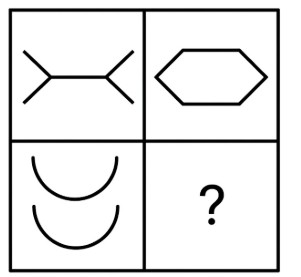
Choose the correct picture that fits the blank place?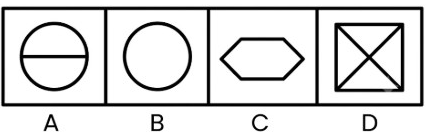
The question involves identifying a pattern in the given diagrams and selecting the correct option to complete the sequence. Each diagram in the question image represents a unique shape or pattern.
Correct Option: D) The square with intersecting lines fits the pattern by maintaining symmetry and complementing the intersecting lines theme.
The problem asks us to determine which statement(s) are sufficient to find the sum of the first 10 consecutive even numbers in a series. We need to evaluate each statement individually and then in combination.
The question asks for the sum of the first 10 consecutive even numbers in a series. This implies an arithmetic progression where the terms are even numbers. Let the series be \(a_1, a_2, \ldots, a_{10}\).
We need to find the sum \(S_{10}\) of these 10 numbers. The formula for the sum of an arithmetic progression is:
\[ S_n = \frac{n}{2} (a_1 + a_n) \]where \(n\) is the number of terms, \(a_1\) is the first term, and \(a_n\) is the \(n\)-th term.
In this case, \(n = 10\), so the formula becomes:
\[ S_{10} = \frac{10}{2} (a_1 + a_{10}) = 5 (a_1 + a_{10}) \]To find \(S_{10}\), we need to know the first term \(a_1\) and the 10th term \(a_{10}\).
Statement I: The first number is 2 and 10th number is 20.
From this statement, we have \(a_1 = 2\) and \(a_{10} = 20\).
Using the sum formula:
\[ S_{10} = 5 (a_1 + a_{10}) = 5 (2 + 20) = 5 (22) = 110 \]Since we can calculate the sum using Statement I, Statement I alone is sufficient to answer the question.
Statement II: The common difference is 2.
This statement tells us that \(d = 2\). This is consistent with a series of consecutive even numbers. However, it does not provide the first term (\(a_1\)) or any other specific term in the series. Without knowing at least one term, we cannot determine the entire series or its sum.
For example, if the series starts with 2, it would be 2, 4, 6, ..., 20. The sum is 110.
If the series starts with 4, it would be 4, 6, 8, ..., 22. The sum would be \(5 (4 + 22) = 5 (26) = 130\).
Since the sum changes depending on the starting term, Statement II alone is not sufficient.
Statement I alone is sufficient to find the sum. Statement II alone is not sufficient.
Correct Option: B) Only statement I is sufficient
This problem involves calculating distance given different speeds for travel to and from a destination and the total time taken. We can use the fundamental relationship between distance, speed, and time, and set up an equation based on the total time.
Let the distance between Raghu's home and college be \(D\) km.
Raghu goes to college at a speed of 4 kmph. The time taken to go to college (\(T_1\)) is:
\[ T_1 = \frac{\text{Distance}}{\text{Speed}} = \frac{D}{4} \text{ hours} \]Raghu returns from college at a speed of 3 kmph. The time taken to return from college (\(T_2\)) is:
\[ T_2 = \frac{\text{Distance}}{\text{Speed}} = \frac{D}{3} \text{ hours} \]The total time taken for the entire journey (to and fro) is given as 5.95 hours. So, the sum of \(T_1\) and \(T_2\) must be equal to 5.95 hours:
\[ T_1 + T_2 = 5.95 \] \[ \frac{D}{4} + \frac{D}{3} = 5.95 \]To solve for \(D\), find a common denominator for the fractions, which is 12:
\[ \frac{3D}{12} + \frac{4D}{12} = 5.95 \] \[ \frac{3D + 4D}{12} = 5.95 \] \[ \frac{7D}{12} = 5.95 \]Now, isolate \(D\):
\[ 7D = 5.95 \times 12 \] \[ 7D = 71.4 \] \[ D = \frac{71.4}{7} \] \[ D = 10.2 \text{ km} \]Thus, the distance between Raghu's home and college is 10.2 km.
A) 10.2 km
The problem involves fractions representing the proportion of people sitting and chairs occupied. We need to find the total number of chairs and people, then calculate the empty chairs if everyone was seated.
D) 10
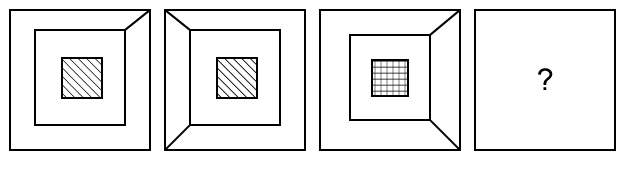
Choose the correct picture which fits the blank space from the figures given below?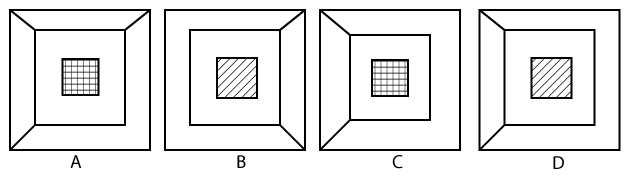
The question involves identifying a pattern among the given figures and selecting the correct option that fits the sequence. Each figure consists of a square with a pattern inside it, and the task is to determine the next logical figure in the sequence.
Correct Option: A) The option with the grid pattern matches the expected sequence.