
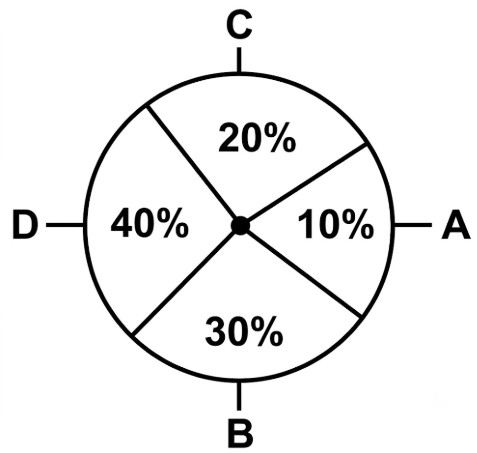
The problem requires calculating the number of children vaccinated in city 'A' based on the given percentage from a pie chart.
Calculation:
\[ \text{Number of children in city 'A'} = \frac{10}{100} \times 1,20,000 = 12,000 \]Thus, 12,000 children were vaccinated in city 'A'.
Correct Option: C) 12,000
The question asks for the term that defines the rate of change of displacement. This is a fundamental concept in kinematics, a branch of physics that describes motion. We need to recall the definitions of displacement, velocity, speed, and acceleration.
Correct Option: B) Velocity is defined as the rate of change of displacement. It is a vector quantity that specifies both the speed of an object and its direction of motion. The formula is given by \( \vec{v} = \frac{d\vec{s}}{dt} \), where \( \vec{v} \) is velocity, \( \vec{s} \) is displacement, and \( t \) is time.
To find the sum of the zeros of a cubic polynomial, we can use Vieta's formulas. For a general cubic polynomial \(Ax^3 + Bx^2 + Cx + D = 0\), the sum of its zeros (roots) is given by the formula \( -(B/A) \).
A general cubic polynomial is given by \(Ax^3 + Bx^2 + Cx + D\).
The given polynomial is \(2x^3 - x^2 - 2x + 1\). Comparing this with \(Ax^3 + Bx^2 + Cx + D\), we can identify the coefficients:
For a cubic polynomial with zeros \(a, b,\) and \(c\), the sum of the zeros is given by:
\[ a + b + c = -\frac{B}{A} \]Substitute \(A = 2\) and \(B = -1\) into the formula:
\[ a + b + c = -\frac{(-1)}{2} \] \[ a + b + c = \frac{1}{2} \]Correct Option: D) \( \frac{1}{2} \)
To calculate the compound interest for varying rates over different years, we need to calculate the amount at the end of each year and then use that amount as the principal for the next year. Finally, subtract the original principal from the final amount to get the compound interest.
The principal for the first year is Rs. 5,000 and the rate of interest is 4%.
\[ \text{Amount after 1st year} = \text{Principal} \times \left(1 + \frac{\text{Rate}_1}{100}\right) \]\[ = 5000 \times \left(1 + \frac{4}{100}\right) \]\[ = 5000 \times (1 + 0.04) \]\[ = 5000 \times 1.04 \]\[ = \text{Rs. } 5200 \]The principal for the second year is the amount after the first year, which is Rs. 5,200. The rate of interest is 3%.
\[ \text{Amount after 2nd year} = \text{Amount after 1st year} \times \left(1 + \frac{\text{Rate}_2}{100}\right) \]\[ = 5200 \times \left(1 + \frac{3}{100}\right) \]\[ = 5200 \times (1 + 0.03) \]\[ = 5200 \times 1.03 \]\[ = \text{Rs. } 5356 \]The principal for the third year is the amount after the second year, which is Rs. 5,356. The rate of interest is 2%.
\[ \text{Amount after 3rd year} = \text{Amount after 2nd year} \times \left(1 + \frac{\text{Rate}_3}{100}\right) \]\[ = 5356 \times \left(1 + \frac{2}{100}\right) \]\[ = 5356 \times (1 + 0.02) \]\[ = 5356 \times 1.02 \]\[ = \text{Rs. } 5463.12 \]Compound interest is the final amount minus the original principal.
\[ \text{Compound Interest} = \text{Amount after 3rd year} - \text{Original Principal} \]\[ = 5463.12 - 5000 \]\[ = \text{Rs. } 463.12 \]D) Rs. 463.12 is the correct compound interest calculated over three years with varying rates.
To find the volume of the open-top cuboid, we first need to determine the dimensions (length, width, and height) of the cuboid. These dimensions are derived from the original square plate after cutting out smaller squares from each corner and folding the remaining structure.
The area of each small square cut from the corners is given as \(0.25 \, \text{cm}^2\).
\[ \text{Area of small square} = s^2 = 0.25 \, \text{cm}^2 \]\[ s = \sqrt{0.25} \, \text{cm} = 0.5 \, \text{cm} \]When squares of side \(s\) are cut from each corner of a larger square plate and the sides are folded up, the side length of the cut-out square becomes the height (\(h\)) of the cuboid.
\[ h = s = 0.5 \, \text{cm} \]Original side length of the square plate \(L_{\text{plate}} = 7 \, \text{cm}\).
Length of the cuboid (\(l\)):
\[ l = L_{\text{plate}} - 2s = 7 \, \text{cm} - 2(0.5 \, \text{cm}) = 7 \, \text{cm} - 1 \, \text{cm} = 6 \, \text{cm} \]Width of the cuboid (\(w\)):
\[ w = L_{\text{plate}} - 2s = 7 \, \text{cm} - 2(0.5 \, \text{cm}) = 7 \, \text{cm} - 1 \, \text{cm} = 6 \, \text{cm} \]The volume (\(V\)) of a cuboid is given by the formula:
\[ V = l \times w \times h \]\[ V = 6 \, \text{cm} \times 6 \, \text{cm} \times 0.5 \, \text{cm} \]\[ V = 36 \times 0.5 \, \text{cm}^3 \]\[ V = 18 \, \text{cm}^3 \]Correct Option: C) 18
The question asks us to identify which of the given arguments is 'strong'. A strong argument is one that is factual, logical, and directly relevant to the statement. It should be based on verifiable evidence or widely accepted facts, not on personal opinion or unsubstantiated claims.
Correct Option: C) Only argument I is strong
Which pattern will the given transparent sheet resemble when it is folded at the dotted line?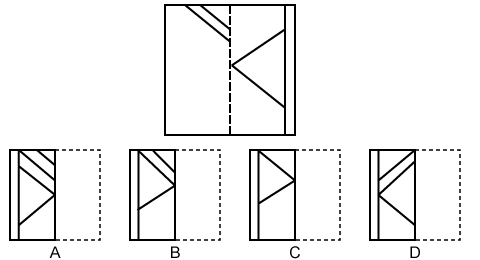
To determine which pattern the transparent sheet will resemble when folded along the dotted line, we need to visualize how the shapes on the sheet align after folding.
Correct Option: B) The pattern aligns correctly after folding.
The question asks to identify the first Indian female gymnast to compete in the Olympics. This requires knowledge of significant milestones in Indian sports history, specifically in gymnastics.
B) Dipa Karmakar is the first Indian female gymnast ever to compete in the Olympics. She achieved this historic feat at the 2016 Rio Olympics, where she finished fourth in the women's vault event, narrowly missing a bronze medal. Her participation marked a significant milestone for Indian gymnastics.
The problem asks us to identify the pattern in the given series of numbers and then find the next number. We will analyze the differences between consecutive terms to determine the underlying rule.
The differences between consecutive terms follow a repeating pattern of \(+2, +4, +2, +4, +2, \dots\).
Since the last difference was \(+2\) (between 21 and 23), the next difference in the sequence should be \(+4\).
Add \(4\) to the last term in the series:
\[ 23 + 4 = 27 \]D) 27 — Based on the identified pattern of alternating differences (\(+2, +4\)), the next number in the series is \(23 + 4 = 27\).
The question asks to identify the state animal of Andhra Pradesh. This is a factual question related to general knowledge about Indian states and their symbols.
D) Blackbuck
The Blackbuck (Antilope cervicapra) is indeed the state animal of Andhra Pradesh. It is an antelope native to India and Nepal, known for its distinctive spiraling horns in males and its speed.