
To find the ratio of the frequencies of the two groups, we will use the formula for the combined mean. The combined mean is calculated as the weighted average of the individual means, where the weights are the frequencies (number of elements) of each group.
Let the first set of numbers be \(S_1\) with mean \(\bar{X}_1 = 12\). Let its frequency (number of elements) be \(n_1\).
Let the second set of numbers be \(S_2\) with mean \(\bar{X}_2 = 15\). Let its frequency (number of elements) be \(n_2\).
The combined mean of both sets is given as \(\bar{X}_c = 12.5\).
The formula for the combined mean is:
\[ \bar{X}_c = \frac{n_1 \bar{X}_1 + n_2 \bar{X}_2}{n_1 + n_2} \]Substitute the given values into the formula:
\[ 12.5 = \frac{n_1(12) + n_2(15)}{n_1 + n_2} \]Multiply both sides by \((n_1 + n_2)\):
\[ 12.5(n_1 + n_2) = 12n_1 + 15n_2 \]Distribute 12.5 on the left side:
\[ 12.5n_1 + 12.5n_2 = 12n_1 + 15n_2 \]Rearrange the terms to group \(n_1\) and \(n_2\) separately:
\[ 12.5n_1 - 12n_1 = 15n_2 - 12.5n_2 \]Simplify both sides:
\[ 0.5n_1 = 2.5n_2 \]To find the ratio \(n_1 : n_2\), divide both sides by \(n_2\) and by 0.5:
\[ \frac{n_1}{n_2} = \frac{2.5}{0.5} \]Calculate the ratio:
\[ \frac{n_1}{n_2} = \frac{25}{5} = 5 \]\[ \frac{n_1}{n_2} = \frac{5}{1} \]So, the ratio of the frequency of both groups is \(5 : 1\).
Correct Option: B) The ratio of the frequencies is \(5 : 1\).
The question asks about the home state of the famous Indian boxing champion Mary Kom. This is a general knowledge question related to prominent personalities in sports and their geographical origins in India.
Correct Option: C) Mary Kom, whose full name is Mangte Chungneijang Mary Kom, is an Indian amateur boxer, politician, and sitting Member of Parliament, Rajya Sabha. She was born in Kangathei, Churachandpur district, Manipur. She is the only female to become World Amateur Boxing champion for a record six times, the only female boxer to have won a medal in each one of the first seven World Championships, and the only boxer (male or female) to win eight World Championship medals. She won a bronze medal in the 2012 London Olympics.
Select the alphanumeric-cluster from among the given options that can replace the question mark (?) in the following series.
4U, 6V, 10W, 16X,?
The problem presents an alphanumeric series where each term consists of a number and a letter. We need to identify the pattern for both the numerical and alphabetical parts separately to find the missing term.
Therefore, the missing alphanumeric-cluster is 24Y.
D) 24 Y — This option correctly follows both the numerical and alphabetical patterns identified.
What day of the week was August 17th, 1947?
The question asks us to determine the day of the week on August 17, 1947. We can solve this using the odd days method, which calculates the remainder when the total number of days is divided by 7. Since a week consists of 7 days, the remaining odd days help us identify the day of the week. We will calculate the odd days for the completed years and the days elapsed in 1947 to determine the correct answer.
Understand the concept of odd days:
Odd days are the extra days remaining after dividing a given number of days by 7.
\[ \text{Odd days}=\text{Total days}\bmod7 \]The correspondence between odd days and weekdays is:
Calculate the odd days in the first 1600 years:
According to the Gregorian calendar, every 400 years contain an exact number of weeks and contribute 0 odd days.
\[ 1600=4\times400 \] \[ \text{Odd days}=0 \]Calculate the odd days in the next 300 years (1601–1900):
In the Gregorian calendar, 300 years contribute 1 odd day.
\[ \text{Odd days}=1 \]Calculate the odd days from 1901 to 1946:
There are 46 completed years during this period, including 11 leap years.
Each ordinary year contributes 1 odd day, while each leap year contributes 2 odd days.
\[ \text{Total days}=46\times365+11 \]Since each ordinary year contributes 1 odd day, we can calculate:
\[ 46+11=57 \] \[ 57\div7=8\text{ remainder }1 \]Therefore, these 46 years contribute 1 odd day.
Calculate the days from January 1 to August 17, 1947:
Since 1947 was not a leap year, February had 28 days.
Total days:
\[ 31+28+31+30+31+30+31+17=229 \]Calculate the odd days:
\[ 229\div7=32\text{ remainder }5 \]Therefore, the period contributes 5 odd days.
Calculate the total odd days:
Add the odd days obtained from all the periods:
\[ 0+1+1+5=7 \]Divide by 7 to obtain the remainder:
\[ 7\div7=1\text{ remainder }0 \]Therefore, the total number of odd days is 0.
Determine the day of the week:
According to the odd days method, 0 odd days correspond to Sunday.
Therefore, August 17, 1947, was a Sunday.
Correct Option: D) Sunday — Using the odd days method, the total number of odd days up to August 17, 1947, is \(0+1+1+5=7\). Dividing 7 by 7 gives a remainder of 0, which corresponds to Sunday. Hence, Option D is the correct answer.
A) Saturday: This is incorrect because Saturday corresponds to 6 odd days, whereas the calculation gives 0 odd days. August 16, 1947, was Saturday, not August 17.
B) Wednesday: This is incorrect because Wednesday corresponds to 3 odd days. The calculated remainder is 0, which corresponds to Sunday. August 13, 1947, was Wednesday.
C) Monday: This is incorrect because Monday corresponds to 1 odd day, whereas the calculated remainder is 0. August 18, 1947, was Monday, one day after the given date.
Who among the following was awarded the Best Child Actor Award for the film 'Kunju Daivam' at the 64th National Film Awards held in April 2017?
Diya Chalvad
Aadish Praveen
Darsheel Kumar
Sara Arjun
This question tests knowledge about the winners of specific awards at the National Film Awards, a common topic in general awareness sections of competitive exams. To answer this, one needs to recall the recipients of the Best Child Actor award for the specified year and film.
Correct Option: B) Aadish Praveen was awarded the Best Child Actor for the film 'Kunju Daivam' at the 64th National Film Awards.
Five years ago, the ratio of Jaimini's and Jatin's salaries was 1 : 3. Every year Jaimini's salary increased by Rs. 300 and Jatin's salary increased by Rs. 100. If after five years from today their salaries are the same, then what is the present salary of Jatin?
This problem involves setting up equations based on the given ratios and salary increases over time. We need to find the present salaries first, then project them five years into the future to find when they become equal.
Let Jaimini's salary five years ago be \(J_0\) and Jatin's salary five years ago be \(T_0\).
Given that the ratio of their salaries five years ago was 1 : 3, we can write:
\[ \frac{J_0}{T_0} = \frac{1}{3} \]So, \(T_0 = 3J_0\).
Let the present year be year 0. Five years ago was year -5. The salaries increased annually for 5 years to reach the present day.
Jaimini's salary increased by Rs. 300 per year. So, Jaimini's present salary \(J_P\) is:
\[ J_P = J_0 + 5 \times 300 = J_0 + 1500 \]Jatin's salary increased by Rs. 100 per year. So, Jatin's present salary \(T_P\) is:
\[ T_P = T_0 + 5 \times 100 = T_0 + 500 \]Now, substitute \(T_0 = 3J_0\) into the equation for \(T_P\):
\[ T_P = 3J_0 + 500 \]The problem states that after five years from today (i.e., 5 years from the present), their salaries will be the same.
Let's calculate their salaries five years from today (at year +5).
Jaimini's salary after 5 years from today \(J_{F}\) will be:
\[ J_F = J_P + 5 \times 300 = (J_0 + 1500) + 1500 = J_0 + 3000 \]Jatin's salary after 5 years from today \(T_{F}\) will be:
\[ T_F = T_P + 5 \times 100 = (T_0 + 500) + 500 = T_0 + 1000 \]Given that \(J_F = T_F\):
\[ J_0 + 3000 = T_0 + 1000 \]Substitute \(T_0 = 3J_0\) into this equation:
\[ J_0 + 3000 = 3J_0 + 1000 \]Rearrange the terms to solve for \(J_0\):
\[ 3000 - 1000 = 3J_0 - J_0 \]\[ 2000 = 2J_0 \]\[ J_0 = 1000 \]Now we can find \(T_0\):
\[ T_0 = 3J_0 = 3 \times 1000 = 3000 \]The question asks for the present salary of Jatin (\(T_P\)).
\[ T_P = T_0 + 500 \]\[ T_P = 3000 + 500 \]\[ T_P = 3500 \]A) Rs. 3,500 is the present salary of Jatin.

Which of the following is the mirror image of the above figure: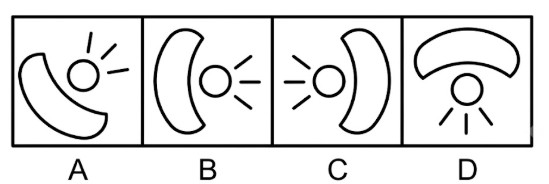
To find the mirror image of a given figure, we need to imagine how the figure would look if reflected across a vertical axis. This involves reversing the positions of elements horizontally.
Correct Option: B) The semicircle and circle are correctly mirrored.
Through which amendment act was the word 'Secular' added to the Constitution of India?
The question asks about the specific constitutional amendment that introduced the word 'Secular' into the Preamble of the Indian Constitution. This requires knowledge of significant amendments in Indian constitutional history.
Correct Option: D) 42 nd — The 42nd Amendment Act of 1976 is famously known as the 'Mini-Constitution' due to the large number of changes it brought about in the Indian Constitution. Among these changes was the addition of the words 'Socialist', 'Secular', and 'Integrity' to the Preamble, thereby explicitly defining India as a secular nation.
The amount of common salt in 320 g of water in a solution is 46 g. Calculate the concentration of the solution in terms of mass by mass percentage.
To calculate the concentration of a solution in terms of mass by mass percentage, we need to find the mass of the solute and the total mass of the solution. The formula for mass by mass percentage is the mass of the solute divided by the total mass of the solution, multiplied by 100.
The total mass of the solution is the sum of the mass of the solute and the mass of the solvent.
\[ \text{Mass of solution} = \text{Mass of solute} + \text{Mass of solvent} \]\[ \text{Mass of solution} = 46 \text{ g} + 320 \text{ g} \]\[ \text{Mass of solution} = 366 \text{ g} \]The concentration in terms of mass by mass percentage is given by:
\[ \text{Mass by mass percentage} = \frac{\text{Mass of solute}}{\text{Mass of solution}} \times 100 \]\[ \text{Mass by mass percentage} = \frac{46 \text{ g}}{366 \text{ g}} \times 100 \]\[ \text{Mass by mass percentage} = 0.125688... \times 100 \]\[ \text{Mass by mass percentage} = 12.5688... \% \]Rounding to two decimal places, the concentration is \(12.57\%\).
D) 12.57% — This is the correct calculation for the mass by mass percentage of the solution.
This problem can be solved using Venn diagrams or by applying the rules of syllogism. We need to determine which of the given conclusions logically follows from the provided statements.
C) Only conclusion 1 follows.