
There is a private museum in a palace. The following table shows the number of visitors there in a week. If they charge Rs. 100 per admission, then what will be their total income for the given week?
| Day | Museum Visitors |
| Monday | 30 |
| Tuesday | 30 |
| Wednesday | 40 |
| Thursday | 30 |
| Friday | 40 |
| Saturday | 55 |
| Sunday | 45 |
To find the total income, we first need to calculate the total number of visitors for the entire week by summing the visitors for each day. Then, we multiply the total number of visitors by the admission charge per person.
Add the number of visitors for each day of the week:
Total visitors \( = 30 + 30 + 40 + 30 + 40 + 55 + 45 \)
Total visitors \( = 270 \)
The admission charge per person is Rs. 100.
Total income \( = \text{Total visitors} \times \text{Admission charge per person} \)
Total income \( = 270 \times 100 \)
Total income \( = 27000 \)
So, the total income for the given week will be Rs. 27,000.
Correct Option: D) Rs. 27,000
The problem involves calculating the number of members in a second group given their average score, the average score of a first group, and the combined average score of both groups. We will use the formula for the average, which states that the average is the sum of scores divided by the number of members. We will set up an equation using the combined average and solve for the unknown number of members, \(n\).
Thus, the value of \(n\) is 18.
Correct Option: A) 18
What is the probability of drawing 1 Heart and 1 spade card from a deck of cards?
\( \frac{13}{102} \)
\( \frac{3}{13} \)
\( \frac{3}{26} \)
\( \frac{12}{13} \)
To find the probability of drawing one Heart and one Spade card, we need to calculate the number of ways to draw one Heart, the number of ways to draw one Spade, and the total number of ways to draw two cards from a standard deck. Then, we use the formula for probability: \[\text{Probability} = \frac{\text{Favorable Outcomes}}{\text{Total Possible Outcomes}}\].
Correct Option: A) \( \frac{13}{102} \) is the calculated probability of drawing one Heart and one Spade card from a deck.
The question asks to identify the Mughal ruler who initiated Din-i-Ilahi. This requires knowledge of the major policies and religious initiatives of prominent Mughal emperors.
Din-i-Ilahi (meaning "Religion of God") was a syncretic religion propounded by the Mughal emperor Akbar in 1582 AD. It was intended to merge the best elements of the religions of his empire, and its primary aim was to reconcile the differences that separated different religious groups.
B) Akbar — Emperor Akbar introduced Din-i-Ilahi in 1582. It was an attempt to create a new religious path based on the common truths of various religions, aiming for religious harmony and unity within his diverse empire.
The question asks to identify the spokesperson of the Indian Navy as of 2018. This requires knowledge of current affairs and specific appointments during that period.
Correct Option: B) Capt. D.K. Sharma was the official spokesperson for the Indian Navy in 2018. He held this position and was responsible for communicating information regarding the Navy to the public and media.
This problem involves the relationship between distance, speed, and time. We are given a scenario where a train is running late and then increases its speed to cover a certain distance on time. We need to find the original (actual) speed of the train. We can set up an equation based on the time taken in two different scenarios: with the actual speed and with the increased speed.
Let the actual speed of the train be \(x\) km/hr.
The distance to the next station is 36 km.
The time taken to cover 36 km at the actual speed \(x\) would be:
\[ T_{\text{actual}} = \frac{\text{Distance}}{\text{Speed}} = \frac{36}{x} \text{ hours} \]The train increases its speed by 4 km/hr. So, the new speed is \((x+4)\) km/hr.
The time taken to cover 36 km at the increased speed \((x+4)\) would be:
\[ T_{\text{increased}} = \frac{\text{Distance}}{\text{Speed}} = \frac{36}{x+4} \text{ hours} \]The train was running late by 6 minutes, but by increasing its speed, it reaches the next station on time. This means the time taken with the increased speed is 6 minutes less than the time it would have taken if it continued at the actual speed without being late.
Convert 6 minutes to hours:
\[ 6 \text{ minutes} = \frac{6}{60} \text{ hours} = \frac{1}{10} \text{ hours} \]Now, we can set up the equation: The difference between the time taken at actual speed and the time taken at increased speed is 6 minutes (or \(1/10\) hour).
\[ T_{\text{actual}} - T_{\text{increased}} = \frac{1}{10} \]\[ \frac{36}{x} - \frac{36}{x+4} = \frac{1}{10} \]Solve the equation for \(x\):
Find a common denominator on the left side:
\[ \frac{36(x+4) - 36x}{x(x+4)} = \frac{1}{10} \]\[ \frac{36x + 144 - 36x}{x^2 + 4x} = \frac{1}{10} \]\[ \frac{144}{x^2 + 4x} = \frac{1}{10} \]Cross-multiply:
\[ 144 \times 10 = 1 \times (x^2 + 4x) \]\[ 1440 = x^2 + 4x \]Rearrange into a quadratic equation:
\[ x^2 + 4x - 1440 = 0 \]Solve the quadratic equation. We can use the quadratic formula or factorization. Let's try to factorize. We need two numbers that multiply to -1440 and add to 4. These numbers are 40 and -36.
\[ x^2 + 40x - 36x - 1440 = 0 \]\[ x(x+40) - 36(x+40) = 0 \]\[ (x-36)(x+40) = 0 \]This gives two possible values for \(x\): \(x = 36\) or \(x = -40\).
Since speed cannot be negative, we discard \(x = -40\).
Therefore, the actual speed of the train is 36 km/hr.
Correct Option: C) 36 km/hr
You are given a question and some statements. Decide which of the statements are sufficient to answer the question.
Question:
Four children A, B, C, and D live in the same colony. Who is the heaviest among them?
Statements:
1. A is heavier than C and D.
2. D is the lightest among them.
3. B is heavier than A.
Statement 2 alone is sufficient.
Neither statement 1 nor statement 2 is sufficient.
Statement 1 alone is sufficient.
Statements 1, 2 and 3 all together are sufficient
The problem asks us to determine who is the heaviest among four children (A, B, C, D) using a set of given statements. We need to evaluate the sufficiency of each statement, individually and in combination, to answer the question.
Analyze the Question: We need to find the single heaviest person among A, B, C, and D.
Analyze Statement 1: "A is heavier than C and D."
This can be written as: \(A > C\) and \(A > D\).
From this statement, we know A is heavier than C and D. However, we don't know the relationship between A and B, or between C and D. A could be the heaviest, or B could be heavier than A. So, statement 1 alone is not sufficient.
Analyze Statement 2: "D is the lightest among them."
This means \(D < A\), \(D < B\), and \(D < C\).
This statement tells us D is the lightest, but it doesn't help us identify the heaviest among A, B, and C. So, statement 2 alone is not sufficient.
Analyze Statement 3: "B is heavier than A."
This can be written as: \(B > A\).
This statement only establishes a relationship between B and A. We don't know how B compares to C and D, or how A compares to C and D. So, statement 3 alone is not sufficient.
Combine Statements 1 and 2:
From Statement 1: \(A > C\) and \(A > D\).
From Statement 2: \(D\) is the lightest, meaning \(D < A\), \(D < B\), \(D < C\).
Combining these, we still have \(A > C\) and \(A > D\). We know D is the lightest, but we don't know who is heaviest between A, B, and C. For example, B could be heavier than A, or C could be heavier than A (which contradicts statement 1, so C cannot be heavier than A). The relationship between A and B is still unknown. So, statements 1 and 2 together are not sufficient.
Combine Statements 1 and 3:
From Statement 1: \(A > C\) and \(A > D\).
From Statement 3: \(B > A\).
Combining these, we get: \(B > A > C\) and \(B > A > D\).
This implies that B is heavier than A, C, and D. Therefore, B is the heaviest. So, statements 1 and 3 together are sufficient.
Combine Statements 2 and 3:
From Statement 2: \(D\) is the lightest (\(D < A\), \(D < B\), \(D < C\)).
From Statement 3: \(B > A\).
We know \(B > A\) and \(D\) is the lightest. This means \(B > A > D\). However, we don't know the position of C relative to A or B. C could be heavier than A but lighter than B, or lighter than A. So, statements 2 and 3 together are not sufficient.
Combine Statements 1, 2, and 3:
From Statement 1: \(A > C\) and \(A > D\).
From Statement 2: \(D\) is the lightest.
From Statement 3: \(B > A\).
Let's put these together:
From (3), we have \(B > A\).
From (1), we have \(A > C\) and \(A > D\).
Combining these, we get \(B > A > C\) and \(B > A > D\).
This clearly shows that B is heavier than A, C, and D. Therefore, B is the heaviest. All three statements together are sufficient to identify the heaviest person.
D) Statements 1, 2 and 3 all together are sufficient
The question asks to identify which option is NOT an example of gravity's influence. We need to evaluate each option based on our understanding of gravity's role in celestial mechanics and astrophysics.
B) It is helpful in the rotation of the black hole. — While gravity is essential for the formation and existence of black holes, it doesn't directly cause their rotation. Black holes rotate due to the conservation of angular momentum of the progenitor star or accreting material, not as a direct gravitational effect on the rotation itself. Gravity defines the spacetime around the rotating black hole, but it's not the 'cause' of the rotation in the context of the other options.
The question asks to identify the group to which algae belong. This requires knowledge of the classification of the plant kingdom, specifically the major divisions based on structural complexity.
Correct Option: B) Thallophyta — Algae are characterized by a simple, undifferentiated plant body called a thallus, lacking true roots, stems, and leaves. This is the defining feature of the Thallophyta division, which includes algae, fungi, and lichens.
Identify the odd one out: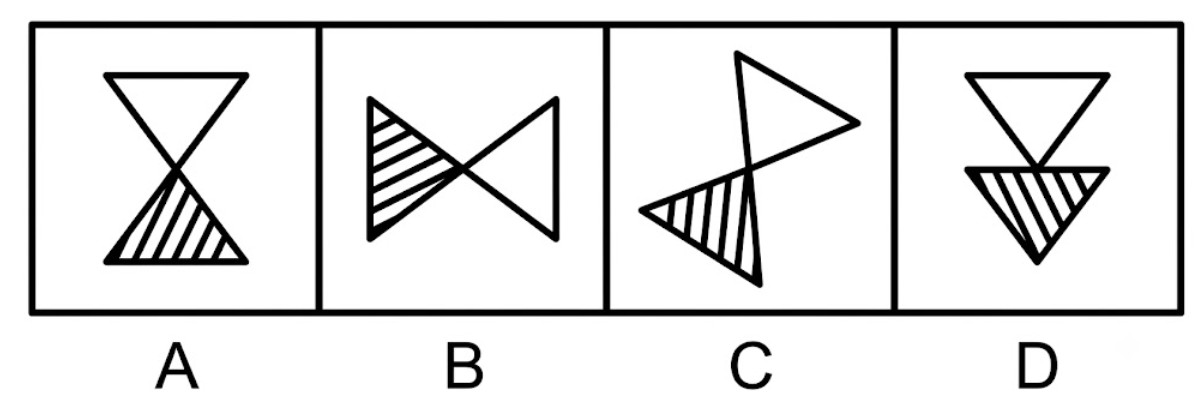
To identify the odd one out, we need to analyze the visual patterns and orientations of the shapes in each option. The goal is to find the option that does not follow the same pattern or symmetry as the others.
Correct Option: C) Option C is the odd one out because it breaks the symmetry and pattern seen in the other options.