
Select the next option picture in the following series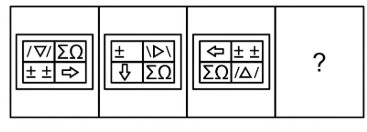
Option picture: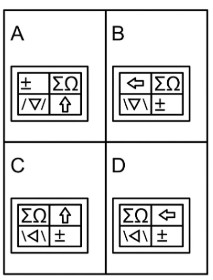
To solve this problem, we need to identify the pattern in the series of images and determine which option logically follows as the next in the sequence.
Correct Option: B) The symbols are arranged to continue the observed pattern from the series.
The following pie chart shows the information on sporting equipment sold by Company 'XYZ'. The company's total revenue for the year 2016 was $36,82,000.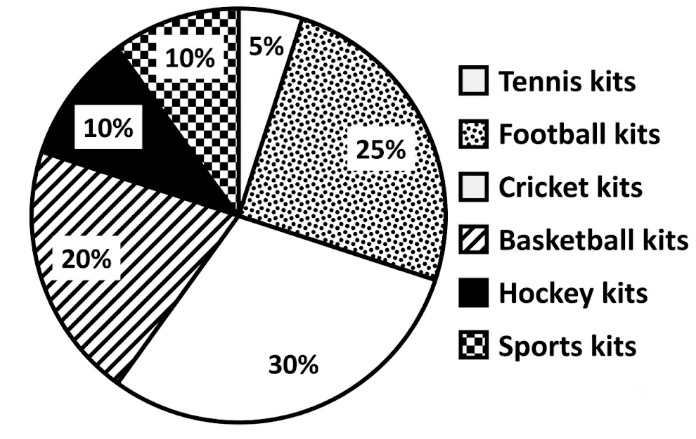
The revenue from which sports equipment was the least received by the company?
basketball games equipment
cricket games equipment
tennis games equipment
hockey games equipment
To determine which sports equipment generated the least revenue for Company 'XYZ', we need to analyze the pie chart provided. The pie chart displays the percentage of total revenue contributed by each type of sports equipment.
Correct Option: C) Tennis games equipment
This problem involves calculating the required speed for the remaining part of a journey to cover a certain distance in a given time. We will use the fundamental relationship between distance, speed, and time: \(\text{Distance} = \text{Speed} \times \text{Time}\). We will set up variables for the total distance, total time, and required average speed, and then calculate the distance covered in the first part of the journey and the remaining distance and time.
Let the total distance to be covered be \(D\) and the total time allowed be \(T\).
Let the required average speed be \(S\). So, \(D = S \times T\).
For the first part of the journey:
For the remaining part of the journey:
Let the speed required for the remaining part be \(S_2\). We know that \(D_2 = S_2 \times T_2\).
Substitute the values for \(D_2\) and \(T_2\):
\[ 0.84 ST = S_2 \times (0.80 T) \]Now, solve for \(S_2\):
\[ S_2 = \frac{0.84 ST}{0.80 T} \]\[ S_2 = \frac{0.84 S}{0.80} \]\[ S_2 = 1.05 S \]To express this as a percentage of the required average speed \(S\):
\[ S_2 = 1.05 \times 100\% \text{ of } S = 105\% \text{ of } S \]A) 105 — The calculation shows that Ritu needs to travel at 105% of the required average speed for the remaining 80% of the time to cover the total distance in the total time.
We are given two conditions about two numbers: their division and their product. We need to find the product of their sum and difference. We will set up a system of two equations with two variables, solve for the numbers, and then calculate the required expression.
Let the two numbers be \(x\) and \(y\).
From the problem statement, the division of the two numbers gives 6. Assuming \(x\) is the larger number, we can write this as:
\[ \frac{x}{y} = 6 \]This implies \(x = 6y\). Let's call this Equation (1).
The product of the two numbers gives 96. So,
\[ xy = 96 \]Let's call this Equation (2).
Substitute Equation (1) into Equation (2):
\[ (6y)y = 96 \]\[ 6y^2 = 96 \]Solve for \(y\):
\[ y^2 = \frac{96}{6} \]\[ y^2 = 16 \]\[ y = \sqrt{16} \]Since we are dealing with numbers in this context, we usually consider positive values unless specified. So, \(y = 4\).
Substitute the value of \(y\) back into Equation (1) to find \(x\):
\[ x = 6y \]\[ x = 6(4) \]\[ x = 24 \]So, the two numbers are 24 and 4.
Now, we need to find the product of the sum and difference of these two numbers. First, calculate the sum:
\[ \text{Sum} = x + y = 24 + 4 = 28 \]Next, calculate the difference:
\[ \text{Difference} = x - y = 24 - 4 = 20 \]Finally, calculate the product of the sum and difference:
\[ \text{Product of sum and difference} = (\text{Sum}) \times (\text{Difference}) \]\[ = 28 \times 20 \]\[ = 560 \]B) 560 is the correct product of the sum and difference of the two numbers.
The weight of a body is determined by the gravitational force acting on it. This force is influenced by the mass of the body, the mass of the Earth, the distance from the Earth's center, and the Earth's rotation. We need to identify the location where these factors combine to produce the minimum weight.
A) At the equator — At the equator, the Earth's radius is largest, meaning the distance from the center of the Earth is maximum, which reduces gravitational acceleration. Additionally, the centrifugal force due to the Earth's rotation is maximum at the equator and acts opposite to gravity, further decreasing the effective gravitational acceleration and thus the weight of a body.
To find the distance traveled by the car, we need to use the equations of motion. First, convert the final speed from km/h to m/s. Since the car starts from rest (initial position implies initial speed is 0) and accelerates uniformly, we can use the formula for distance traveled under constant acceleration.
Identify given values:
Convert final speed from km/h to m/s:
To convert km/h to m/s, multiply by \(\frac{5}{18}\).
\[ v = 144 \text{ km/h} \times \frac{5}{18} \frac{\text{m/s}}{\text{km/h}} \]\[ v = 8 \times 5 \text{ m/s} \]\[ v = 40 \text{ m/s} \]Calculate the acceleration (\(a\)):
Using the first equation of motion: \(v = u + at\)
\[ 40 \text{ m/s} = 0 \text{ m/s} + a \times 20 \text{ s} \]\[ 40 = 20a \]\[ a = \frac{40}{20} \text{ m/s}^2 \]\[ a = 2 \text{ m/s}^2 \]Calculate the distance traveled (\(s\)):
Using the second equation of motion: \(s = ut + \frac{1}{2}at^2\)
\[ s = (0 \text{ m/s}) \times (20 \text{ s}) + \frac{1}{2} \times (2 \text{ m/s}^2) \times (20 \text{ s})^2 \]\[ s = 0 + \frac{1}{2} \times 2 \times 400 \text{ m} \]\[ s = 400 \text{ m} \]Alternatively, since the acceleration is uniform, the average speed can be used:
\[ \text{Average speed} = \frac{\text{Initial speed} + \text{Final speed}}{2} \]\[ \text{Average speed} = \frac{0 \text{ m/s} + 40 \text{ m/s}}{2} \]\[ \text{Average speed} = 20 \text{ m/s} \]\[ \text{Distance} = \text{Average speed} \times \text{Time} \]\[ \text{Distance} = 20 \text{ m/s} \times 20 \text{ s} \]\[ \text{Distance} = 400 \text{ m} \]A) 400 meters is the correct distance traveled by the car.
Solve the following equation:
15.5 × 15.5 − 2.5 × 2.5 =?
This problem can be solved by recognizing the algebraic identity \(a^2 - b^2 = (a - b)(a + b)\). This method simplifies the calculation significantly compared to direct multiplication and subtraction.
Here, let \(a = 15.5\) and \(b = 2.5\).
Thus, \(15.5 \times 15.5 - 2.5 \times 2.5 = 234\).
Correct Option: B) 234
This problem involves calculating a value from a previous period given a current value and a constant percentage decrease per year. This is a compound depreciation problem. We can use the formula for compound depreciation to find the original number of smokers.
A) 12000 is the correct answer. The calculation shows that 3 years ago, there were 12000 smokers.
The question asks about the relationship between the number of electrons in the valence shell of an atom and its position in the periodic table. This concept is fundamental to understanding the periodic trends and chemical properties of elements.
C) Group number. For main group elements, the group number (or the last digit of the group number for groups 13-18) indicates the number of valence electrons. For example, elements in Group 1 have 1 valence electron, Group 2 has 2, Group 13 has 3, Group 14 has 4, and so on.
The weight of an object is the force of gravity acting on it. It depends on the mass of the object and the acceleration due to gravity at that location. The mass of an object remains constant, but the acceleration due to gravity varies from one celestial body to another. The acceleration due to gravity on the Moon is approximately one-sixth of that on Earth.
Correct Option: D) 1000 N — This is the correct weight of the object on the Moon, as the Moon's gravity is one-sixth that of Earth's.