
Who is the 35th Governor of Bihar?
D. Y. Patil
Ram Nath Kovind
Devanand Konwar
Satya Pal Malik
The question asks to identify the 35th Governor of Bihar from the given options. This requires knowledge of the history of Governors of Bihar.
Satya Pal Malik served as the 35th Governor of Bihar from October 4, 2017, to August 21, 2018.
D) Satya Pal Malik was indeed the 35th Governor of Bihar, serving from October 4, 2017, to August 21, 2018.
The question asks to identify the first Indian state that launched the Single Women Pension Scheme. This requires knowledge of social welfare schemes initiated by various state governments in India.
Correct Option: D) Telangana
Telangana was the first Indian state to launch a dedicated pension scheme for single women. This scheme is part of the broader 'Aasara Pension Scheme' which provides social security pensions to various vulnerable sections of society, including single women, widows, elderly, physically disabled, and beedi workers.
The question asks to identify the sport associated with the 'Bandodkar Gold Trophy'. This requires knowledge of famous sports trophies and the sports they are linked to.
Correct Option: A) Football
The question asks to identify the Minister of Higher and Technical Education for the state of Maharashtra as of 2018. This requires knowledge of the political appointments and cabinet ministers during that specific period.
Correct Option: A) Vinod Tawde was the Minister of Higher and Technical Education for the state of Maharashtra as of 2018.
One of the answer figures is embedded in the given question figure. Identify this figure
Question figure: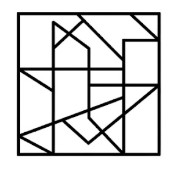
Answer figure: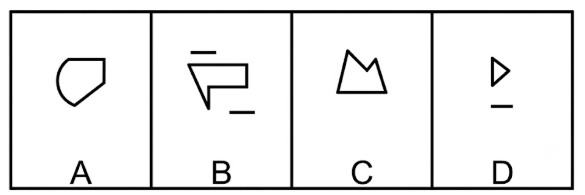
The task is to identify which of the given answer figures is embedded within the question figure. This requires careful observation of the shapes and lines present in the question figure and matching them with the options provided.
Correct Option: A) The shape in option A is clearly visible in the question figure, specifically in the bottom left section.
Alkenes, unsaturated hydrocarbons containing a double bond between two carbon atoms, have a general formula, which is:
The question asks for the general formula of alkenes. Alkenes are unsaturated hydrocarbons characterized by the presence of at least one carbon-carbon double bond. Their general formula can be derived by considering the number of hydrogen atoms relative to the number of carbon atoms, keeping in mind the valency of carbon (4) and hydrogen (1).
D) C n H 2n — This is the correct general formula for alkenes, where 'n' represents the number of carbon atoms. Each double bond reduces the number of hydrogen atoms by two compared to the corresponding alkane.
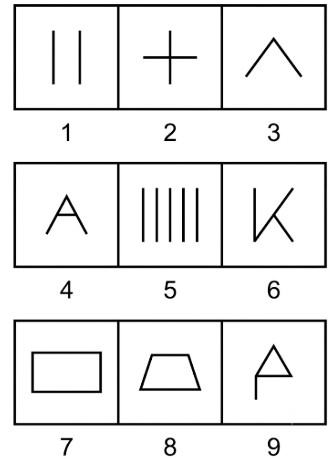
The above group has a similar figure:
1, 2, 5 ; 8, 6, 4 ; 2, 7, 9
1, 3, 2 ; 5, 6, 4 ; 8, 7, 9
1, 2, 8 ; 5, 6, 3 ; 4, 7, 9
1, 2, 3 ; 5, 6, 8 ; 4, 7, 9
The question involves identifying a similar figure pattern among the given options. Each figure in the diagram has a unique shape or arrangement of lines. The goal is to find the option where the grouping of figures follows a logical sequence or pattern.
Correct Option: B) 1, 3, 2; 5, 6, 4; 8, 7, 9
Which option has the closest resemblance to the following figure?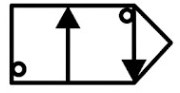
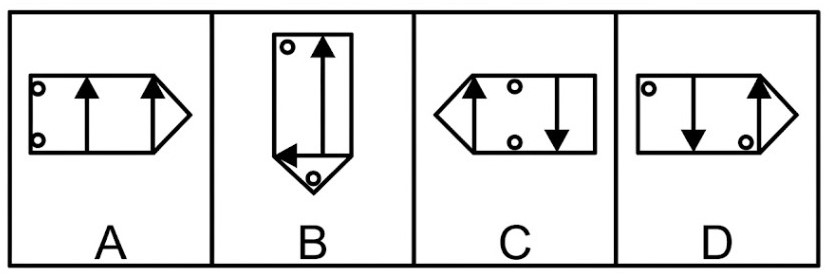
To determine which option closely resembles the given figure, we need to analyze the orientation and placement of elements such as arrows and circles in the diagrams.
Correct Option: B) This option matches the orientation and placement of arrows and circles in the original figure.
The question asks to identify the Governor-General who introduced the 'Doctrine of Lapse' and took office in 1848. This requires knowledge of key figures in British Indian history and their administrative policies.
Correct Option: D) Lord Dalhousie, who served as Governor-General from 1848 to 1856, is credited with formulating and extensively implementing the 'Doctrine of Lapse'. This policy allowed the British East India Company to annex any Indian princely state if its ruler died without a direct natural heir. States like Satara, Sambalpur, Udaipur, Nagpur, and Jhansi were annexed under this doctrine, which became a major cause of discontent leading to the Revolt of 1857.
To find the next number in the sequence, we need to identify the pattern or relationship between consecutive numbers. This can often be done by looking at the differences between adjacent terms.
The differences are 21, 19, 17, 15. This is an arithmetic progression where each subsequent difference decreases by 2.
Following the pattern, the next difference should be \(15 - 2 = 13\).
Subtract this next difference from the last given number in the sequence:
\[ 38 - 13 = 25 \]D) 25 — The pattern of differences between consecutive terms is 21, 19, 17, 15. This is a decreasing arithmetic progression with a common difference of -2. The next difference in this pattern would be \(15 - 2 = 13\). Subtracting this from the last number in the sequence (\(38 - 13\)) gives 25.