
Last year Manish Corner had invested Rs. 1,00,000 on shop 1 and Rs. 1,50,000 on shop 2 for the furniture replacement. They recovered expenses over the next three quarters: Quarter 1 - 20%, Quarter 2 - 55%. What was the amount (in Rs.) received in Quarter 3?
The problem asks us to calculate the amount recovered in Quarter 3. To do this, we first need to find the total investment made. Then, we calculate the percentage of the total investment recovered in Quarter 1 and Quarter 2. Finally, we subtract the amounts recovered in Quarter 1 and Quarter 2 from the total investment to find the amount recovered in Quarter 3.
Manish Corner invested Rs. 1,00,000 on shop 1 and Rs. 1,50,000 on shop 2.
\[ \text{Total Investment} = \text{Investment on Shop 1} + \text{Investment on Shop 2} \\ \text{Total Investment} = \text{Rs. } 1,00,000 + \text{Rs. } 1,50,000 \\ \text{Total Investment} = \text{Rs. } 2,50,000 \]In Quarter 1, 20% of the total investment was recovered.
\[ \text{Amount recovered in Q1} = 20\% \times \text{Total Investment} \\ \text{Amount recovered in Q1} = \frac{20}{100} \times 2,50,000 \\ \text{Amount recovered in Q1} = 20 \times 2,500 \\ \text{Amount recovered in Q1} = \text{Rs. } 50,000 \]In Quarter 2, 55% of the total investment was recovered.
\[ \text{Amount recovered in Q2} = 55\% \times \text{Total Investment} \\ \text{Amount recovered in Q2} = \frac{55}{100} \times 2,50,000 \\ \text{Amount recovered in Q2} = 55 \times 2,500 \\ \text{Amount recovered in Q2} = \text{Rs. } 1,37,500 \]The amount recovered in Quarter 3 is the remaining amount from the total investment after Quarter 1 and Quarter 2 recoveries.
\[ \text{Amount recovered in Q3} = \text{Total Investment} - \text{Total recovered in Q1 and Q2} \\ \text{Amount recovered in Q3} = \text{Rs. } 2,50,000 - \text{Rs. } 1,87,500 \\ \text{Amount recovered in Q3} = \text{Rs. } 62,500 \]B) 62,500 is the correct amount received in Quarter 3.
The question asks to identify the longest rod among T1, T2, and T3. We need to determine if the given statements provide enough information to definitively answer this question. This is a data sufficiency problem.
This statement tells us that both T1 and T2 are longer than T3. So, T3 cannot be the longest rod. However, it does not provide any information about the relative lengths of T1 and T2. Either T1 could be longer than T2, or T2 could be longer than T1, or they could be equal. Therefore, Statement 1 alone is not sufficient to determine the longest rod.
This statement describes the material of rod T2. It gives no information about the length of T2, or the lengths of T1 and T3, or their materials. Therefore, Statement 2 alone is not sufficient to determine the longest rod.
Combining both statements:
Even with both statements, we still know that T3 is not the longest. But we have no information to compare the lengths of T1 and T2. Knowing that T2 is made of iron does not help in comparing its length to T1. Hence, we cannot definitively say whether T1 or T2 is the longest rod.
Correct Option: B) Statements 1 and 2 both are not sufficient
This problem involves understanding age relationships. We need to set up equations based on the given information about the father's and son's ages and then solve for the son's current age. Once the son's current age is found, we can calculate his age 5 years ago.
Let the present age of the son be \(S\) years.
The present age of the father is given as 40 years.
The father says, "I was equal to your present age at the time of your birth." This means that when the son was born (age 0), the father's age was equal to the son's current age \(S\).
The difference between the father's current age and his age at the son's birth is equal to the son's current age. This is because the father has aged by the same amount as the son's current age since the son's birth.
So, we can write the equation:
\[ \text{Father's present age} - \text{Father's age at son's birth} = \text{Son's present age} \]Substituting the given values and variables:
\[ 40 - S = S \]Now, solve for \(S\):
\[ 40 = S + S \] \[ 40 = 2S \] \[ S = \frac{40}{2} \] \[ S = 20 \]So, the present age of the son is 20 years.
The question asks for the age of his son 5 years ago.
\[ \text{Son's age 5 years ago} = \text{Son's present age} - 5 \] \[ \text{Son's age 5 years ago} = 20 - 5 \] \[ \text{Son's age 5 years ago} = 15 \text{ years} \]A) 15 years is the correct answer, as calculated.
B) 13 years — This would be incorrect. If the son's age 5 years ago was 13, his present age would be \(13+5=18\). Then, according to the condition, the father's age at the son's birth would be 18, and the father's present age would be \(18+18=36\), which contradicts the given father's age of 40.
C) 17 years — This would be incorrect. If the son's age 5 years ago was 17, his present age would be \(17+5=22\). Then, according to the condition, the father's age at the son's birth would be 22, and the father's present age would be \(22+22=44\), which contradicts the given father's age of 40.
D) 23 years — This would be incorrect. If the son's age 5 years ago was 23, his present age would be \(23+5=28\). Then, according to the condition, the father's age at the son's birth would be 28, and the father's present age would be \(28+28=56\), which contradicts the given father's age of 40.
This question tests general knowledge regarding appointments in major public sector undertakings. Candidates need to recall the Chairman and Managing Director of Air India as of August 2018.
Correct Option: B) Pradeep Singh Kharola
To find a percentage of a number, we convert the percentage into a decimal or a fraction and then multiply it by the given number.
The percentage given is 36%. To convert a percentage to a fraction, divide it by 100.
\[ 36\% = \frac{36}{100} \]Now, multiply this fraction by 325.
\[ \text{Value} = \frac{36}{100} \times 325 \]We can simplify the fraction before multiplying or multiply directly.
Method 1: Direct multiplication
\[ \text{Value} = \frac{36 \times 325}{100} \]\[ \text{Value} = \frac{11700}{100} \]\[ \text{Value} = 117 \]Method 2: Simplify first
Divide 325 and 100 by their common factor, 25.
\[ 325 \div 25 = 13 \]\[ 100 \div 25 = 4 \]\[ \text{Value} = \frac{36}{4} \times 13 \]\[ \text{Value} = 9 \times 13 \]\[ \text{Value} = 117 \]Both methods yield the same result.
D) 117 — As calculated, 36% of 325 is 117.
This problem involves applying Newton's second law and the principle of conservation of momentum to a rocket. The thrust force on a rocket is generated by the expulsion of exhaust gases. We need to relate this thrust force to the acceleration of the rocket and the velocity of the exhaust gases.
Thrust Force Equation: The thrust force (\(F\)) on a rocket is given by the product of the mass flow rate of the exhaust gases (\(\frac{dm}{dt}\)) and the velocity of the exhaust gases relative to the rocket (\(v_e\)).
\[ F = v_e \frac{dm}{dt} \]Newton's Second Law: According to Newton's second law, the force acting on an object is equal to its mass (\(M\)) times its acceleration (\(a\)).
\[ F = Ma \]Equating Forces: By equating the thrust force to the force from Newton's second law, we get:
\[ Ma = v_e \frac{dm}{dt} \]Solving for Acceleration: We can express the acceleration (\(a\)) as:
\[ a = \frac{v_e}{M} \frac{dm}{dt} \]Analyzing Proportionality: The question states that the acceleration of the rocket is proportional to the \(n\)th power of the velocity of the exhaust gases (\(v_e\)). From the equation above, we can see that:
\[ a \propto v_e \]This means that the acceleration is directly proportional to the first power of the exhaust gas velocity, assuming \[\frac{1}{M} \frac{dm}{dt}\] is considered a constant of proportionality for this relationship.
Determining n: Comparing \(a \propto v_e\) with \(a \propto v_e^n\), we find that \(n = 1\).
A) 1 — The acceleration of a rocket is directly proportional to the velocity of the exhaust gases, as derived from the thrust equation \(F = v_e \frac{dm}{dt}\) and Newton's second law \(F = Ma\). Therefore, \(a \propto v_e^1\), which means \(n=1\).
The question asks to identify a religious city located in the Indian state of Maharashtra from the given options. This requires knowledge of the geographical location of prominent religious sites in India.
Correct Option: A) Shirdi is a prominent religious city located in the Ahmednagar district of Maharashtra, famous for the Shri Sai Baba Sansthan Temple, which attracts millions of devotees annually.
Count the number of triangles in the given figure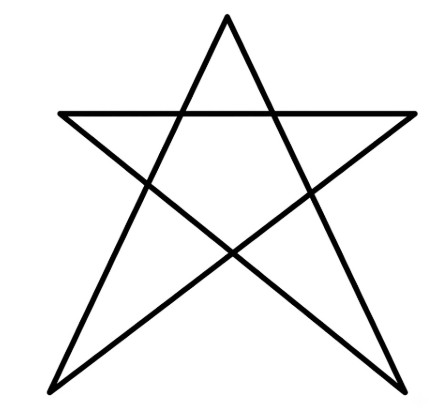
To find the number of triangles in the given star-shaped figure, we need to identify all possible triangles formed by the intersections of lines.
Correct Option: C) 10
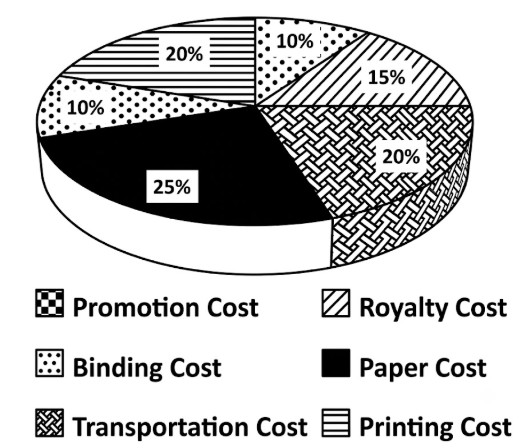
The given chart shows the expenses of a publishing company in Karnataka. If the total expenditure is Rs. 50,000, what is the binding cost?
To find the binding cost, we need to identify the percentage of the total expenditure allocated to binding from the pie chart and then calculate the amount based on the total expenditure of Rs. 50,000.
Binding Cost = \( \frac{15}{100} \times 50,000 \)
Calculate the value:
Binding Cost = \( 0.15 \times 50,000 = 7,500 \)
Therefore, the binding cost is Rs. 7,500.
Correct Option: B) 7,500
If \(\sqrt{50}\) + \(\sqrt{128}\) = \(\sqrt{N}\), then find the value of N.
To find the value of N, we need to simplify the given equation by expressing the square roots in their simplest form, i.e., \(a\sqrt{b}\), and then combine them. Finally, we will square both sides to find N.
First, simplify \(\sqrt{50}\):
\[ \sqrt{50} = \sqrt{25 \times 2} = \sqrt{25} \times \sqrt{2} = 5\sqrt{2} \]Next, simplify \(\sqrt{128}\):
\[ \sqrt{128} = \sqrt{64 \times 2} = \sqrt{64} \times \sqrt{2} = 8\sqrt{2} \]The given equation is \(\sqrt{50} + \sqrt{128} = \sqrt{N}\).
Substitute the simplified values:
\[ 5\sqrt{2} + 8\sqrt{2} = \sqrt{N} \]Since both terms have \(\sqrt{2}\), we can add their coefficients:
\[ (5 + 8)\sqrt{2} = \sqrt{N} \]\[ 13\sqrt{2} = \sqrt{N} \]To eliminate the square root on the right side, square both sides of the equation:
\[ (13\sqrt{2})^2 = (\sqrt{N})^2 \]\[ 13^2 \times (\sqrt{2})^2 = N \]\[ 169 \times 2 = N \]\[ N = 338 \]C) 338 — The step-by-step calculation correctly leads to \(N = 338\).