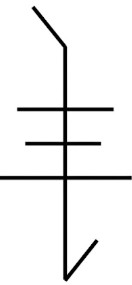
To find the shortest distance between two points, we need to determine their coordinates or relative positions. We will trace the person's path step-by-step, noting their direction and distance covered. We can visualize this movement on a 2D Cartesian plane, assigning coordinates to each point. Once the coordinates of D and B are known, the distance formula can be applied.
B) 5 — The shortest distance between point D \((0,1)\) and point B \((-4,4)\) is 5 km, calculated using the distance formula.
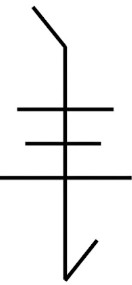
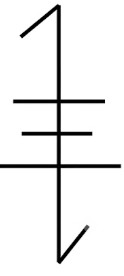
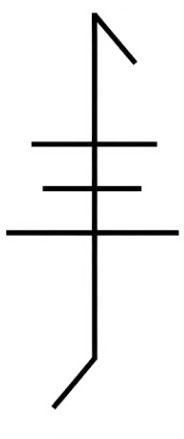
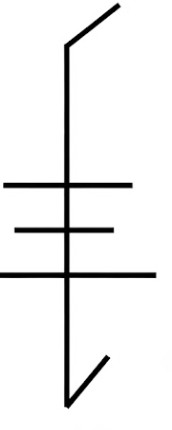
Find the figure that will replace the question mark in the following symmetry.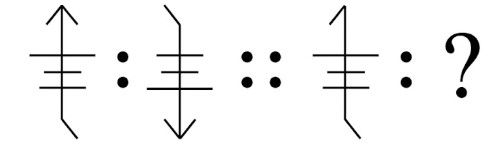
The problem involves identifying a pattern of symmetry in a sequence of figures and selecting the correct figure that completes the sequence.
Correct Option: A) The figure is a reflection of the third figure, maintaining symmetry.
A sum of Rs 5,400 is invested at 20% per annum compounded annually for 2 years. What will be the compound interest earned after 2 years.
To calculate the compound interest, we can first find the amount after 2 years using the compound interest formula and then subtract the principal amount from it. Alternatively, we can calculate the interest for each year separately, adding the interest of the first year to the principal for the second year's calculation.
The formula for the amount (\(A\)) compounded annually is:
\[ A = P \left(1 + \frac{R}{100}\right)^n \]Compound Interest = Amount - Principal
\[ \text{CI} = A - P \]\[ \text{CI} = 7776 - 5400 \]\[ \text{CI} = 2376 \]For the 1st year:
\[ \text{Interest}_1 = \frac{P \times R \times T}{100} \]\[ \text{Interest}_1 = \frac{5400 \times 20 \times 1}{100} \]\[ \text{Interest}_1 = 54 \times 20 \]\[ \text{Interest}_1 = 1080 \]Amount after 1st year:
\[ \text{Amount}_1 = P + \text{Interest}_1 \]\[ \text{Amount}_1 = 5400 + 1080 \]\[ \text{Amount}_1 = 6480 \]For the 2nd year: (Principal for 2nd year is Amount after 1st year)
\[ \text{Interest}_2 = \frac{\text{Amount}_1 \times R \times T}{100} \]\[ \text{Interest}_2 = \frac{6480 \times 20 \times 1}{100} \]\[ \text{Interest}_2 = 648 \times 2 \]\[ \text{Interest}_2 = 1296 \]Total Compound Interest:
\[ \text{Total CI} = \text{Interest}_1 + \text{Interest}_2 \]\[ \text{Total CI} = 1080 + 1296 \]\[ \text{Total CI} = 2376 \]Both methods yield the same result.
C) Rs 2,376 is the compound interest earned after 2 years.
A and B are in ideal condition. The ratio of molecular weights of A and B is 1 : 4. The pressure of the gas mixture of A and B with equal weight is P atm. What is the partial pressure (in atm) of mixture B?
\( \frac{P}{2} \)
\( \frac{P}{5} \)
\( \frac{P}{2.5} \)
\( \frac{P}{4} \)
To find the partial pressure of gas B, we need to use Dalton's Law of Partial Pressures, which states that the partial pressure of a gas in a mixture is equal to its mole fraction multiplied by the total pressure. We are given the ratio of molecular weights and that the gases have equal weights. From this, we can calculate the moles of each gas, then their mole fractions, and finally the partial pressure of B.
Define molecular weights: Let the molecular weight of A be \(M_A\) and the molecular weight of B be \(M_B\). Given that the ratio of molecular weights of A and B is 1:4, we can write:
\[ \frac{M_A}{M_B} = \frac{1}{4} \]So, \(M_B = 4M_A\).
Define weights of gases: Let the weight of gas A be \(w_A\) and the weight of gas B be \(w_B\). Given that the gases are present in equal weight, we have:
\[ w_A = w_B = w \]Calculate moles of each gas: Number of moles (\(n\)) is given by the formula: \[n = \frac{\text{weight}}{\text{molecular weight}}\]. For gas A:
\[ n_A = \frac{w_A}{M_A} = \frac{w}{M_A} \]For gas B:
\[ n_B = \frac{w_B}{M_B} = \frac{w}{4M_A} \]Calculate the total moles: Total moles (\(n_{\text{total}}\)) is the sum of moles of A and B:
\[ n_{\text{total}} = n_A + n_B = \frac{w}{M_A} + \frac{w}{4M_A} \] \[ n_{\text{total}} = w \left( \frac{1}{M_A} + \frac{1}{4M_A} \right) = w \left( \frac{4+1}{4M_A} \right) = \frac{5w}{4M_A} \]Calculate the mole fraction of gas B: The mole fraction of B (\(X_B\)) is given by:
\[ X_B = \frac{n_B}{n_{\text{total}}} = \frac{\frac{w}{4M_A}}{\frac{5w}{4M_A}} \] \[ X_B = \frac{w}{4M_A} \times \frac{4M_A}{5w} = \frac{1}{5} \]Calculate the partial pressure of gas B: According to Dalton's Law of Partial Pressures, the partial pressure of B (\(P_B\)) is:
\[ P_B = X_B \times P_{\text{total}} \]Given that the total pressure of the gas mixture is P atm, \(P_{\text{total}} = P\). So,
\[ P_B = \frac{1}{5} \times P = \frac{P}{5} \]Correct Option: B) \( \frac{P}{5} \)
What are the coordinates of the point dividing the line segment internally in the ratio of 3 : 1, end points of the line segment are (–2, 2) and (10, –6)?
To find the coordinates of a point that divides a line segment internally in a given ratio, we use the section formula. The section formula states that if a point \((x, y)\) divides the line segment joining points \((x_1, y_1)\) and \((x_2, y_2)\) internally in the ratio \(m_1 : m_2\), then its coordinates are given by:
\[ x = \frac{m_1x_2 + m_2x_1}{m_1 + m_2} \]\[ y = \frac{m_1y_2 + m_2y_1}{m_1 + m_2} \]Identify the given values:
Apply the section formula for the x-coordinate:
\[ x = \frac{m_1x_2 + m_2x_1}{m_1 + m_2} \]\[ x = \frac{(3)(10) + (1)(-2)}{3 + 1} \]\[ x = \frac{30 - 2}{4} \]\[ x = \frac{28}{4} \]\[ x = 7 \]Apply the section formula for the y-coordinate:
\[ y = \frac{m_1y_2 + m_2y_1}{m_1 + m_2} \]\[ y = \frac{(3)(-6) + (1)(2)}{3 + 1} \]\[ y = \frac{-18 + 2}{4} \]\[ y = \frac{-16}{4} \]\[ y = -4 \]Combine the coordinates:
The coordinates of the point dividing the line segment internally in the ratio 3:1 are \((7, -4)\).
C) (7,-4) is the correct answer, as calculated using the section formula.
This problem involves calculating the combined work rate of two pipes to fill a tank. We need to determine the time each pipe takes to fill the entire tank individually and then use the formula for combined work rates.
Calculate the time taken by Pipe M to fill the entire tank:
Pipe M fills \(\frac{3}{5}\) of the tank in 24 hours.
So, to fill the entire tank (which is \(\frac{5}{5}\) or 1 unit), Pipe M will take:
\[ \text{Time for M to fill entire tank} = 24 \text{ hours} \times \frac{5}{3} = 8 \times 5 = 40 \text{ hours} \]Determine the work rate of Pipe M:
If Pipe M fills the tank in 40 hours, its 1-hour work rate is:
\[ \text{Work rate of M} = \frac{1}{40} \text{ of the tank per hour} \]Determine the work rate of Pipe N:
Pipe N alone can fill the entire tank in 60 hours.
So, its 1-hour work rate is:
\[ \text{Work rate of N} = \frac{1}{60} \text{ of the tank per hour} \]Calculate the combined work rate of Pipe M and Pipe N:
When both pipes work together, their work rates add up:
\[ \text{Combined work rate} = \text{Work rate of M} + \text{Work rate of N} \]\[ \text{Combined work rate} = \frac{1}{40} + \frac{1}{60} \]To add these fractions, find a common denominator, which is 120:
\[ \text{Combined work rate} = \frac{3}{120} + \frac{2}{120} = \frac{3+2}{120} = \frac{5}{120} = \frac{1}{24} \text{ of the tank per hour} \]Calculate the time taken by both pipes together to fill the tank:
If their combined work rate is \(\frac{1}{24}\) of the tank per hour, then they will fill the entire tank in the reciprocal of this rate:
\[ \text{Time taken by both pipes} = \frac{1}{\text{Combined work rate}} = \frac{1}{\frac{1}{24}} = 24 \text{ hours} \]C) 24 hours
The question asks about the honorary rank conferred upon MS Dhoni in the Indian Army. This is a factual question related to current affairs and general knowledge about prominent Indian personalities and their associations with the armed forces.
Correct Option: A) Lieutenant Colonel (Lt. Col.)
MS Dhoni, the former captain of the Indian Cricket Team, was conferred the honorary rank of Lieutenant Colonel by the Indian Territorial Army on November 1, 2011. This was in recognition of his contributions to the sport and his exemplary leadership qualities.
Which carbon isotope is radioactive and is used for radio-carbon dating?
The question asks to identify the carbon isotope that is radioactive and used in radiocarbon dating. This requires knowledge of common carbon isotopes and their properties, specifically their stability and application in dating methods.
Correct Option: B) 14 C is the radioactive isotope of carbon used for radiocarbon dating. It has a half-life of approximately 5,730 years, making it suitable for dating organic materials up to about 50,000 years old.
To determine which pair is not co-prime, we need to find the Greatest Common Divisor (GCD) of each pair of numbers. Two numbers are co-prime (or relatively prime) if their GCD is 1. If their GCD is greater than 1, they are not co-prime.
C) The pair (49, 133) is not a co-prime pair because their Greatest Common Divisor (GCD) is 7, which is greater than 1. Both numbers are divisible by 7.
This question tests general knowledge about recent collaborations between technology companies and state governments in India, specifically focusing on digital skill development initiatives. The key is to recall which company partnered with the Government of Rajasthan for digital training in government colleges.
Correct Option: D) Microsoft