
This problem involves calculating work done by multiple people with varying work rates and schedules. We will determine the individual work rates, then calculate the work done in cycles of three days, and finally find the total number of days required to complete the task.
Panu can complete the task in 30 days. So, Panu's 1-day work rate is:
\[ \text{Panu's 1-day work} = \frac{1}{30} \text{ of the task} \]Jiban can complete the task in 20 days. So, Jiban's 1-day work rate is:
\[ \text{Jiban's 1-day work} = \frac{1}{20} \text{ of the task} \]Jalil can complete the task in 60 days. So, Jalil's 1-day work rate is:
\[ \text{Jalil's 1-day work} = \frac{1}{60} \text{ of the task} \]Jiban works every day. Panu and Jalil help Jiban every third day. This means:
Work done in the first 2 days (by Jiban alone):
\[ \text{Work in 2 days} = 2 \times \frac{1}{20} = \frac{1}{10} \text{ of the task} \]Work done on the 3rd day (by Jiban, Panu, and Jalil together):
\[ \text{Work on 3rd day} = \frac{1}{20} + \frac{1}{30} + \frac{1}{60} \]To add these fractions, find a common denominator, which is 60:
\[ \text{Work on 3rd day} = \frac{3}{60} + \frac{2}{60} + \frac{1}{60} = \frac{3+2+1}{60} = \frac{6}{60} = \frac{1}{10} \text{ of the task} \]Total work done in one 3-day cycle:
\[ \text{Work in 3-day cycle} = \frac{1}{10} + \frac{1}{10} = \frac{2}{10} = \frac{1}{5} \text{ of the task} \]Since \(\frac{1}{5}\) of the task is completed in 3 days, to complete the entire task (which is 1 unit of work), we need:
\[ \text{Number of cycles} = \frac{1}{\frac{1}{5}} = 5 \text{ cycles} \]Total days to complete the task:
\[ \text{Total days} = \text{Number of cycles} \times 3 \text{ days/cycle} = 5 \times 3 = 15 \text{ days} \]D) 15 days
If 3 is added to both the numerator and the denominator, the fraction becomes \( \frac{10}{11} \). When 4 is subtracted from both the numerator and the denominator of the same fraction, it becomes \( \frac{3}{4} \). What is the value of the fraction?
\( \frac{3}{5} \)
\( \frac{7}{8} \)
\( \frac{3}{4} \)
\( \frac{6}{13} \)
We are given two conditions about a fraction. We can represent the fraction using variables for the numerator and denominator. Then, we will form a system of two linear equations based on the given conditions and solve for the variables to find the original fraction.
Let the original fraction be \( \frac{x}{y} \), where \(x\) is the numerator and \(y\) is the denominator.
First condition: If 3 is added to both the numerator and the denominator, the fraction becomes \( \frac{10}{11} \).
This can be written as:
\[ \frac{x+3}{y+3} = \frac{10}{11} \]Cross-multiply to form the first equation:
\[ 11(x+3) = 10(y+3) \]\[ 11x + 33 = 10y + 30 \]\[ 11x - 10y = 30 - 33 \]\[ 11x - 10y = -3 \quad \text{(Equation 1)} \]Second condition: When 4 is subtracted from both the numerator and the denominator, the fraction becomes \( \frac{3}{4} \).
This can be written as:
\[ \frac{x-4}{y-4} = \frac{3}{4} \]Cross-multiply to form the second equation:
\[ 4(x-4) = 3(y-4) \]\[ 4x - 16 = 3y - 12 \]\[ 4x - 3y = -12 + 16 \]\[ 4x - 3y = 4 \quad \text{(Equation 2)} \]Now we have a system of two linear equations:
Equation 1: \( 11x - 10y = -3 \)
Equation 2: \( 4x - 3y = 4 \)
We can solve this system using the elimination method. Multiply Equation 1 by 3 and Equation 2 by 10 to make the coefficients of \(y\) equal:
Multiply Equation 1 by 3:
\[ 3(11x - 10y) = 3(-3) \]\[ 33x - 30y = -9 \quad \text{(Equation 3)} \]Multiply Equation 2 by 10:
\[ 10(4x - 3y) = 10(4) \]\[ 40x - 30y = 40 \quad \text{(Equation 4)} \]Subtract Equation 3 from Equation 4:
\[ (40x - 30y) - (33x - 30y) = 40 - (-9) \]\[ 40x - 30y - 33x + 30y = 40 + 9 \]\[ 7x = 49 \]\[ x = \frac{49}{7} \]\[ x = 7 \]Substitute the value of \(x=7\) into Equation 2 to find \(y\):
\[ 4(7) - 3y = 4 \]\[ 28 - 3y = 4 \]\[ -3y = 4 - 28 \]\[ -3y = -24 \]\[ y = \frac{-24}{-3} \]\[ y = 8 \]The original fraction is \[\frac{x}{y} = \frac{7}{8}\].
Correct Option: B) \( \frac{7}{8} \)
Find the measure of angle ABC (in degrees) in the parallelogram ABCD as shown in the given figure: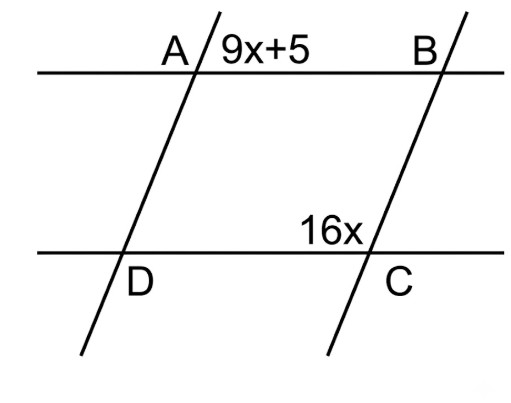
To find the measure of angle ABC in the parallelogram ABCD, we use the properties of parallelograms and the given expressions for angles.
Correct Option: A) 68
The question asks to identify South Indian film stars who formally entered politics recently as of 2018. This requires knowledge of the political activities of prominent South Indian actors around that specific time.
Correct Option: D) Rajinikanth and Kamal Haasan. Both these iconic South Indian film stars formally announced their political entry and launched their respective political parties around 2018, making this the correct option.
P 3 R I M J 3 Q % W @ / N $ E 5 X Y 1 # 8 In the above series, the 6th term to the left of the 15th term from the left is:
The problem asks us to identify a specific term in a given series based on its position relative to other terms. We need to first find the 15th term from the left and then count 6 terms to its left.
P 3 R I M J 3 Q % W @ / N \( E 5 X Y 1 # 8
Let's count the terms from the left:
1st: P
2nd: 3
3rd: R
4th: I
5th: M
6th: J
7th: 3
8th: Q
9th: %
10th: W
11th: @
12th: /
13th: N
14th: \)
15th: E
So, the 15th term from the left is 'E'.
Now, starting from 'E' and moving to the left, we count 6 terms:
1st to the left of E: $
2nd to the left of E: N
3rd to the left of E: /
4th to the left of E: @
5th to the left of E: W
6th to the left of E: %
Alternatively, we can calculate the position directly. If we want the 6th term to the left of the 15th term from the left, it means we are looking for the term at position \(15 - 6 = 9\) from the left end.
Let's count to the 9th term from the left:
1st: P
2nd: 3
3rd: R
4th: I
5th: M
6th: J
7th: 3
8th: Q
9th: %
Both methods confirm that the term is '%'.
B) % — As determined in the step-by-step explanation, the 6th term to the left of the 15th term from the left is '%'.
If tan θ = \( \frac{a}{b} \) such that \(\frac{a\sin\theta-b\cos\theta}{a\sin\theta+b\cos\theta}=\left[\frac{a^2-b^2}{a^2+b^2}\right]^k\), then k is:
The problem provides an equation involving trigonometric functions and asks for the value of \(k\). We are given \(\tan \theta = \frac{a}{b}\). The strategy is to simplify the left-hand side of the given equation by dividing the numerator and denominator by \(\cos \theta\) to introduce \(\tan \theta\), then substitute the given value of \(\tan \theta\) and compare the result with the right-hand side.
Given the equation:
\[ \frac{a\sin\theta-b\cos\theta}{a\sin\theta+b\cos\theta}=\left[\frac{a^2-b^2}{a^2+b^2}\right]^k \]We are also given that \(\tan \theta = \frac{a}{b}\).
To simplify the left-hand side (LHS) of the equation, divide both the numerator and the denominator by \(\cos \theta\) (assuming \(\cos \theta \neq 0\)):
\[ \text{LHS} = \frac{\frac{a\sin\theta}{\cos\theta}-\frac{b\cos\theta}{\cos\theta}}{\frac{a\sin\theta}{\cos\theta}+\frac{b\cos\theta}{\cos\theta}} \]Simplify the expression using the identity \(\tan \theta = \frac{\sin \theta}{\cos \theta}\):
\[ \text{LHS} = \frac{a\tan\theta-b}{a\tan\theta+b} \]Now, substitute the given value of \(\tan \theta = \frac{a}{b}\) into the simplified LHS:
\[ \text{LHS} = \frac{a\left(\frac{a}{b}\right)-b}{a\left(\frac{a}{b}\right)+b} \]Perform the multiplication and combine the terms:
\[ \text{LHS} = \frac{\frac{a^2}{b}-b}{\frac{a^2}{b}+b} \]To further simplify, find a common denominator for the terms in the numerator and denominator:
\[ \text{LHS} = \frac{\frac{a^2-b^2}{b}}{\frac{a^2+b^2}{b}} \]Cancel out the common denominator \(b\):
\[ \text{LHS} = \frac{a^2-b^2}{a^2+b^2} \]Now, equate this simplified LHS with the right-hand side (RHS) of the original equation:
\[ \frac{a^2-b^2}{a^2+b^2} = \left[\frac{a^2-b^2}{a^2+b^2}\right]^k \]By comparing the exponents, we can see that for the equality to hold, \(k\) must be 1.
C) 1 — The step-by-step simplification of the left-hand side of the equation leads to \(\frac{a^2-b^2}{a^2+b^2}\). Comparing this with the right-hand side \(\left[\frac{a^2-b^2}{a^2+b^2}\right]^k\) implies that \(k=1\).
To find the Greatest Common Factor (GCF) of a set of numbers, we can use the prime factorization method. This involves finding the prime factors of each number and then multiplying the common prime factors raised to their lowest powers.
A) 39 is the GCF of 156, 312, and 195, as calculated by finding the product of their common prime factors raised to the lowest power.
This problem involves calculating the cost price (CP) of an item given the difference in its selling prices (SP) when sold at two different loss percentages. We can set up equations for the selling prices based on the cost price and loss percentages, and then use the given difference to find the cost price.
Thus, the cost price of the keyboard is Rs. 500.
D) Rs. 500 — The calculations show that the cost price is Rs. 500, which matches this option.
The 17th Lok Sabha elections are proposed to be held in which year?
The question asks about the year in which the 17th Lok Sabha elections were proposed to be held. This requires knowledge of the electoral cycle in India and the timing of past Lok Sabha elections.
Correct Option: B) 2019. The 17th Lok Sabha elections were held in 2019, forming the government that is currently in power.
The question asks to identify the Managing Director and CEO of Axis Bank as of 2018. This requires knowledge of key appointments in the Indian banking sector during that period.
As of 2018, Shikha Sharma was the Managing Director and CEO of Axis Bank. She served in this role from June 2009 until December 2018.
C) Shikha Sharma — She was the MD & CEO of Axis Bank from June 2009 to December 2018, making her the correct answer for the year 2018.