
If the edge of a cube is halved, then its volume reduces to _______ times its original volume.
\( \frac{1}{3} \)
\( \frac{1}{4} \)
\( \frac{1}{8} \)
\( \frac{1}{2} \)
To solve this problem, we need to recall the formula for the volume of a cube. We will then calculate the original volume and the new volume after the edge length is halved, and finally find the ratio of the new volume to the original volume.
Define the original edge length: Let the original edge length of the cube be \(a\).
Calculate the original volume: The formula for the volume of a cube is \(V = (\text{edge})^3\). So, the original volume \(V_1\) is:
\[ V_1 = a^3 \]Define the new edge length: The problem states that the edge of the cube is halved. So, the new edge length \(a'\) will be:
\[ a' = \frac{a}{2} \]Calculate the new volume: Using the new edge length, the new volume \(V_2\) is:
\[ V_2 = (a')^3 = \left(\frac{a}{2}\right)^3 = \frac{a^3}{2^3} = \frac{a^3}{8} \]Find the ratio of the new volume to the original volume: To see how many times the volume reduces, we compare \(V_2\) with \(V_1\):
\[ \frac{V_2}{V_1} = \frac{\frac{a^3}{8}}{a^3} = \frac{1}{8} \]Thus, the new volume is \(\frac{1}{8}\) times its original volume.
Correct Option: C) \( \frac{1}{8} \)
Select the option figure that will complete the series of question figures.
Question Figures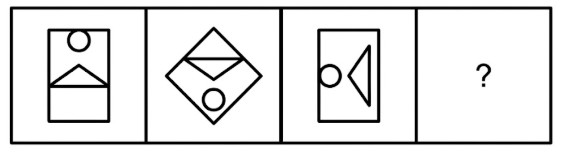
Answer Figures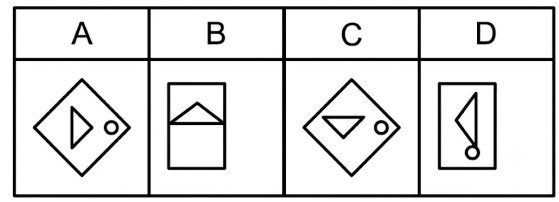
The question involves identifying the pattern in a series of figures and selecting the option that logically completes the series. Each figure in the sequence shows a different arrangement of shapes within a square or rectangular boundary.
Correct Option: D) The pattern of alternating shapes and orientations is continued correctly.
The question asks to identify the inventor of a specific smart glove, TerraBlue XT - TJay, designed to predict epileptic seizures. This requires knowledge of current affairs, specifically innovations and their creators.
Rajlakshmi Borthakur is widely recognized for inventing the TerraBlue XT - TJay smart glove. She developed this device after her son was diagnosed with epilepsy, aiming to create a non-invasive way to monitor and predict seizures.
A) Rajlakshmi Borthakur is the correct answer. She is the innovator behind the TerraBlue XT - TJay smart glove, which uses sensors to collect physiological data and predict epileptic seizures.
This question involves logical deduction based on categorical statements. We can use Venn diagrams or syllogistic rules to determine which conclusions logically follow from the given statements.
C) Both 1 and 2 follow.
As established in the step-by-step analysis, both Conclusion 1 and Conclusion 2 logically follow from the given statements.
The question asks to identify the common name for calcium sulphate hemihydrate. This requires knowledge of common chemical compounds and their chemical names, which is a fundamental concept in chemistry.
The chemical reaction for the setting of Plaster of Paris is:
\[ \text{CaSO}_4 \cdot \frac{1}{2}\text{H}_2\text{O} + 1\frac{1}{2}\text{H}_2\text{O} \rightarrow \text{CaSO}_4 \cdot 2\text{H}_2\text{O} \]This reaction forms gypsum (calcium sulphate dihydrate).
D) Plaster of Paris is the common name for calcium sulphate hemihydrate \[(\text{CaSO}_4 \cdot \frac{1}{2}\text{H}_2\text{O})\].
This problem can be solved using the principle of counting the total number of "subject-study instances" in two different ways. We can calculate the total number of times a subject is studied by summing up the studies per student, and then equate this to summing up the students per subject.
Identify given information:
Calculate the total number of "subject-study instances" from the students' perspective:
If there are 100 students and each student studies 8 subjects, then the total number of times a subject is studied across all students is:
\[ \text{Total instances} = \text{Number of students} \times \text{Subjects per student} \]\[ \text{Total instances} = 100 \times 8 = 800 \]Calculate the total number of "subject-study instances" from the subjects' perspective:
Let \(N\) be the number of subjects. We know that each subject is studied by 10 students. So, if we sum up the number of students studying each subject, we get:
\[ \text{Total instances} = \text{Number of subjects} \times \text{Students per subject} \]\[ \text{Total instances} = N \times 10 \]Equate the two calculations to find the number of subjects:
Since both calculations represent the same total number of subject-study instances, we can set them equal:
\[ N \times 10 = 800 \]\[ N = \frac{800}{10} \]\[ N = 80 \]Therefore, the number of subjects is 80.
Correct Option: A) Exactly 80
This is a blood relation problem. To solve such problems, it's best to break down the statement into smaller parts and trace the relationships step-by-step, starting from the speaker's perspective or a known relation.
B) Mother
As deduced, if the woman's son is Raghav's brother, then the woman is Raghav's mother.
In which of the following classifications are the elements arranged in the order of their increasing atomic number?
The Modern Periodic Table
Mendeleev’s Periodic Table
Newland’s Law of Octaves
Dobereiner’s Triads
The question asks to identify the classification of elements where they are arranged according to their increasing atomic number. We need to recall the basis of arrangement for each historical and modern periodic classification system.
Correct Option: A) The Modern Periodic Table arranges elements in the order of their increasing atomic number. This arrangement is based on Henry Moseley's discovery that atomic number is a more fundamental property of an element than its atomic mass.
Select the option that can replace the question mark(?) in the following series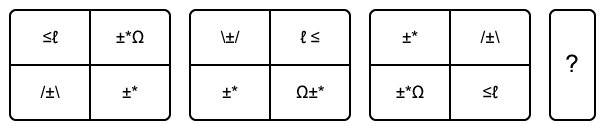
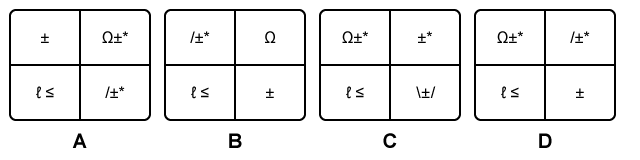
The problem involves identifying the pattern in a series of boxes containing symbols and selecting the correct option to complete the series. Each box is divided into four quadrants, each containing different symbols.
Correct Option: C) The symbols are arranged according to the identified pattern.
The question asks about a specific appointment in a public sector bank, Canara Bank, as of 2018. This is a factual recall question related to current affairs or banking awareness from that period. To answer correctly, one needs to know the key appointments made in public sector banks around 2018.
In 2018, Debashish Mukherjee was appointed as the Executive Director of Canara Bank. This was part of a series of appointments made by the Appointments Committee of the Cabinet (ACC) for various public sector banks.
D) Debashish Mukherjee was appointed as the Executive Director of Canara Bank in 2018. This was a significant appointment in the Indian banking sector at that time.