The question asks to identify whose birth and previous lives are described in the Jataka tales. This is a direct factual question related to ancient Indian literature and religious texts.
Correct Option: A) The Jataka tales are a collection of 547 poems that describe the previous births of the Buddha, both in human and animal form. They illustrate the virtues and actions that led to his enlightenment.
This problem involves the relationship between distance, speed, and time. We are given two different speeds and the difference in distance covered for the same duration. We can use the formula \(\text{Distance} = \text{Speed} \times \text{Time}\) to set up equations and solve for the unknown time and then the actual distance.
Let the time taken be \(T\) hours. Since the problem states "if he walks... instead of...", it implies the time duration is the same in both scenarios.
When Jatin walks at 4 km/hr, the distance covered is \(D_1 = 4T\) km.
When Jatin walks at 9 km/hr, the distance covered is \(D_2 = 9T\) km.
According to the problem, he covers 7.5 km more if he walks at 9 km/hr. So, the difference in distances is 7.5 km:
\[ D_2 - D_1 = 7.5 \]
Substitute the expressions for \(D_1\) and \(D_2\) into the equation:
\[ 9T - 4T = 7.5 \]
Simplify the equation:
\[ 5T = 7.5 \]
Solve for \(T\):
\[ T = \frac{7.5}{5} \]
\[ T = 1.5 \text{ hours} \]
The question asks for the actual distance covered by him. The term "actual distance covered" usually refers to the distance covered at the initial (slower) speed mentioned, or it can be interpreted as the distance covered in the given time at the slower speed. In competitive exams, if not specified, the first speed mentioned is often considered the 'actual' or 'initial' condition. So, we calculate \(D_1\):
\[ D_1 = 4T \]
\[ D_1 = 4 \times 1.5 \]
\[ D_1 = 6 \text{ km} \]
Correct Option: D) 6
This question tests understanding of relative directions and standard seating arrangements for a game like chess. When two people play chess, they sit opposite each other. If one person is facing a certain direction, the other person, sitting directly opposite, must be facing the exact opposite direction.
C) West — If Shakuntala is facing East, and Radha is sitting opposite her in a standard chess playing posture, Radha must be facing West.
Which of the following tennis players has defeated Albert Ramos-Vinolas to win the Monte Carlo Masters title for the 10th time?
Novak Djokovic
Roger Federer
Rafael Nadal
Peter Aldrich
The question asks to identify the tennis player who won the Monte Carlo Masters title for the 10th time by defeating Albert Ramos-Vinolas. This is a general knowledge question related to sports, specifically tennis history and records.
Correct Option: C) Rafael Nadal is the tennis player who defeated Albert Ramos-Vinolas to win the Monte Carlo Masters title for the 10th time. This historic victory occurred in 2017.
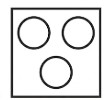
Choose the best suitable Venn diagram for the following three terms.
Bus, Car, Bicycle
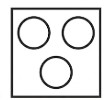
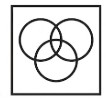
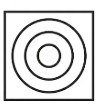
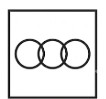
To determine the best Venn diagram for the terms "Bus," "Car," and "Bicycle," we need to consider the relationship between these categories. They are all modes of transportation but belong to distinct categories.
Correct Option: A) The diagram with three separate circles accurately represents the distinct categories of "Bus," "Car," and "Bicycle."
To find the amount after 2 years with compound interest, we will use the compound interest formula. The formula calculates the total amount, including both the principal and the accumulated interest, after a certain period.
The formula for the amount \((A)\) when interest is compounded annually is:
\[ A = P \left(1 + \frac{R}{100}\right)^n \]Since the options are given as whole numbers, we can consider Rs. 5,940.50, which is closest to Rs. 5,940.
Correct Option: A) Rs. 5,940
If α and β are zeroes of the polynomial x2 - 5x + 6, then find the value of \(\frac{\alpha^2+\beta^2}{\alpha^{-2}+\beta^{-2}}\).
The problem asks us to find the value of an expression involving the zeroes of a quadratic polynomial. We will first identify the sum and product of the zeroes using Vieta's formulas. Then, we will simplify the given expression algebraically and substitute the values of the sum and product of the zeroes to find the final result.
Identify coefficients of the polynomial:
The given polynomial is \(x^2 - 5x + 6\). Comparing this with the standard quadratic form \(ax^2 + bx + c\), we have:
Find the sum and product of the zeroes:
For a quadratic polynomial \(ax^2 + bx + c\) with zeroes \(\alpha\) and \(\beta\):
Substituting the values for our polynomial:
Simplify the expression to be evaluated:
The expression is \(\frac{\alpha^2+\beta^2}{\alpha^{-2}+\beta^{-2}}\). Let's simplify the denominator first:
\[ \alpha^{-2}+\beta^{-2} = \frac{1}{\alpha^2} + \frac{1}{\beta^2} = \frac{\beta^2 + \alpha^2}{\alpha^2 \beta^2} \]Substitute the simplified denominator back into the main expression:
\[ \frac{\alpha^2+\beta^2}{\alpha^{-2}+\beta^{-2}} = \frac{\alpha^2+\beta^2}{\frac{\alpha^2+\beta^2}{\alpha^2 \beta^2}} \]Further simplify the expression:
When dividing by a fraction, we multiply by its reciprocal:
\[ \frac{\alpha^2+\beta^2}{\frac{\alpha^2+\beta^2}{\alpha^2 \beta^2}} = (\alpha^2+\beta^2) \times \frac{\alpha^2 \beta^2}{\alpha^2+\beta^2} \]Cancel out common terms:
Assuming \(\alpha^2+\beta^2 \neq 0\), we can cancel \(\alpha^2+\beta^2\) from the numerator and denominator:
\[ (\alpha^2+\beta^2) \times \frac{\alpha^2 \beta^2}{\alpha^2+\beta^2} = \alpha^2 \beta^2 \]Rewrite the expression in terms of \(\alpha \beta\):
\[ \alpha^2 \beta^2 = (\alpha \beta)^2 \]Substitute the value of \(\alpha \beta\):
We found \(\alpha \beta = 6\). So,
\[ (\alpha \beta)^2 = (6)^2 = 36 \]Thus, the value of the given expression is 36.
C) 36 — The step-by-step calculation shows that the expression simplifies to \((\alpha \beta)^2\), and since \(\alpha \beta = 6\), the result is \(6^2 = 36\).
To find the number of odd days in a normal year, we need to determine the total number of days in a normal year and then divide this number by 7 (the number of days in a week). The remainder of this division will be the number of odd days.
Correct Option: D) 1
A normal year has 365 days. When 365 is divided by 7 (days in a week), the quotient is 52 and the remainder is 1. This remainder is the number of odd days.
The question asks to identify the Indian leader popularly known as 'Punjab Kesari'. This requires knowledge of historical titles and epithets associated with prominent figures of the Indian independence movement.
Correct Option: A) Lala Lajpat Rai was a prominent Indian nationalist, writer, and orator. He was one of the three members of the 'Lal Bal Pal' triumvirate, known for their extremist (in the context of the Indian National Congress) views and advocacy for Swaraj (self-rule). His fearless leadership and sacrifices for the nation earned him the honorific title of 'Punjab Kesari' or 'Lion of Punjab'.
0.03\(\overline{45}\) written as a vulgar fraction in its simplest form is equal to?
\( \frac{9}{275} \)
\( \frac{19}{550} \)
\( \frac{38}{1111} \)
\( \frac{19}{555} \)
To convert a recurring decimal into a vulgar fraction, we use a standard algebraic method. We set the given decimal equal to a variable, multiply it by powers of 10 to align the repeating part, and then subtract the equations to eliminate the repeating digits. Finally, we simplify the resulting fraction.
Let the given recurring decimal be \(x\):
\[ x = 0.03\overline{45} \]Write out the decimal to understand the repeating part:
\[ x = 0.03454545... \]Multiply \(x\) by a power of 10 such that the non-repeating part (if any) is to the left of the decimal point. In this case, '03' is the non-repeating part after the decimal point, so we need to move the decimal two places to the right:
\[ 100x = 3.454545... \quad \text{(Equation 1)} \]Multiply \(x\) by another power of 10 such that the repeating block starts immediately after the decimal point. The repeating block is '45', which has two digits. So, we multiply by \(100 \times 100 = 10000\):
\[ 10000x = 345.454545... \quad \text{(Equation 2)} \]Subtract Equation 1 from Equation 2 to eliminate the repeating part:
\[ 10000x - 100x = 345.454545... - 3.454545... \]\[ 9900x = 342 \]Solve for \(x\):
\[ x = \frac{342}{9900} \]Simplify the fraction. Both the numerator and denominator are divisible by 2:
\[ x = \frac{342 \div 2}{9900 \div 2} = \frac{171}{4950} \]Check for further common factors. The sum of digits of 171 is \(1+7+1=9\), which is divisible by 9. The sum of digits of 4950 is \(4+9+5+0=18\), which is also divisible by 9. So, divide by 9:
\[ x = \frac{171 \div 9}{4950 \div 9} = \frac{19}{550} \]The fraction \(\frac{19}{550}\) is in its simplest form because 19 is a prime number, and 550 is not a multiple of 19 (\(19 \times 20 = 380\), \(19 \times 30 = 570\)).
B) \( \frac{19}{550} \) is the vulgar fraction in its simplest form, as derived from the step-by-step calculation.