
This question describes a chemical reaction between two salt solutions. We need to identify the type of reaction and the product formed. This is a classic example of a double displacement reaction, specifically a precipitation reaction.
D) barium sulfate is formed. As determined from the solubility rules, barium sulphate (\(\text{BaSO}_4\)) is an insoluble product that will precipitate when sodium sulphate and barium chloride solutions are mixed.
To solve this problem, we need to follow the order of operations, often remembered by the acronym BODMAS/PEMDAS. This means we perform operations in the following order: Brackets (Parentheses), Orders (Exponents), Division and Multiplication (from left to right), and Addition and Subtraction (from left to right). We will work from the innermost brackets outwards.
So, the original expression simplifies to: \(52 \div [36 – \{24 – 14\}]\).
So, the expression simplifies to: \(52 \div [36 – 10]\).
So, the expression simplifies to: \(52 \div 26\).
A) 2 — The step-by-step application of the BODMAS rule leads to the result of 2.
What are the special features of the following group of elements?
1. All these elements are metals
2. All these elements react with water to form hydrogen gas
3. All these elements have a valency 1
Halogen group
Alkali metal group
Alkaline earth metal group
Alkali Metals and Halogen Groups
The question asks to identify the group of elements that possess three specific characteristics: being metals, reacting with water to produce hydrogen gas, and having a valency of 1. We need to evaluate each option based on these properties.
B) Alkali metal group – This group perfectly matches all three described features: they are all metals, they react with water to form hydrogen gas, and they all have a valency of 1.
This problem involves work and time. We need to calculate the total time taken to complete a task when two individuals work together for some time, and one leaves before completion. We can solve this by finding the individual work rates, then determining the amount of work done by each person or group during their respective working periods.
Calculate individual work rates:
Janki can paint a wall in 45 days. So, Janki's 1-day work rate is:
\[ \text{Janki's 1-day work} = \frac{1}{45} \text{ of the wall} \]Mansi can paint a wall in 72 days. So, Mansi's 1-day work rate is:
\[ \text{Mansi's 1-day work} = \frac{1}{72} \text{ of the wall} \]Calculate their combined 1-day work rate:
When they work together, their combined 1-day work rate is:
\[ \text{Combined 1-day work} = \frac{1}{45} + \frac{1}{72} \]To add these fractions, find a common denominator, which is the LCM of 45 and 72. The LCM of 45 (which is \(5 \times 3^2\)) and 72 (which is \(2^3 \times 3^2\)) is \(2^3 \times 3^2 \times 5 = 8 \times 9 \times 5 = 360\).
\[ \text{Combined 1-day work} = \frac{8}{360} + \frac{5}{360} = \frac{13}{360} \text{ of the wall} \]Determine the work done by Mansi in the last 33 days:
Janki left 33 days before the completion of the work. This means that Mansi worked alone for the last 33 days.
Work done by Mansi in the last 33 days:
\[ \text{Work by Mansi alone} = \text{Mansi's 1-day work} \times 33 \text{ days} = \frac{1}{72} \times 33 = \frac{33}{72} = \frac{11}{24} \text{ of the wall} \]Calculate the remaining work:
The remaining work is the part of the wall that Janki and Mansi completed together.
\[ \text{Remaining work} = 1 - \frac{11}{24} = \frac{24 - 11}{24} = \frac{13}{24} \text{ of the wall} \]Calculate the number of days Janki and Mansi worked together:
They completed the remaining work (\(\frac{13}{24}\) of the wall) together at their combined rate (\(\frac{13}{360}\) of the wall per day).
\[ \text{Days worked together} = \frac{\text{Remaining work}}{\text{Combined 1-day work}} = \frac{13/24}{13/360} = \frac{13}{24} \times \frac{360}{13} = \frac{360}{24} = 15 \text{ days} \]Calculate the total number of days to complete the work:
Total days = Days worked together + Days Mansi worked alone
\[ \text{Total days} = 15 \text{ days} + 33 \text{ days} = 48 \text{ days} \]Correct Option: B) 48
The question asks to identify which novel by Salman Rushdie was published in the year 2017. This requires knowledge of the publication dates of his major works.
A) The Golden House
Salman Rushdie's novel The Golden House was indeed published in 2017. It is a contemporary novel set in New York City, exploring themes of identity, ambition, and the American dream.
The problem presents a number series, and we need to find the next number. We will analyze the differences and patterns between consecutive terms to identify the rule governing the series.
The differences are alternating between \(+20\) and \(-1\). The pattern observed is: \(+20, -1, +20, \dots\)
Since the last operation was \(+20\) (from 29 to 49), the next operation in the alternating sequence should be \(-1\).
The next number will be \(49 - 1 = 48\).
B) 48 is the correct answer because the series follows an alternating pattern of adding 20 and subtracting 1.
The problem presents a number series, and we need to find the next number. We will analyze the pattern by looking at the differences between consecutive terms.
Correct Option: B) 230 is the correct answer because it follows the established pattern of subtracting 30 from the preceding number.
Identify the odd one out: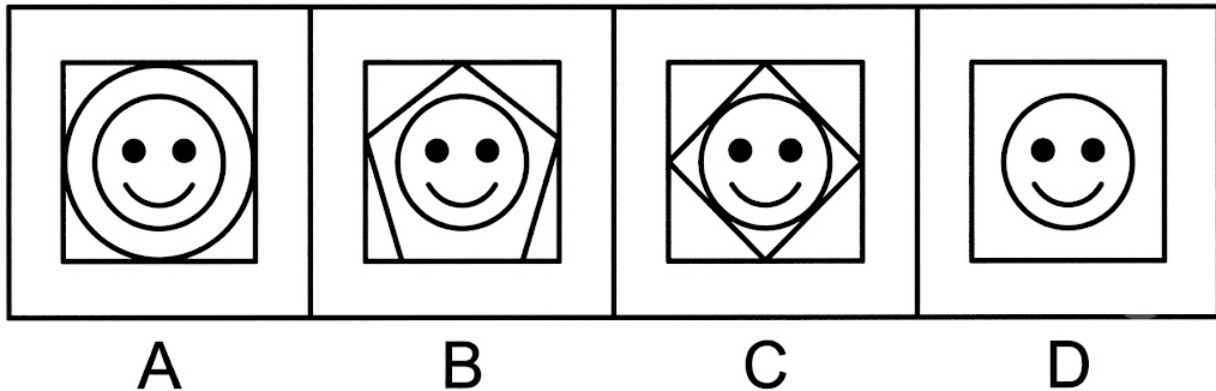
To identify the odd one out, we need to analyze the geometric patterns surrounding the smiley face in each option.
Option A: The smiley face is enclosed within a circle, which is inside a square. This pattern includes two shapes: a circle and a square.
Option B: The smiley face is enclosed within a pentagon, which is inside a square. This pattern includes two shapes: a pentagon and a square.
Option C: The smiley face is enclosed within a hexagon, which is inside a square. This pattern includes two shapes: a hexagon and a square.
Option D: The smiley face is enclosed directly within a square, without any additional shape. This pattern includes only one shape: a square.
Options A, B, and C all have an additional geometric shape (circle, pentagon, hexagon) inside the square, whereas Option D has only the square.
Correct Option: D) Option D is the odd one out because it lacks an additional geometric shape inside the square.
The question asks where "free fall" truly occurs. Free fall is defined as the motion of an object solely under the influence of gravity, with no other forces acting upon it. We need to identify the environment where this condition is met.
Correct Option: B) Vacuum
In a vacuum, there is no air or other medium to exert resistance. Therefore, an object in a vacuum falls purely under the influence of gravity, accelerating at the rate of gravitational acceleration (\(g\)) without any hindrance. This is the true definition of free fall.
(−7)[60 ÷ {6 − (−4)}] ÷ [(−2){19 − (−2) × (−6)}] =?
To solve this problem, we need to follow the order of operations (BODMAS/PEMDAS). This means we first evaluate expressions inside brackets, then orders (powers/roots), then division and multiplication (from left to right), and finally addition and subtraction (from left to right).
Let's break down the given expression into two main parts separated by the division sign:
\[ (\text{Part 1}) \div (\text{Part 2}) \]Evaluate Part 1: \( (-7)[60 \div \{6 - (-4)\}] \)
First, solve the innermost curly bracket: \( \{6 - (-4)\} = \{6 + 4\} = 10 \)
Substitute this back into Part 1:
\[ (-7)[60 \div 10] \]Next, perform the division inside the square bracket: \( [60 \div 10] = 6 \)
Finally, multiply by \(-7\): \( (-7) \times 6 = -42 \)
So, Part 1 = -42.
Evaluate Part 2: \( [(-2)\{19 - (-2) \times (-6)\}] \)
First, solve the innermost multiplication within the curly bracket: \( (-2) \times (-6) = 12 \)
Substitute this back into the curly bracket: \( \{19 - 12\} = 7 \)
Substitute this back into Part 2:
\[ (-2) \times 7 \]Finally, perform the multiplication: \( (-2) \times 7 = -14 \)
So, Part 2 = -14.
Perform the final division:
Now, divide Part 1 by Part 2:
\[ \frac{\text{Part 1}}{\text{Part 2}} = \frac{-42}{-14} \]Perform the division: \( -42 \div -14 = 3 \)
D) The final calculated value of the expression is 3.