
A car starting from rest, accelerates in a straight road at a constant rate of 3.0 m s-2 for 8 s. Find the distance travelled by the car during this time.
This problem involves calculating the distance traveled by a car undergoing constant acceleration. We can use the equations of motion (kinematic equations) for uniformly accelerated linear motion. Since the car starts from rest, its initial velocity is zero. We are given the acceleration and the time, and we need to find the distance.
The second equation of motion relates initial velocity, acceleration, time, and distance:
\[ s = ut + \frac{1}{2}at^2 \]C) 96 m is the correct distance traveled by the car.
The question asks to identify the lead actress in the Bollywood movie 'Mary Kom'. This is a factual question related to Indian cinema and general knowledge.
D) Priyanka Chopra — Priyanka Chopra Jonas played the lead role of Mary Kom in the 2014 biographical sports film 'Mary Kom'. Her performance in the film was critically acclaimed.
66 × 32 ÷ 23 + 8 = ______?
The question asks to identify the physical quantity that has the same units as Joule/coulomb. This requires recalling the definitions of fundamental electrical quantities and their SI units.
Work done or energy is measured in Joules (\(\text{J}\)).
Electric charge is measured in Coulombs (\(\text{C}\)).
Therefore, electric potential (Voltage) has units of Joules per Coulomb (\(\text{J/C}\)).
Correct Option: D) 1 Volt
The question asks for the state where the Tarapur Atomic Power Station is located. This is a factual question requiring knowledge of major power plants in India and their geographical locations.
B) Maharashtra — The Tarapur Atomic Power Station is indeed located in Tarapur, Palghar district, Maharashtra. It was the first commercial nuclear power station built in India.
Identify the mirror image of the following figure.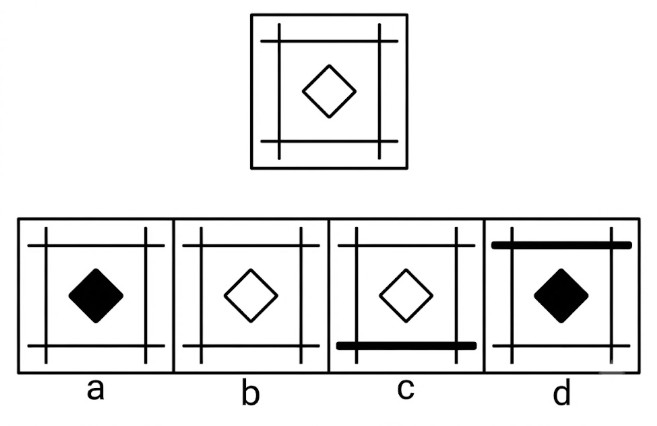
To identify the mirror image of a figure, we need to visualize how the figure would appear if reflected over a vertical axis. This involves flipping the figure horizontally.
Correct Option: B) The diamond remains upright, and the lines are correctly positioned as a horizontal flip of the original figure.
To find the Least Common Multiple (LCM) of two numbers, we can use the prime factorization method. This involves finding the prime factors of each number and then multiplying the highest powers of all common and uncommon prime factors.
Since 145 ends in 5, it is divisible by 5.
\[ 145 = 5 \times 29 \]29 is a prime number.
So, the prime factorization of 145 is \(5 \times 29\).
To check for divisibility by 3, sum the digits: \(8 + 7 = 15\). Since 15 is divisible by 3, 87 is divisible by 3.
\[ 87 = 3 \times 29 \]29 is a prime number.
So, the prime factorization of 87 is \(3 \times 29\).
The LCM is the product of the highest powers of all prime factors present in either number.
Prime factors are 3, 5, and 29.
Therefore, the LCM is:
\[ \text{LCM}(145, 87) = 3 \times 5 \times 29 \]\[ \text{LCM}(145, 87) = 15 \times 29 \]\[ \text{LCM}(145, 87) = 435 \]Correct Option: D) 435
The problem asks us to find the missing term in a sequence based on a given alphanumeric string. We need to identify the pattern in the given pairs (W 8, P 6, ______, H B) by observing their positions in the original sequence.
B) T E — Upon re-examination, the question asks for the missing term, and the options are pairs of elements. My step 7 identified 'M V' as the missing pair based on the 6-position jump. Let's re-read the question carefully: "Find the missing term using the above sequence W 8, P 6,______, H B
This question tests logical reasoning, specifically identifying implicit assumptions. An assumption is something taken for granted or accepted as true without proof. For the statement to be valid, the implicit assumption must be true.
D) Only assumption I is implicit. The statement explicitly talks about improvement after operation, which inherently assumes that an operation is possible and can be performed on Rajesh in his current condition.
To determine the direction the man is facing at point C, we need to trace his path and the direction he faces after each turn. We will start from his initial position and direction and update his facing direction with every turn.
The subsequent movements (turns at C, D, and E) are not relevant to determine the direction he is facing at point C.
Correct Option: A) East