Find the figure that can replace the question mark in the following analogy.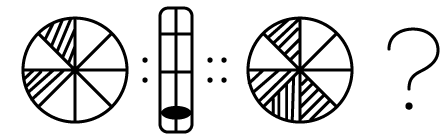
This question involves finding the correct figure to complete an analogy based on visual patterns. The key is to identify the transformation or pattern between the given figures and apply it to find the missing figure.
Correct Option: D) The ellipse in the middle figure's center has been flipped, matching the pattern transformation seen in the circles.
Select the answer figure that will replace the question mark in the question figure series.
Question figure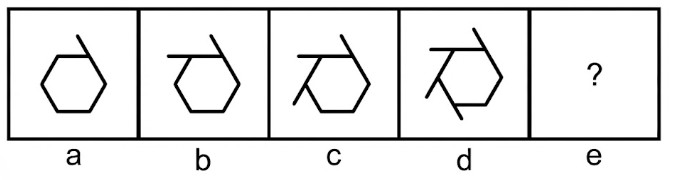
Answer Figures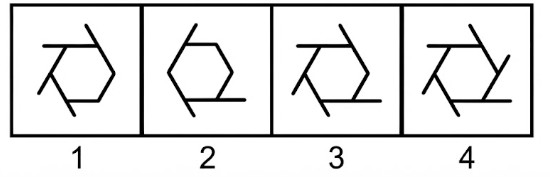
The problem involves identifying the pattern in the sequence of images and selecting the correct figure that continues the pattern.
Correct Option: D) 3
The question asks to identify the sport or game in which the terms 'Birdie' and 'Eagle' are used. This requires knowledge of common terminology across various sports.
Correct Option: C) Golf
This question tests knowledge of human sex determination, which is governed by sex chromosomes. Understanding the role of X and Y chromosomes in forming a zygote will lead to the correct answer.
Therefore, for a child to be male, the zygote must have an XY combination of sex chromosomes.
C) XY — This combination of sex chromosomes (one X from the mother and one Y from the father) results in the development of a male child.
To find the kinetic energy of an object, we use the formula for kinetic energy, which relates the object's mass and its velocity. We will substitute the given values into this formula and calculate the result, ensuring the correct units are used.
The kinetic energy possessed by the object is \(80 \text{ J}\).
Correct Option: A) 80 J
Choose the mirror image for the following figure considering MN to be the mirror: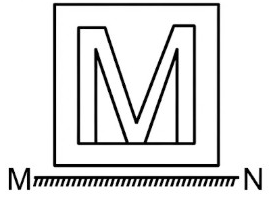
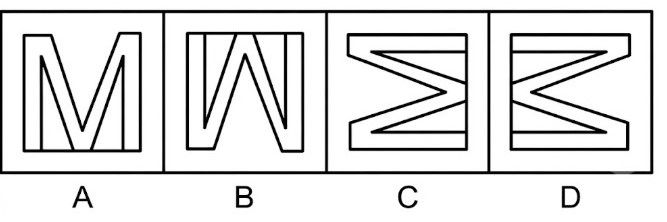
To find the mirror image of a figure with respect to a given line, we need to reflect the figure across that line. The mirror line MN in this question is horizontal, so the reflection will involve flipping the figure vertically.
Correct Option: B) Option B is the correct mirror image as it accurately represents the vertical flipping of 'M' to 'W'.
This problem involves setting up and solving a system of linear equations based on the given age relationships. We will use variables to represent the present ages of the mother and daughter and then formulate equations from the problem statements.
Define variables:
Let \(M\) be the mother's present age.
Let \(D\) be the daughter's present age.
Formulate the first equation:
The sum of their present ages is 46.
\[ M + D = 46 \quad \text{(Equation 1)} \]
Formulate the second equation:
After 4 years, the mother's age will be \(M+4\) and the daughter's age will be \(D+4\).
The mother will be twice the age of her daughter after 4 years.
\[ M + 4 = 2(D + 4) \]\[ M + 4 = 2D + 8 \]\[ M = 2D + 4 \quad \text{(Equation 2)} \]
Solve the system of equations:
Substitute Equation 2 into Equation 1:
\[ (2D + 4) + D = 46 \]\[ 3D + 4 = 46 \]\[ 3D = 46 - 4 \]\[ 3D = 42 \]\[ D = \frac{42}{3} \]\[ D = 14 \]
Find the mother's age (optional, for verification):
Using Equation 1: \(M = 46 - D = 46 - 14 = 32\).
Check with Equation 2: \(M = 2D + 4 = 2(14) + 4 = 28 + 4 = 32\). The ages are consistent.
The daughter's age today is 14 years.
Correct Option: B) 14 years
Electric current is equal to ________.
I = \(\frac{Q}{t}\)
I = \(\frac{W}{t}\)
I = \(\frac{\pi}{t}\)
I = \(\frac{\Omega}{t}\)
The question asks for the correct formula for electric current. We need to recall the fundamental definition of electric current in terms of charge and time.
Correct Option: A) \(I = \frac{Q}{t}\) is the correct formula for electric current, representing the rate of flow of electric charge.
The question asks to identify the bank with which the Indian Army signed a Memorandum of Understanding (MoU) for its Defence Salary Package. This is a factual question related to current affairs or general knowledge about banking partnerships with defence forces.
D) State Bank of India — The Indian Army and State Bank of India (SBI) signed a Memorandum of Understanding (MoU) for the 'Defence Salary Package' scheme. This renewed MoU covers various benefits for all ranks of Army personnel, including serving and retired individuals. SBI is a major public sector bank and has a significant presence across the country, making it a preferred partner for such large-scale initiatives.
This is a logical reasoning question where we need to determine which conclusions logically follow from the given statement. We must only use the information provided in the statement and avoid making assumptions based on external knowledge or personal opinions.
Correct Option: C) Neither 1 nor 2 follows