
The question asks for the characteristic of sound that allows us to differentiate between two sounds having the same loudness and pitch. This points to a property that distinguishes the unique 'texture' or 'timbre' of a sound, even when its basic intensity and frequency are identical.
Correct Option: A) Quality is the characteristic of sound that enables us to distinguish between two sounds of the same loudness and pitch. It is also known as timbre and depends on the waveform of the sound, specifically the presence and relative intensity of overtones (harmonics) along with the fundamental frequency. This is why a note played on a piano sounds different from the same note played on a guitar, even if they have the same loudness and pitch.
The question asks to identify the option that is NOT an example of non-uniform motion. To answer this, we need to understand the definitions of uniform and non-uniform motion.
D) The rotation of the blades of a ceiling fan. Once a ceiling fan reaches a steady state, its blades rotate at a constant angular speed. While the direction of velocity of any point on the blade continuously changes (making it accelerated motion), the magnitude of the velocity (speed) of those points remains constant. In the context of distinguishing from the highly variable motions in options A, B, and C, this is considered the example that is NOT non-uniform motion in the sense of varying speed or highly erratic path.
The question asks for the home state of Gauri Lankesh, a prominent journalist who was tragically murdered in 2017. This is a factual question related to current affairs and personalities relevant to Indian society and politics.
A) Karnataka — Gauri Lankesh was a prominent journalist and activist from Karnataka, known for her work in Kannada journalism and her critical views. She was assassinated outside her home in Bengaluru, Karnataka, in 2017.
The question asks to identify which of the given options is NOT a part of a neuron. We need to recall the basic structure of a neuron and the components associated with it, then compare them with the provided options.
Correct Option: D) Sarcolemma is the cell membrane of a muscle fiber, not a neuron. Neurons have a cell membrane, but it is not called sarcolemma.
The question asks for the full form of the acronym UIDAI. This requires knowledge of common abbreviations related to Indian government bodies and initiatives.
Correct Option: D) Unique Identification Authority of India
The Unique Identification Authority of India (UIDAI) is a statutory authority established under the provisions of the Aadhaar (Targeted Delivery of Financial and Other Subsidies, Benefits and Services) Act, 2016 by the Government of India. It is responsible for issuing the Aadhaar number, a 12-digit unique identification number to all residents of India.
How many triangles are there in this figure?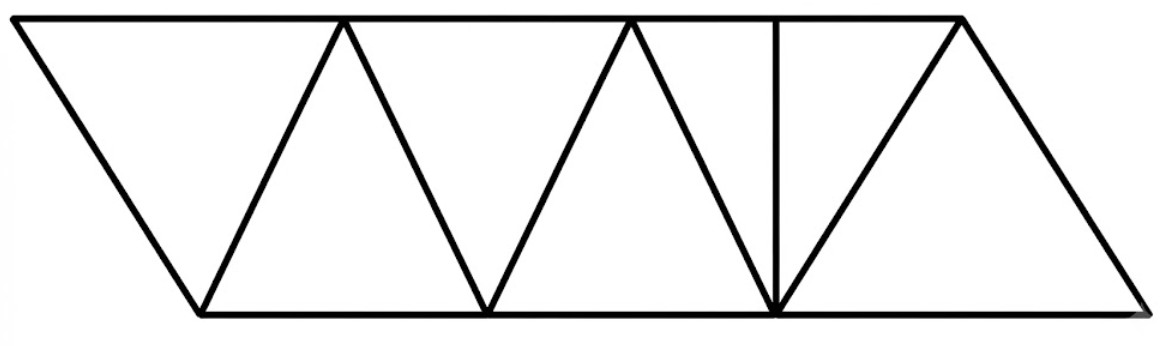
To determine the total number of triangles in the given figure, we need to carefully identify and count all possible triangles formed by the intersecting lines.
Correct Option: A) 8
This question asks about the definition of thrust exerted by a body on a surface. Thrust is essentially a force. We need to identify which of the given options represents the force a body exerts due to gravity when resting on a surface.
Correct Option: A) The thrust exerted by a body on the surface is equal to its weight. Weight is the force exerted by gravity on an object, and when an object rests on a surface, it exerts this gravitational force (its weight) perpendicular to the surface, which is defined as thrust in this context.
The ability of one metal to displace another from its salt solution is a fundamental concept in chemistry, particularly related to the reactivity series of metals. This phenomenon is governed by the relative chemical reactivity of the metals involved.
D) Reactivity — Metals displace each other based on their relative reactivity. A more reactive metal will displace a less reactive metal from its salt solution. This is a core concept in understanding the reactivity series of metals.
To find the least natural number that leaves a specific remainder when divided by several numbers, we first need to find the Least Common Multiple (LCM) of the divisors. Once we have the LCM, we add the common remainder to it. This gives us the smallest such number.
Correct Option: A) 247 is the least natural number which when divided by 8, 12, 15 or 16 leaves a remainder of 7.
This is a syllogism problem that can be solved using Venn diagrams or by analyzing the relationships between the categories. We need to determine which conclusion(s) logically follow from the given statements. The key is to understand that "Some" statements imply an overlap but not necessarily a complete inclusion or exclusion.
From the statements, we know: Jaguars ↔ Cheetahs, Cheetahs ↔ Leopards, Leopards ↔ Panthers. There is no direct or definite connection established between 'panthers' and 'cheetahs'. While it's possible that some panthers are cheetahs (if the 'leopards' set overlaps with both 'cheetahs' and 'panthers' in a way that creates an overlap between 'cheetahs' and 'panthers'), it is not a definite conclusion. We cannot be certain from the given information.
Similarly, we cannot definitively conclude that no panther is a cheetah. The statements only provide information about "some" overlaps, not complete exclusions. It's possible for some panthers to be cheetahs, and it's also possible for no panthers to be cheetahs, based on different possible Venn diagram configurations.
Conclusions 1 and 2 are a complementary pair (contradictory pair). If "Some panthers are cheetahs" is true, then "No panther is a cheetah" must be false. If "No panther is a cheetah" is true, then "Some panthers are cheetahs" must be false. In situations where individual conclusions cannot be definitively proven true or false, but they form a complementary pair covering all possibilities, the 'Either 1 or 2 follows' condition applies. Since there is no direct link between panthers and cheetahs, and both possibilities (some overlap or no overlap) are consistent with the given statements, then one of these two conclusions must be true.
D) Either 1 or 2 follows. This is because Conclusion 1 ("Some panthers are cheetahs") and Conclusion 2 ("No panther is a cheetah") form a complementary pair. Both cannot be true simultaneously, and both cannot be false simultaneously. Since the statements do not provide enough information to definitively prove or disprove either conclusion individually, but one of them must be true, the 'either/or' condition is met.