
The question asks to identify an appliance that converts electrical energy into mechanical energy. We need to analyze the primary energy conversion in each given option.
Correct Option: D) Electric fan
The question asks to identify the bank for which Murali Ramaswami was appointed as Executive Director. This is a factual question related to appointments in the banking sector, which is common in competitive exams.
Correct Option: A) Murali Ramaswami was appointed as the Executive Director of Vijaya Bank. This appointment was made by the Appointments Committee of the Cabinet (ACC) in 2016.
To find the compound interest when compounded half-yearly, we need to adjust the annual rate and time period. The annual rate is divided by 2, and the number of years is multiplied by 2 to get the number of compounding periods. Then, we use the compound interest formula to calculate the amount and subsequently the compound interest.
The formula for the amount when compounded half-yearly is:
\[ A = P \left(1 + \frac{r}{100}\right)^n \]\[ A = 15625 \left(1 + \frac{4}{100}\right)^3 \]\[ A = 15625 \left(1 + 0.04\right)^3 \]\[ A = 15625 \left(1.04\right)^3 \]\[ A = 15625 \times 1.04 \times 1.04 \times 1.04 \]\[ A = 15625 \times 1.124864 \]\[ A = 17576 \]Compound Interest is the difference between the Amount and the Principal.
\[ \text{CI} = A - P \]\[ \text{CI} = 17576 - 15625 \]\[ \text{CI} = 1951 \]D) 1,951 is the correct compound interest calculated.
The question asks about the proposed location for the National War Memorial. This is a factual question related to national monuments and current affairs. To answer this, one needs to recall the established location of the National War Memorial.
Correct Option: D) The National War Memorial is located in New Delhi, specifically near India Gate. It was inaugurated in 2019 to honor soldiers who have died in service to the nation since independence.
The problem involves calculating the weight of a smaller piece of metal cut from a larger lump of the same metal. The key concept here is density, which is a characteristic property of a material and remains constant regardless of the size or shape of the object. We will first calculate the density of the metal using the given volume and weight of the lump, and then use this density to find the weight of the cube with a known volume.
Density (\(\rho\)) is defined as mass (weight in this context) per unit volume. The given lump of metal has a volume of 133 cu. cm and weighs 207 g.
\[ \rho = \frac{\text{Weight}}{\text{Volume}} \]Substitute the given values:
\[ \rho = \frac{207 \text{ g}}{133 \text{ cm}^3} \]Calculate the density:
\[ \rho \approx 1.55639 \text{ g/cm}^3 \]A cube with a side of 2 cm has a volume calculated as side cubed.
\[ \text{Volume of cube} = (\text{side})^3 \]Substitute the side length:
\[ \text{Volume of cube} = (2 \text{ cm})^3 \]Calculate the volume:
\[ \text{Volume of cube} = 8 \text{ cm}^3 \]Since the cube is cut from the same metal, its density will be the same as calculated in Step 1. We can now find its weight using the formula:
\[ \text{Weight} = \rho \times \text{Volume} \]Substitute the density and the volume of the cube:
\[ \text{Weight} = 1.55639 \text{ g/cm}^3 \times 8 \text{ cm}^3 \]Calculate the weight:
\[ \text{Weight} \approx 12.45112 \text{ g} \]The options are given with two decimal places, so we round our answer to two decimal places.
\[ \text{Weight} \approx 12.45 \text{ g} \]Correct Option: C) 12.45 gms
To find the electric charge, we need to use the fundamental relationship between potential difference, work done, and electric charge. The potential difference (voltage) is defined as the work done per unit charge.
Identify the given values:
Recall the formula relating potential difference, work done, and charge:
The potential difference (\(V\)) is defined as the work done (\(W\)) to move a unit charge (\(Q\)) from one point to another. The formula is:
\[ V = \frac{W}{Q} \]Rearrange the formula to solve for charge (\(Q\)):
To find the charge, we can rearrange the formula as:
\[ Q = \frac{W}{V} \]Substitute the given values into the rearranged formula:
\[ Q = \frac{60 \text{ J}}{12 \text{ V}} \]Calculate the charge:
\[ Q = 5 \text{ C} \]The unit for electric charge is Coulombs (C).
Correct Option: D) 5 C
The question asks us to evaluate two statements related to the liquefaction of gases and the effect of atmospheric conditions on evaporation and cooling. We need to determine if each statement is true or false based on scientific principles.
D) Both are true
What is the count of smallest triangular units present in the following figure?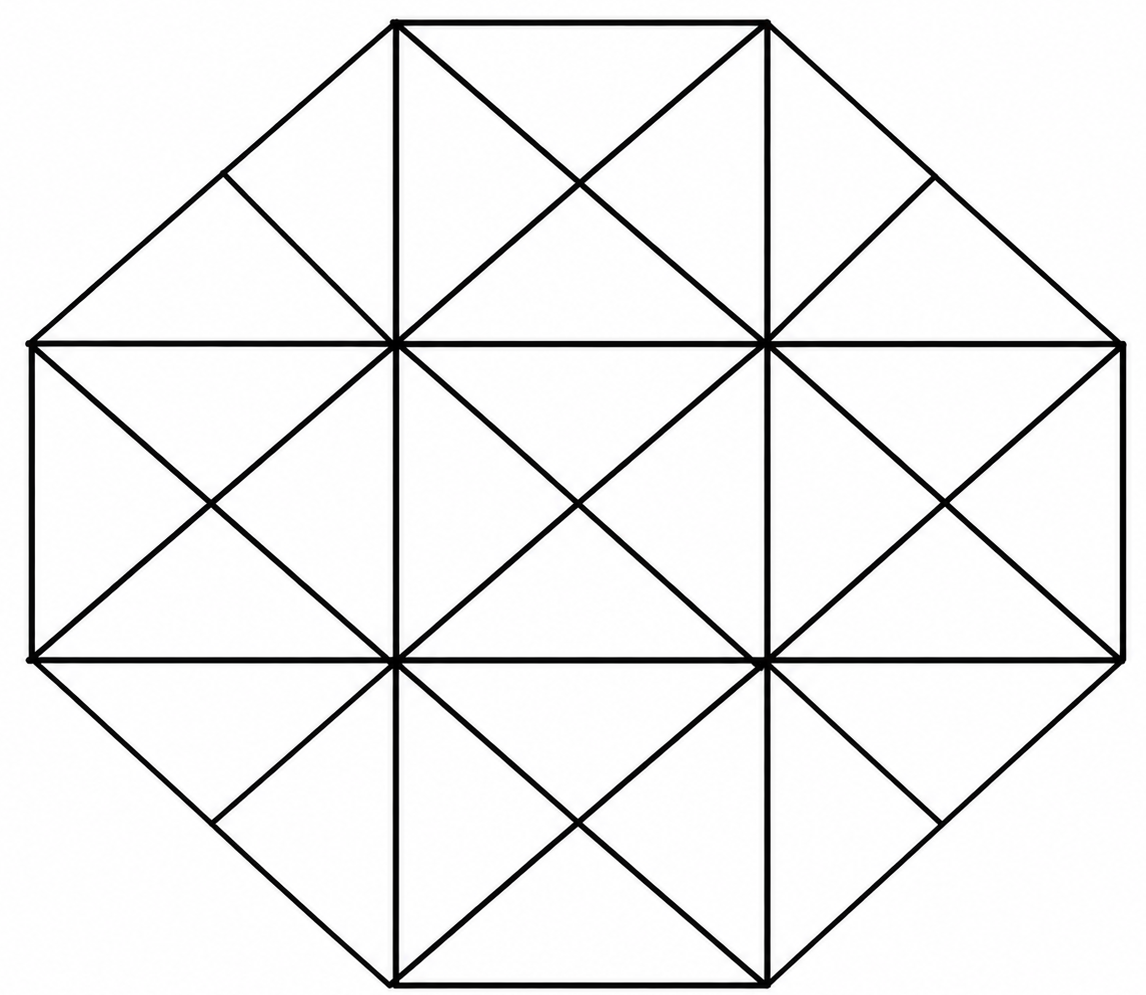
To find the count of the smallest triangular units in the given figure, we need to systematically count each small triangle formed by the intersecting lines.
Number of squares = 9
Triangles per square = 4
Total smallest triangles = \(9 \times 4 = 36\)
However, the figure is an octagon, and the corner triangles are not part of the grid. We need to subtract these excess triangles.
The figure has 8 corner triangles that are half outside the main grid.
Thus, the effective number of smallest triangles is:
\(36 - 8 = 28\)
Correct Option: C) 28
The following Bar graph shows information about results in the national level entrance exam by the institute “ABC” for the last 5 years.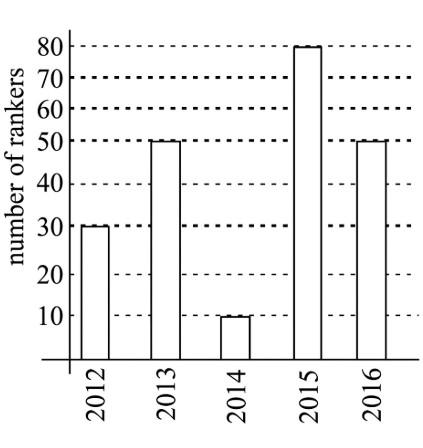
In the year 2014 how many ranks were scored from institute “ABC”?
To determine the number of ranks scored by the institute "ABC" in the year 2014, we need to analyze the bar graph provided. The graph displays the number of rankers for each year from 2012 to 2016.
Correct Option: A) 10
This question tests knowledge about the speed of sound in different solid media. The speed of sound varies significantly depending on the medium's properties (elasticity and density). We need to recall or refer to standard values for the speed of sound in Aluminium and Nickel at a given temperature (25°C).
Correct Option: A) Only A is true