To find the cost of 5.5 kg of jam, we first need to determine the cost per kilogram of the jam. Once we have the unit cost, we can multiply it by the desired quantity (5.5 kg) to find the total cost.
Given that 2.5 kg of jam costs Rs 78.60.
\[ \text{Cost per kg} = \frac{\text{Total cost}}{\text{Quantity}} \]\[ \text{Cost per kg} = \frac{78.60 \text{ Rs}}{2.5 \text{ kg}} \]\[ \text{Cost per kg} = 31.44 \text{ Rs/kg} \]Now that we know the cost per kilogram, we can find the cost for 5.5 kg.
\[ \text{Cost of 5.5 kg} = \text{Cost per kg} \times \text{Desired quantity} \]\[ \text{Cost of 5.5 kg} = 31.44 \text{ Rs/kg} \times 5.5 \text{ kg} \]\[ \text{Cost of 5.5 kg} = 172.92 \text{ Rs} \]Correct Option: B) 172.92
Choose the best suitable Venn diagram for the following words:
Tiger, Buffalo, Animals
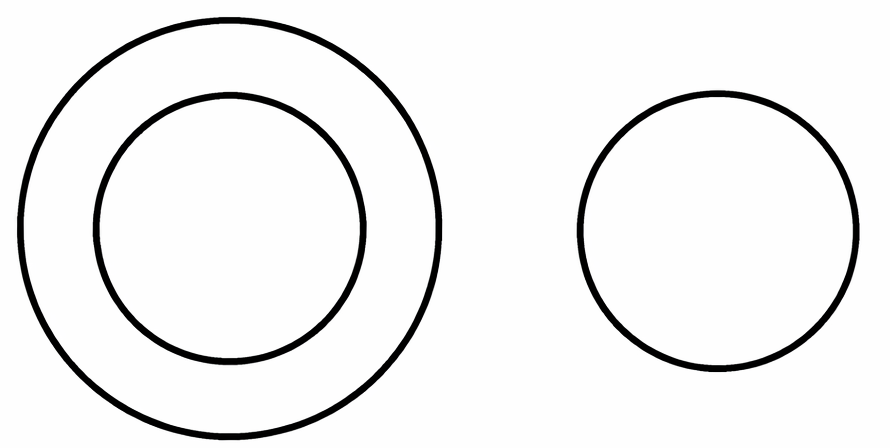
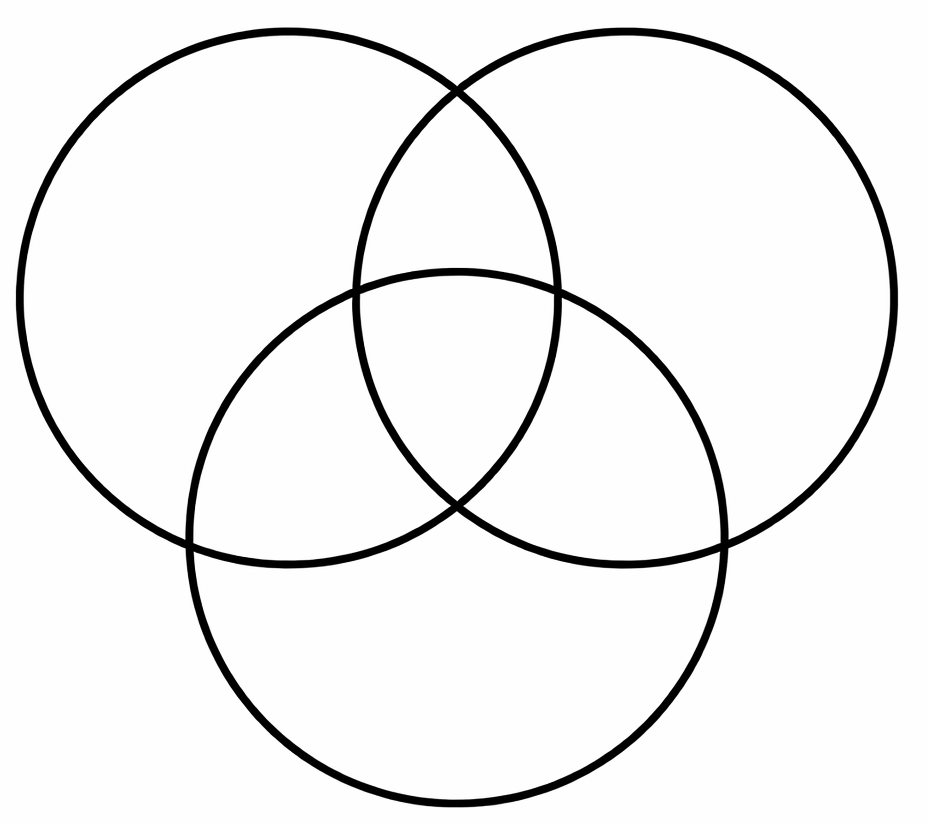
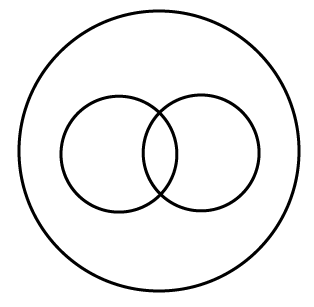
To determine the best Venn diagram for the words "Tiger," "Buffalo," and "Animals," we need to understand their hierarchical relationship. Both tigers and buffaloes are types of animals, but they do not overlap with each other as categories.
Correct Option: D) The diagram shows two non-overlapping circles inside a larger circle, accurately representing "Tiger" and "Buffalo" as distinct categories within "Animals."
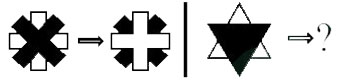
Select the figure that replaces the (?) symbol above from the given options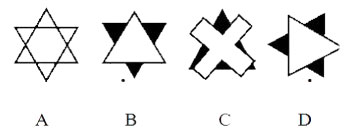
The problem involves identifying a pattern or transformation applied to a sequence of figures. The task is to determine which option continues the sequence logically.
Correct Option: A) Star of David
To find the cost of copper used, we need to determine the cost per gram of copper and then multiply it by the quantity of copper used. The problem provides the price for 1 kg of copper and the mass of copper used in grams. We need to ensure consistent units (either all kilograms or all grams) before calculation.
Convert units: The price is given for 1 kg, and the quantity used is in grams. We know that \(1 \text{ kg} = 1000 \text{ g}\).
Calculate the cost per gram:
Given price of 1 kg of copper = Rs 420
So, the price of 1000 g of copper = Rs 420
Cost per gram of copper \[= \frac{\text{Total Cost}}{\text{Total Mass}}\]
\[ \text{Cost per gram} = \frac{420 \text{ Rs}}{1000 \text{ g}} = 0.42 \text{ Rs/g} \]Calculate the total cost of copper used:
Mass of copper used = 50 g
Cost of copper used \( = \text{Mass used} \times \text{Cost per gram}\)
\[ \text{Cost} = 50 \text{ g} \times 0.42 \text{ Rs/g} = 21 \text{ Rs} \]Correct Option: C) Rs 21
The question asks for the value of the universal gas constant, R. This is a fundamental physical constant used in the ideal gas law and other thermodynamic equations. Its value is experimentally determined and widely accepted in SI units.
C) The value \(8.31 \text{ J K}^{-1} \text{ mol}^{-1}\) is the standard and most accurate value for the universal gas constant \(R\) when expressed in Joules per Kelvin per mole.
This problem involves ratios and algebraic equations. We can set up initial salaries using a common multiplier and then form an equation based on the given increase and new ratio. Solving this equation will give us the value of the multiplier, which can then be used to find Charan's original salary.
Let the initial salaries of Charan and Rajat be \(5x\) and \(4x\) respectively, where \(x\) is a common multiplier.
\[ \text{Charan's salary} = 5x \] \[ \text{Rajat's salary} = 4x \]Each salary increases by Rs 3,000. So, the new salaries will be:
\[ \text{New Charan's salary} = 5x + 3000 \] \[ \text{New Rajat's salary} = 4x + 3000 \]The new ratio of their salaries is given as 6 : 5. We can set up an equation using this information:
\[ \frac{5x + 3000}{4x + 3000} = \frac{6}{5} \]Now, we cross-multiply to solve for \(x\):
\[ 5(5x + 3000) = 6(4x + 3000) \] \[ 25x + 15000 = 24x + 18000 \]Rearrange the terms to isolate \(x\):
\[ 25x - 24x = 18000 - 15000 \] \[ x = 3000 \]The question asks for Charan's salary. Charan's original salary was \(5x\).
\[ \text{Charan's salary} = 5 \times 3000 = 15000 \]B) 15,000 is the correct answer. Charan's original salary is Rs 15,000.
A) 18,000 — This would be Charan's new salary (\(5x + 3000 = 15000 + 3000 = 18000\)), not his original salary.
C) 20,000 — This value does not fit the given ratios and conditions.
D) 12,000 — This would be Rajat's original salary (\(4x = 4 \times 3000 = 12000\)), not Charan's.
This problem involves calculating the cost of carriage based on weight, distance, and rate. We need to determine the relationship between these variables and then apply it to the new scenario with a different weight, distance, and a reduced rate.
Understand the relationship between cost, weight, and distance:
The cost of carriage is directly proportional to the weight and the distance. We can express this as:
\[ \text{Cost} \propto \text{Weight} \times \text{Distance} \]So, \(\text{Cost} = K \times \text{Weight} \times \text{Distance}\), where \(K\) is the rate constant per unit weight per unit distance.
Calculate the initial rate constant (K):
Given:
Using the formula \(C_1 = K \times W_1 \times D_1\):
\[ 45 = K \times 910 \times 70 \] \[ K = \frac{45}{910 \times 70} \] \[ K = \frac{45}{63700} \]Determine the new rate:
The problem states the new rate is half the former rate. So, the new rate constant \(K' = \frac{1}{2} K\).
\[ K' = \frac{1}{2} \times \frac{45}{63700} \] \[ K' = \frac{45}{127400} \]Calculate the new cost:
Given for the new scenario:
Using the formula \(C_2 = K' \times W_2 \times D_2\):
\[ C_2 = \frac{45}{127400} \times 940 \times 63 \] \[ C_2 = \frac{45 \times 940 \times 63}{127400} \]Simplify the expression:
\[ C_2 = \frac{45 \times 94 \times 63}{12740} \]Divide 940 by 10 and 127400 by 100 to simplify:
\[ C_2 = \frac{45 \times 94 \times 63}{12740} \]Let's perform the multiplication in the numerator:
\[ 45 \times 94 = 4230 \] \[ 4230 \times 63 = 266490 \]So,
\[ C_2 = \frac{266490}{12740} \]Now, perform the division:
\[ C_2 = 21 \]The new cost will be Rs 21.
B) 21
Select the figure from the following that is different from the rest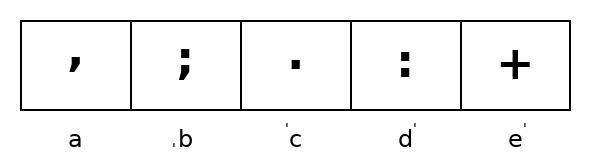
The task is to identify the figure that is different from the others. This involves analyzing the shapes and patterns in each option to find the one that does not follow the same rule as the others.
Correct Option: B) e
Find the odd one out: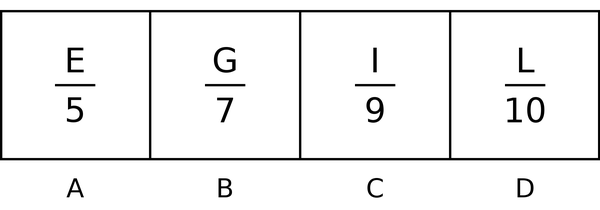
To find the odd one out, we need to identify a pattern or rule that applies to all options except one.
Correct Option: C) \( \frac{I}{9} \) — This option breaks the pattern as it does not fit the sequence logic applied to the others.
This problem involves relative speed. We need to calculate the time it takes for the policeman to cover the initial distance between them at their relative speed. Once the time is found, we can calculate the distance the smuggler runs during that time.
It's often easier to work with meters and seconds or kilometers and hours. Let's keep speeds in km/hr and convert the initial distance to km.
\[ \text{Initial distance} = 200 \text{ meters} = \frac{200}{1000} \text{ km} = 0.2 \text{ km} \]Since both are running in the same direction, the relative speed at which the policeman gains on the smuggler is the difference between their speeds.
\[ \text{Relative Speed} = S_P - S_V = 12 \text{ km/hr} - 10 \text{ km/hr} = 2 \text{ km/hr} \]The time taken for the policeman to cover the initial distance between them is given by:
\[ \text{Time} = \frac{\text{Distance}}{\text{Relative Speed}} = \frac{0.2 \text{ km}}{2 \text{ km/hr}} = 0.1 \text{ hours} \]During this time (\(0.1 \text{ hours}\)), the smuggler continues to run. The distance covered by the smuggler is:
\[ \text{Distance by Smuggler} = \text{Smuggler's Speed} \times \text{Time} \] \[ \text{Distance by Smuggler} = 10 \text{ km/hr} \times 0.1 \text{ hours} = 1 \text{ km} \]So, the smuggler will have to run 1 km before he is overtaken.
D) 1 km