
The relative density of a substance is defined as the ratio of its density to the density of a reference substance, typically water for liquids and solids. It is a dimensionless quantity.
Density of silver (\(\rho_{\text{Ag}}\)) = \(10.8 \times 10^3 \text{ kg/m}^3\)
Density of water (\(\rho_{\text{water}}\)) = \(10^3 \text{ kg/m}^3\)
Relative density is given by the formula:
\[ \text{Relative Density} = \frac{\text{Density of substance}}{\text{Density of water}} \]The \(10^3\) terms in the numerator and denominator cancel out:
\[ \text{Relative Density of Ag} = \frac{10.8}{1} = 10.8 \]Correct Option: D) 10.8
To find the amount spent, we first need to determine the amount saved. The problem states that Srinivas saves 20% of his monthly income. Once the savings are calculated, the amount spent can be found by subtracting the savings from the total income.
Srinivas's monthly income is Rs 14,500.
\[ \text{Total Income} = \text{Rs } 14,500 \]Srinivas saves 20% of his income.
\[ \text{Savings} = 20\% \text{ of Total Income} \]\[ \text{Savings} = \frac{20}{100} \times 14,500 \]\[ \text{Savings} = 0.20 \times 14,500 \]\[ \text{Savings} = \text{Rs } 2,900 \]The amount spent is the total income minus the savings.
\[ \text{Amount Spent} = \text{Total Income} - \text{Savings} \]\[ \text{Amount Spent} = 14,500 - 2,900 \]\[ \text{Amount Spent} = \text{Rs } 11,600 \]Alternatively, if Srinivas saves 20% of his income, he spends the remaining \(100\% - 20\% = 80\%\) of his income.
\[ \text{Amount Spent} = 80\% \text{ of Total Income} \]\[ \text{Amount Spent} = \frac{80}{100} \times 14,500 \]\[ \text{Amount Spent} = 0.80 \times 14,500 \]\[ \text{Amount Spent} = \text{Rs } 11,600 \]D) The amount spent is Rs 11,600, which matches the calculation.
The problem asks us to find the term that completes the analogy. We need to identify the relationship between the first pair of words (Blogger : Writer) and then apply the same relationship to the third word (Illustrator) to find the fourth term.
A) Artist
An illustrator is a person who creates visual art, and an artist is a general term for someone who creates art. Thus, an illustrator is a specific type of artist, making this the correct analogy.
To find the cost of fencing a rectangular field, we first need to determine its dimensions (length and breadth) using the given ratio and area. Once the dimensions are known, we can calculate the perimeter, which represents the total length of fencing required. Finally, multiply the perimeter by the cost per meter to get the total fencing cost.
Let the length of the rectangular field be \(3x\) and the breadth be \(2x\), as their ratio is 3:2.
The area of a rectangle is given by the formula: \(\text{Area} = \text{Length} \times \text{Breadth}\).
Given area = \(1,350 \text{ m}^2\).
So, we have:
\[ 3x \times 2x = 1350 \] \[ 6x^2 = 1350 \] \[ x^2 = \frac{1350}{6} \] \[ x^2 = 225 \] \[ x = \sqrt{225} \] \[ x = 15 \]Now, calculate the length and breadth:
Length = \(3x = 3 \times 15 = 45 \text{ m}\)
Breadth = \(2x = 2 \times 15 = 30 \text{ m}\)
The perimeter of a rectangle is given by the formula: \(\text{Perimeter} = 2 \times (\text{Length} + \text{Breadth})\).
\[ \text{Perimeter} = 2 \times (45 + 30) \] \[ \text{Perimeter} = 2 \times 75 \] \[ \text{Perimeter} = 150 \text{ m} \]The cost of fencing is Rs 30 per meter.
Total cost = Perimeter \(\times\) Cost per meter
\[ \text{Total cost} = 150 \text{ m} \times \text{Rs } 30/\text{m} \] \[ \text{Total cost} = \text{Rs } 4500 \]Correct Option: B) 4,500
Write four more rational numbers in the following pattern: \( \frac{-1}{6} \), \( \frac{-2}{12} \), \( \frac{3}{-18} \), \( \frac{4}{-24} \), ____
\(\frac{5}{6},\ \frac{7}{8},\ \frac{9}{10},\ \frac{11}{12}\)
\(\frac{5}{30},\ \frac{6}{36},\ \frac{7}{42},\ \frac{8}{48}\)
\(\frac{5}{-6},\ \frac{6}{-12},\ \frac{7}{-18},\ \frac{8}{-24}\)
\(\frac{5}{-30},\ \frac{6}{-36},\ \frac{7}{-42},\ \frac{8}{-48}\)
To find the next rational numbers in the pattern, we need to analyze the given sequence of rational numbers and identify the rule governing their numerators and denominators. We will simplify each given rational number to its lowest terms to reveal the underlying pattern.
The given sequence is: \( \frac{-1}{6} \), \( \frac{-2}{12} \), \( \frac{3}{-18} \), \( \frac{4}{-24} \).
It appears that all the given rational numbers are equivalent to \( \frac{-1}{6} \).
Let's look at the original numerators and denominators:
Notice the absolute values of the numerators are \( 1, 2, 3, 4, \dots \). So, the next numerators should be \( 5, 6, 7, 8 \).
Now let's look at the denominators' absolute values: \( 6, 12, 18, 24, \dots \). These are multiples of 6. So, the next denominators' absolute values should be \( 30, 36, 42, 48 \).
The crucial part is the sign. The simplified form is always \( \frac{-1}{6} \). This means that if the numerator is positive, the denominator must be negative, and if the numerator is negative, the denominator must be positive.
Following this pattern, for the next terms, the numerators will be \( 5, 6, 7, 8 \). Since these are positive, their corresponding denominators must be negative to maintain the overall value of \( \frac{-1}{6} \).
D) \[\frac{5}{-30},\ \frac{6}{-36},\ \frac{7}{-42},\ \frac{8}{-48}\]
This option correctly follows the identified pattern where the numerators are consecutive integers starting from 5, and the denominators are negative multiples of 6, ensuring that each fraction simplifies to \( \frac{-1}{6} \).
The question asks to identify the author of a specific trilogy of books: "The Immortals of Meluha", "The Secret of the Nagas", and "The Oath of the Vayuputras". This requires general knowledge about popular Indian authors and their works.
Correct Option: A) Amish Tripathi is the acclaimed author of the "Shiva Trilogy", which includes "The Immortals of Meluha" (2010), "The Secret of the Nagas" (2011), and "The Oath of the Vayuputras" (2013). These books are mythological fiction based on Lord Shiva and have been highly popular in India.
The question asks to identify the first state in India to receive rainfall. This is related to the onset of the monsoon season in India. The Indian monsoon typically approaches from the southwest, and its first point of contact with the Indian mainland is a key geographical fact.
A) Kerala is the first state in India to receive rainfall because of its geographical location on the southwestern coast, directly in the path of the advancing Southwest Monsoon winds.
To find the sum of given lengths in metres, we need to convert all the given units (kilometres, centimetres, and millimetres) into metres first, and then add them up.
We know that \(1 \text{ km} = 1000 \text{ m}\).
\[ 0.5035 \text{ km} = 0.5035 \times 1000 \text{ m} = 503.5 \text{ m} \]We know that \(1 \text{ m} = 100 \text{ cm}\), so \(1 \text{ cm} = \frac{1}{100} \text{ m}\).
\[ 332.9 \text{ cm} = 332.9 \times \frac{1}{100} \text{ m} = 3.329 \text{ m} \]We know that \(1 \text{ m} = 1000 \text{ mm}\), so \(1 \text{ mm} = \frac{1}{1000} \text{ m}\).
\[ 1771 \text{ mm} = 1771 \times \frac{1}{1000} \text{ m} = 1.771 \text{ m} \]Now, add all the lengths expressed in metres:
\[ \text{Total sum} = 503.5 \text{ m} + 3.329 \text{ m} + 1.771 \text{ m} \]\[ \text{Total sum} = 508.600 \text{ m} \]Correct Option: C) 508.6
Find the next figure in the given series
Problem figures: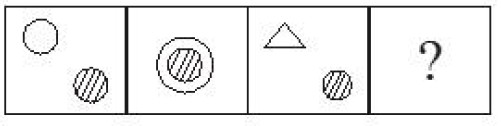
Answer figures: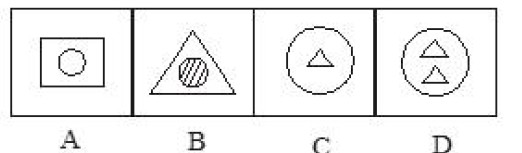
To solve this problem, we need to identify the pattern in the given series of figures and determine which option logically follows as the next figure.
Correct Option: C) The figure with a triangle inside a circle.
\( \frac{3.8}{1.25} \) written as a pure decimal, will be
The question asks us to express the fraction \(\frac{3.8}{1.25}\) as a pure decimal. To solve this, we need to divide the numerator by the denominator. We can simplify the calculation by converting the decimal numbers into whole numbers and then performing the division. The resulting decimal value will be the correct answer.
Identify the given expression:
\[ \frac{3.8}{1.25} \]We need to convert this expression into its decimal form.
Convert the decimal division into whole-number division:
To remove the decimal points, multiply both the numerator and denominator by 100.
\[ \frac{3.8}{1.25} =\frac{3.8\times100}{1.25\times100} \] \[ =\frac{380}{125} \]This makes the division easier to perform.
Simplify the fraction:
Both 380 and 125 are divisible by 5.
\[ \frac{380}{125} =\frac{380\div5}{125\div5} \] \[ =\frac{76}{25} \]Convert the simplified fraction into a decimal:
Multiply both the numerator and denominator by 4 to make the denominator 100.
\[ \frac{76}{25} =\frac{76\times4}{25\times4} \] \[ =\frac{304}{100} \]Calculate the decimal value:
\[ \frac{304}{100}=3.04 \]Therefore, the decimal form of the given expression is 3.04.
Verify the result using multiplication:
Multiply the obtained answer by the original denominator.
\[ 3.04\times1.25 \] \[ =3.04\times\frac{5}{4} \] \[ =\frac{15.20}{4} \] \[ =3.8 \]Since the product equals the original numerator, the answer is correct.
Correct Option: B) 3.04 — By simplifying the given expression, we obtain \(\frac{3.8}{1.25}=\frac{380}{125}=\frac{76}{25}=\frac{304}{100}=3.04\). Therefore, Option B is the correct answer.
A) 3.14: This is incorrect because multiplying 3.14 by 1.25 gives 3.925, not 3.8. Therefore, 3.14 is not the correct quotient.
C) 3.06: This is incorrect because multiplying 3.06 by 1.25 gives 3.825, which is greater than the original numerator, 3.8. Therefore, this value does not satisfy the given division.
D) 3.08: This is incorrect because multiplying 3.08 by 1.25 gives 3.85, not 3.8. Hence, 3.08 is not the correct decimal value.