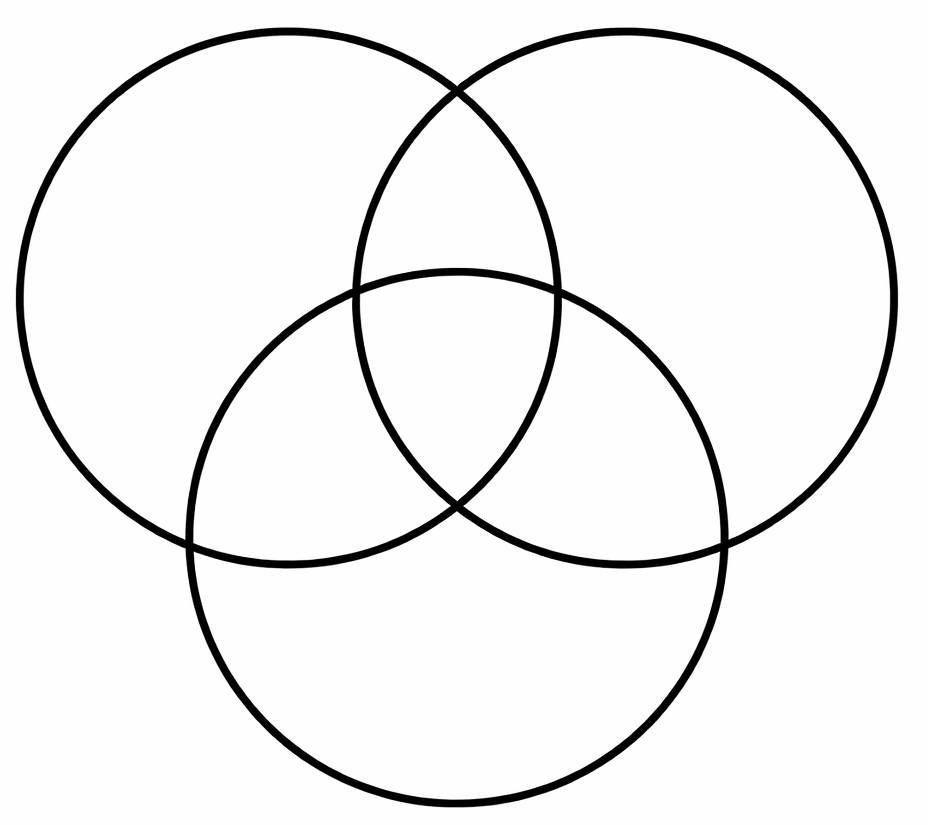
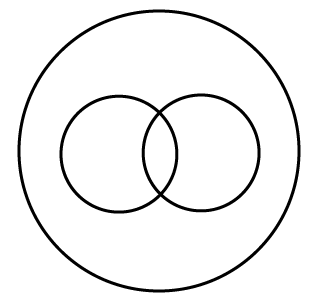
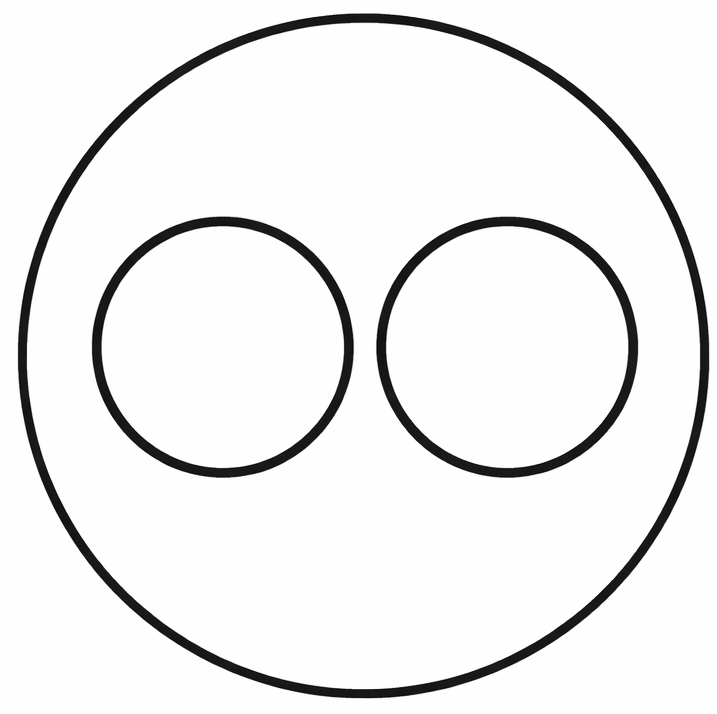
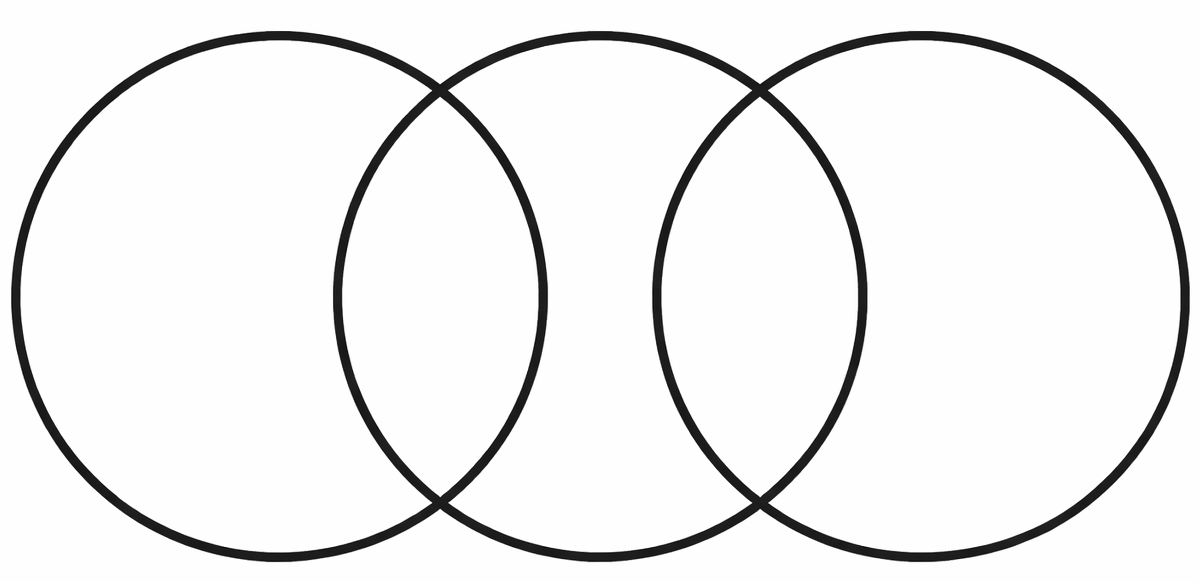
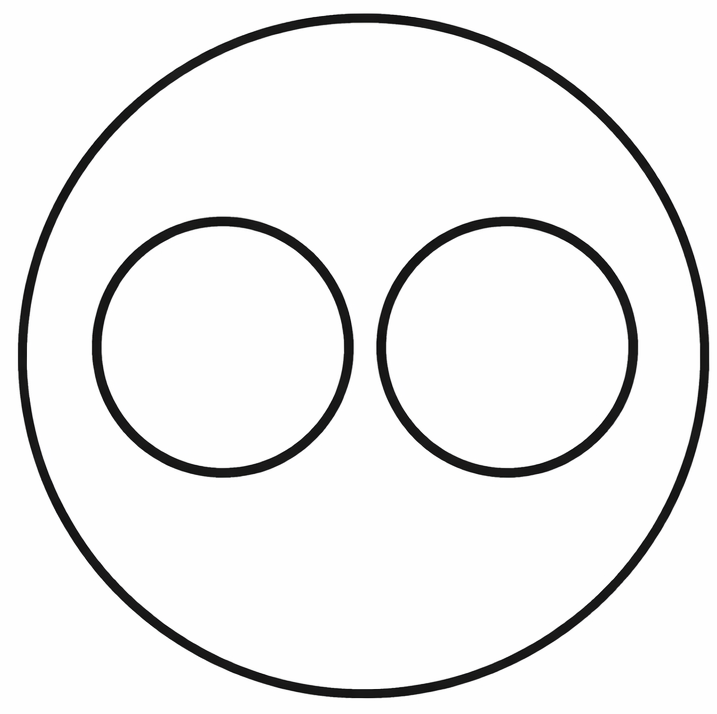
Choose the best suitable Venn diagram for the following words:
“Amphibians, Alligator, Tortoise”
To determine the best Venn diagram for the words "Amphibians, Alligator, Tortoise," we need to understand the relationships between these categories.
The diagram in Option C shows two circles within a larger circle. The two inner circles represent "Alligator" and "Tortoise," both within the larger circle representing "Reptiles," which is distinct from "Amphibians." This matches the relationships described.
Correct Option: C) Two separate circles inside a larger circle, distinct from another.
This problem involves setting up and solving a system of linear equations based on the given conditions about the ages of two persons. We will use variables to represent their present ages and form equations from the two statements provided. The key insight is that the difference in ages remains constant over time.
Let the present ages of the two persons be \(x\) and \(y\), where \(x > y\) (so \(x\) is the elder person's age).
Formulate the first equation from the first condition:
The sum of their present ages is seven times the difference between their ages.
\[ x + y = 7(x - y) \]\[ x + y = 7x - 7y \]\[ 8y = 6x \]\[ 4y = 3x \quad \text{(Equation 1)} \]Or, we can write \( y = \frac{3}{4}x \).
Formulate the second equation from the second condition:
After 5 years, their ages will be \(x+5\) and \(y+5\). The sum of their ages will be \((x+5) + (y+5) = x+y+10\).
The difference between their ages will still be \( (x+5) - (y+5) = x - y \). This is a crucial point: the difference in ages remains constant.
The condition states that the sum of their ages after 5 years will be nine times the difference.
\[ (x+5) + (y+5) = 9(x - y) \]\[ x + y + 10 = 9(x - y) \quad \text{(Equation 2)} \]
Substitute Equation 1 into Equation 2:
From Equation 1, we know \( x - y = \frac{x+y}{7} \). Let's use this in Equation 2.
Alternatively, we can express \(y\) in terms of \(x\) from Equation 1: \(y = \frac{3}{4}x\).
Substitute \(y = \frac{3}{4}x\) into Equation 2:
\[ x + \frac{3}{4}x + 10 = 9(x - \frac{3}{4}x) \]\[ \frac{4x+3x}{4} + 10 = 9(\frac{4x-3x}{4}) \]\[ \frac{7x}{4} + 10 = 9(\frac{x}{4}) \]\[ \frac{7x}{4} + 10 = \frac{9x}{4} \]
Solve for \(x\):
\[ 10 = \frac{9x}{4} - \frac{7x}{4} \]\[ 10 = \frac{2x}{4} \]\[ 10 = \frac{x}{2} \]\[ x = 20 \]
Find \(y\) (optional, but good for verification):
Using \(y = \frac{3}{4}x\):
\[ y = \frac{3}{4} \times 20 \]\[ y = 15 \]
So, the present ages are 20 years and 15 years. The elder person's age is 20 years.
Verify the conditions:
Present: Sum \(20+15=35\). Difference \(20-15=5\). \(35 = 7 \times 5\). (Condition 1 satisfied)
After 5 years: Ages \(25\) and \(20\). Sum \(25+20=45\). Difference \(25-20=5\). \(45 = 9 \times 5\). (Condition 2 satisfied)
D) 20 years. The present age of the elder person is 20 years.
The question asks to identify the specific upward force exerted by water on an object submerged or floating in it. This phenomenon is a fundamental concept in fluid mechanics, specifically related to buoyancy.
Correct Option: B) Buoyant Force — The buoyant force is the upward force exerted by a fluid that opposes the weight of an immersed object. It is a direct consequence of the pressure difference in a fluid at different depths.
What happens to the volume (V) of the cuboid, if its length is doubled, height is doubled and breadth is kept the same?
To determine the change in the volume of a cuboid, we need to understand the formula for the volume of a cuboid and then apply the given changes to its dimensions (length, breadth, and height).
Initial Volume: Let the original length, breadth, and height of the cuboid be \(l\), \(b\), and \(h\) respectively. The initial volume (\(V\)) of the cuboid is given by the formula:
\[ V = l \times b \times h \]Changes in Dimensions: According to the problem statement:
New Volume: Now, calculate the new volume (\(V'\)) using the new dimensions:
\[ V' = l' \times b' \times h' \]Substitute the new dimensions into the formula:
\[ V' = (2l) \times (b) \times (2h) \]Simplify and Compare: Rearrange the terms:
\[ V' = 2 \times 2 \times (l \times b \times h) \] \[ V' = 4 \times (l \times b \times h) \]Since \(V = l \times b \times h\), we can substitute \(V\) back into the equation:
\[ V' = 4V \]Thus, the new volume is 4 times the original volume.
Correct Option: C) 4V — When the length and height are doubled, and the breadth remains the same, the volume becomes 4 times the original volume, as derived from the formula \(V' = 4V\).
The question asks to identify the President of the Sahitya Akademi elected in 2018. This requires knowledge of the history and leadership of the Sahitya Akademi, specifically the election results for that particular year.
Correct Option: A) Chandrashekhar Kambar was elected as the President of the Sahitya Akademi in 2018. He is a prominent figure in Kannada literature and was awarded the Jnanpith Award in 2010.
After India’s 29th state, Telangana, was created, which of the following parties formed the first government in the state?
Telangana Rashtra Samithi (TRS)
Telangana Rajya Samithi (TRS)
Telangana Loka Samithi (TLS)
Telangana Maha Samithi (TMS)
The question asks to identify the political party that formed the first government in Telangana after its formation as India's 29th state. This requires knowledge of the political landscape and key events surrounding the creation of Telangana.
A) Telangana Rashtra Samithi (TRS) – This party spearheaded the movement for a separate Telangana state and won the first assembly elections held in April 2014, subsequently forming the first government with K. Chandrashekar Rao as its Chief Minister.
The problem asks us to determine if the given statements are sufficient to find the total number of oil cans loaded in 8 trolleys. We need to evaluate each statement individually and then combined.
Let's re-interpret Statement 1 to make sense in context with Statement 2. A more reasonable interpretation of Statement 1 is that for some trolleys, only 2 cans can fit in each.
If we combine the statements:
This still doesn't specify how many trolleys are of the "2 cans" type and how many are of the "4 cans" type. For example, if 1 trolley has 2 cans, then \(8-1=7\) trolleys have 4 cans each. Total cans would be \(1 \times 2 + 7 \times 4 = 2 + 28 = 30\).
However, if 2 trolleys have 2 cans each, then \(8-2=6\) trolleys have 4 cans each. Total cans would be \(2 \times 2 + 6 \times 4 = 4 + 24 = 28\).
Since the problem states "All of the trolleys have been filled with oil cans of two different sizes and shapes," and then provides two statements about how many cans fit, it's highly probable that the intent was:
Let's assume the most logical interpretation for a data sufficiency question:
Under this interpretation:
With this interpretation, both statements together are sufficient to answer the question.
If we strictly interpret Statement 1 as "the shape of 8 cans are such that in one trolley only 2 can fit", it's still ambiguous. However, in data sufficiency questions, we often need to find the most reasonable interpretation that leads to sufficiency. The phrasing "8 cans are such that in one trolley only 2 can fit" could mean that these 8 cans are of a specific type, and they are distributed among some trolleys, with 2 cans per trolley. This would imply 4 trolleys are used for these 8 cans. Then Statement 2 would apply to the remaining 4 trolleys.
Given the options, the question expects us to find a scenario where the statements, when combined, provide a definitive answer. The most plausible interpretation is that Statement 1 describes the filling of a certain number of trolleys, and Statement 2 describes the filling of the remaining trolleys.
C) Statement 1 and 2 together are sufficient
To calculate the concentration of a solution in terms of mass by mass percentage, we need to find the ratio of the mass of the solute to the total mass of the solution, and then multiply by 100. The total mass of the solution is the sum of the mass of the solute and the mass of the solvent.
The total mass of the solution is the sum of the mass of the solute and the mass of the solvent.
\[ \text{Mass of solution} = \text{Mass of solute} + \text{Mass of solvent} \]\[ \text{Mass of solution} = 42 \text{ g} + 320 \text{ g} \]\[ \text{Mass of solution} = 362 \text{ g} \]The formula for mass by mass percentage is:
\[ \text{Mass by mass percentage} = \frac{\text{Mass of solute}}{\text{Mass of solution}} \times 100 \]\[ \text{Mass by mass percentage} = \frac{42 \text{ g}}{362 \text{ g}} \times 100 \]\[ \text{Mass by mass percentage} \approx 0.11602 \times 100 \]\[ \text{Mass by mass percentage} \approx 11.602 \% \]Rounding to one decimal place, the concentration is \(11.6 \%\).
Correct Option: C) 11.6 % — This is the correct calculation for mass by mass percentage.
To determine the general formula for alkynes, we need to recall the definitions and general formulas for different types of hydrocarbons: alkanes, alkenes, and alkynes. These are homologous series with specific patterns for the number of hydrogen atoms relative to the number of carbon atoms.
Correct Option: B) \( \text{C}_n\text{H}_{2n-2} \)
To find the number of moles of carbon dioxide, we need to use the formula relating mass, molar mass, and moles. First, calculate the molar mass of carbon dioxide (CO₂) using the atomic masses of carbon and oxygen. Then, divide the given mass of carbon dioxide by its molar mass.
Carbon dioxide (CO₂) consists of one carbon atom and two oxygen atoms.
\[ \text{Molar mass of CO}_2 = (\text{Atomic mass of C}) + 2 \times (\text{Atomic mass of O}) \] \[ \text{Molar mass of CO}_2 = 12 \, \text{g/mol} + 2 \times (16 \, \text{g/mol}) \] \[ \text{Molar mass of CO}_2 = 12 \, \text{g/mol} + 32 \, \text{g/mol} \] \[ \text{Molar mass of CO}_2 = 44 \, \text{g/mol} \]The number of moles can be calculated using the formula:
\[ \text{Number of moles} = \frac{\text{Given mass}}{\text{Molar mass}} \]Given mass of carbon dioxide \(= 220 \, \text{g}\)
\[ \text{Number of moles} = \frac{220 \, \text{g}}{44 \, \text{g/mol}} \] \[ \text{Number of moles} = 5 \, \text{mol} \]Correct Option: A) 5
The calculation shows that 220 g of carbon dioxide contains 5 moles.