
This problem involves concepts of speed, distance, and time. We are given the total distance, the change in speed, and the corresponding change in travel time. We need to find the original duration of the flight. We can set up an equation relating the original time and the new time using the formula \(\text{Time} = \frac{\text{Distance}}{\text{Speed}}\).
Let the original average speed of the flight be \(S\) km/hr and the original duration of the flight be \(T\) hours.
The total distance covered is 1200 km. Using the formula \(\text{Distance} = \text{Speed} \times \text{Time}\), we have:
\[ 1200 = S \times T \quad \text{(Equation 1)} \]Due to an additive tailwind, the speed increases by 120 km/hr. So, the new speed is \((S + 120)\) km/hr.
The travel time is reduced by 30 minutes. Since 30 minutes is \(\frac{30}{60} = 0.5\) hours, the new duration of the flight is \((T - 0.5)\) hours.
Using the same distance formula for the new conditions:
\[ 1200 = (S + 120) \times (T - 0.5) \quad \text{(Equation 2)} \]From Equation 1, we can express \(S\) in terms of \(T\):
\[ S = \frac{1200}{T} \]Substitute this expression for \(S\) into Equation 2:
\[ 1200 = \left(\frac{1200}{T} + 120\right) \times (T - 0.5) \]Expand the right side of the equation:
\[ 1200 = \frac{1200}{T} \times T - \frac{1200}{T} \times 0.5 + 120 \times T - 120 \times 0.5 \]\[ 1200 = 1200 - \frac{600}{T} + 120T - 60 \]Simplify the equation:
\[ 0 = - \frac{600}{T} + 120T - 60 \]Multiply the entire equation by \(T\) to eliminate the denominator:
\[ 0 = -600 + 120T^2 - 60T \]Rearrange the terms to form a quadratic equation:
\[ 120T^2 - 60T - 600 = 0 \]Divide the entire equation by 60 to simplify:
\[ 2T^2 - T - 10 = 0 \]Solve the quadratic equation for \(T\) using factorization or the quadratic formula. By factorization:
We need two numbers that multiply to \(2 \times -10 = -20\) and add up to -1. These numbers are -5 and 4.
\[ 2T^2 - 5T + 4T - 10 = 0 \]\[ T(2T - 5) + 2(2T - 5) = 0 \]\[ (T + 2)(2T - 5) = 0 \]This gives two possible values for \(T\): \(T = -2\) or \(T = \frac{5}{2} = 2.5\).
Since time cannot be negative, we take the positive value:
\[ T = 2.5 \text{ hours} \]The question asks for the duration of the flight, which refers to the original duration. So, the original duration was 2.5 hours.
Let's re-read the question carefully: "What was the duration of the flight in hours?" This usually refers to the original duration unless specified otherwise. However, sometimes it can refer to the new duration. Let's check the options based on the original duration first.
If \(T = 2.5\) hours, then the original speed \(S = \frac{1200}{2.5} = 480\) km/hr.
New speed \(= 480 + 120 = 600\) km/hr.
New time \(= \frac{1200}{600} = 2\) hours.
The reduction in time is \(2.5 - 2 = 0.5\) hours (30 minutes), which matches the problem statement.
The question asks for "the duration of the flight in hours". Given the options, it is asking for the new duration of the flight, which is 2 hours.
D) 2 hours
The original duration was 2.5 hours. The new duration, after reducing travel time by 30 minutes (0.5 hours), is \(2.5 - 0.5 = 2\) hours. This matches option D.
A) 2.2 hours — This value does not fit the conditions. If the new duration was 2.2 hours, the original duration would be 2.7 hours, and the speed calculations would not align with the given speed increase.
B) 1.9 hours — This value does not fit the conditions. If the new duration was 1.9 hours, the original duration would be 2.4 hours, and the speed calculations would not align with the given speed increase.
C) 1.8 hours — This value does not fit the conditions. If the new duration was 1.8 hours, the original duration would be 2.3 hours, and the speed calculations would not align with the given speed increase.
To find the total rotation of the minute hand, we need to calculate the total duration from 2 am to 9 pm. Then, we will use the fact that the minute hand completes a full circle (360°) in 60 minutes (1 hour) to determine the total degrees rotated.
Calculate the total time duration:
From 2 am to 12 pm (noon) is \(12 - 2 = 10\) hours.
From 12 pm to 9 pm is \(9\) hours.
Total duration \(= 10 \text{ hours} + 9 \text{ hours} = 19 \text{ hours}\).
Convert total duration to minutes:
Since 1 hour = 60 minutes,
Total duration in minutes \(= 19 \text{ hours} \times 60 \text{ minutes/hour} = 1140 \text{ minutes}\).
Calculate the rotation of the minute hand:
The minute hand completes one full rotation (360°) in 60 minutes.
Rotation per minute \[= \frac{360^\circ}{60 \text{ minutes}} = 6^\circ/\text{minute}\].
Total rotation \(= \text{Total duration in minutes} \times \text{Rotation per minute}\)
Total rotation \(= 1140 \text{ minutes} \times 6^\circ/\text{minute}\)
Total rotation \(= 6840^\circ\).
B) The total rotation of the minute hand from 2 am to 9 pm is 6840°.
Simplify the following expression:
\(\left(\frac{3}{11}\times\frac{33}{6}\right)-\left(\frac{9}{4}\times\frac{12}{3}\right)+\left(\frac{5}{11}\times\frac{22}{10}\right)\)
\( \frac{-9}{2} \)
\( \frac{-13}{2} \)
\( \frac{13}{2} \)
\( \frac{9}{2} \)
To simplify the given expression, we will evaluate each term separately by performing the multiplications and then combine the results through addition and subtraction. We will use the rules of fraction multiplication and simplification.
We can simplify by canceling common factors:
\[ \frac{3}{11} \times \frac{33}{6} = \frac{3}{1} \times \frac{3}{6} = \frac{1}{1} \times \frac{3}{2} = \frac{3}{2} \]We can simplify by canceling common factors:
\[ \frac{9}{4} \times \frac{12}{3} = \frac{9}{1} \times \frac{3}{3} = \frac{9}{1} \times \frac{1}{1} = 9 \]Alternatively:
\[ \frac{9}{4} \times \frac{12}{3} = \frac{9 \times 12}{4 \times 3} = \frac{108}{12} = 9 \]We can simplify by canceling common factors:
\[ \frac{5}{11} \times \frac{22}{10} = \frac{1}{1} \times \frac{2}{2} = 1 \]Substitute the simplified values back into the original expression:
\[ \frac{3}{2} - 9 + 1 \]First, perform the subtraction:
\[ \frac{3}{2} - 9 = \frac{3}{2} - \frac{18}{2} = \frac{3 - 18}{2} = \frac{-15}{2} \]Now, perform the addition:
\[ \frac{-15}{2} + 1 = \frac{-15}{2} + \frac{2}{2} = \frac{-15 + 2}{2} = \frac{-13}{2} \]Correct Option: B) \( \frac{-13}{2} \)
To calculate the total earning (compound interest) over two years with variable interest rates, we need to calculate the amount after the first year and then use that as the principal for the second year. The total earning will be the final amount minus the initial principal.
Calculate the amount after the first year:
The principal for the first year is \(P = \text{Rs } 18,750\).
The rate of interest for the first year is \(R_1 = 4\%\).
The interest for the first year is:
\[ I_1 = P \times \frac{R_1}{100} = 18750 \times \frac{4}{100} = 18750 \times 0.04 = \text{Rs } 750 \]The amount after the first year is:
\[ A_1 = P + I_1 = 18750 + 750 = \text{Rs } 19,500 \]Calculate the amount after the second year:
The principal for the second year is \(A_1 = \text{Rs } 19,500\).
The rate of interest for the second year is \(R_2 = 8\%\).
The interest for the second year is:
\[ I_2 = A_1 \times \frac{R_2}{100} = 19500 \times \frac{8}{100} = 19500 \times 0.08 = \text{Rs } 1560 \]The amount after the second year is:
\[ A_2 = A_1 + I_2 = 19500 + 1560 = \text{Rs } 21,060 \]Calculate the total earning (compound interest):
The total earning is the difference between the final amount and the initial principal.
\[ \text{Total Earning} = A_2 - P = 21060 - 18750 = \text{Rs } 2310 \]D) 2,310 is the total earning after 2 years.
The question asks to identify the halogen that is a purple-coloured solid. This requires knowledge of the physical properties, specifically the colour and state, of common halogens.
Correct Option: D) Iodine is a dark grey/purple-black solid at room temperature and sublimes to form a purple vapour. Its solid form can appear purple.
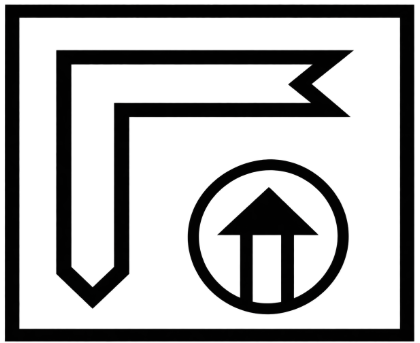
The mirror image of the above figure is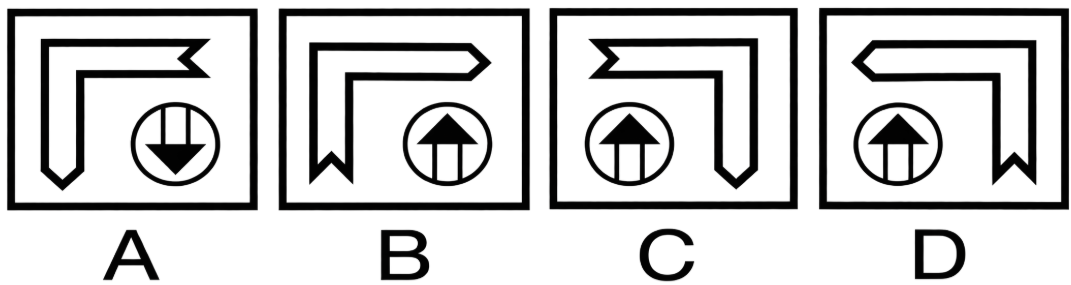
To find the mirror image of a figure, we need to reverse the orientation of its elements horizontally. This involves flipping the figure along a vertical axis.
Correct Option: A) The figure is correctly mirrored, with the geometric shape and arrow orientation reversed.
Find the energy possessed by an object of mass 10 kg when it is at a height of 8 m above the ground. (Given g = 9.8 ms−2)
The problem asks for the energy possessed by an object at a certain height above the ground. This energy is gravitational potential energy, which depends on the object's mass, the acceleration due to gravity, and its height.
The gravitational potential energy (\(PE\)) of an object is given by the formula:
\[ PE = mgh \]Substitute the values of \(m\), \(g\), and \(h\) into the potential energy formula:
\[ PE = (10 \text{ kg}) \times (9.8 \text{ m/s}^2) \times (8 \text{ m}) \]Perform the multiplication:
\[ PE = 10 \times 9.8 \times 8 \]\[ PE = 98 \times 8 \]\[ PE = 784 \text{ J} \]The unit of energy is Joules (\(J\)).
A) The calculated potential energy is \(784 \text{ J}\).
To find the Least Common Multiple (LCM) of a set of numbers, we first find the prime factorization of each number. Then, for each prime factor, we take the highest power that appears in any of the factorizations. The product of these highest powers will be the LCM.
Correct Option: C) 7200
For which film did Noor Islam win the ‘Best Child Artist’ award at the 64th National Film Awards 2017?
Kunju Daivam
Railway Children
Sahaj Paather Gappo
Dhanak
The question asks to identify the film for which Noor Islam received the 'Best Child Artist' award at the 64th National Film Awards in 2017. This requires knowledge of the award recipients for that specific year and category.
Correct Option: C) Sahaj Paather Gappo
Simplify the following expression:
\(\left(\frac{3}{2}\times\frac{1}{6}\right)+\left(\frac{5}{3}\times\frac{7}{2}\right)-\left(\frac{13}{4}\times\frac{4}{3}\right)\) =?
\( \frac{12}{21} \)
\( \frac{21}{12} \)
\( \frac{36}{12} \)
\( \frac{41}{12} \)
To simplify the given expression, we will follow the order of operations (PEMDAS/BODMAS). First, we will perform all multiplications, and then we will perform the additions and subtractions from left to right. We will find a common denominator to combine the fractions.
Simplify the first term:
\[ \left(\frac{3}{2}\times\frac{1}{6}\right) = \frac{3 \times 1}{2 \times 6} = \frac{3}{12} = \frac{1}{4} \]Simplify the second term:
\[ \left(\frac{5}{3}\times\frac{7}{2}\right) = \frac{5 \times 7}{3 \times 2} = \frac{35}{6} \]Simplify the third term:
\[ \left(\frac{13}{4}\times\frac{4}{3}\right) = \frac{13 \times 4}{4 \times 3} = \frac{52}{12} = \frac{13}{3} \]Substitute the simplified terms back into the original expression:
\[ \frac{1}{4} + \frac{35}{6} - \frac{13}{3} \]Find a common denominator for 4, 6, and 3. The least common multiple (LCM) of 4, 6, and 3 is 12.
Convert each fraction to have a denominator of 12:
Perform the addition and subtraction:
\[ \frac{3}{12} + \frac{70}{12} - \frac{52}{12} = \frac{3 + 70 - 52}{12} = \frac{73 - 52}{12} = \frac{21}{12} \]Correct Option: B) \( \frac{21}{12} \)