
From the option figures, select the one that is related to question figure c in the same way as question figure b is related to question figure a.
Question figure: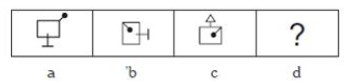
Option figure: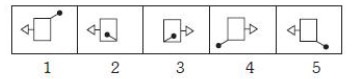
The question involves identifying a pattern or relationship between figures. We need to determine how figure 'b' is related to figure 'a', and then apply the same relationship to figure 'c' to find the correct option for figure 'd'.
Correct Option: A) Option 5
This is a statement and conclusion type of question. We need to evaluate each conclusion based solely on the information provided in the statement. No outside knowledge or assumptions should be used unless explicitly implied by the statement.
A) Only conclusion II follows.
Conclusion II directly follows from the statement that child labour is a "punishable crime." For something to be a punishable crime, there must be a law or ban against it, typically issued by the government.
This question asks us to evaluate the strength of two arguments regarding China's defense spending. We need to determine which argument presents a universally accepted or logically sound reason.
Correct Option: A) Only argument 1 is strong
Argument 1 is strong because national security and the safety of a country are universally recognized as the top priorities for any government. Defense spending is a direct means to achieve this.
The question asks to identify the biggest tax reform in India since independence. This requires knowledge of major tax reforms and their impact on the Indian economy and tax structure.
A) Goods and Services Tax (GST) is widely regarded as the biggest tax reform in India since independence. It subsumed a large number of central and state indirect taxes (like excise duty, service tax, VAT, etc.) into a single, unified tax system. This move aimed to create a common national market, reduce the cascading effect of taxes, and simplify tax administration, making it a transformative change for the Indian economy.
The problem asks us to calculate the work done in moving an electric charge between two points with a given potential difference. We can use the fundamental relationship between work done, charge, and potential difference.
The work done (\(W\)) in moving a charge (\(Q\)) across a potential difference (\(V\)) is given by the formula:
\[ W = Q \times V \]The unit of work done is Joules (J).
A) 48 J is the correct answer, as calculated using the formula \(W = Q \times V\).
To determine the chemical formula of Ammonium phosphate, we need to identify the ions involved and their respective charges. Then, we apply the criss-cross method or balance the charges to ensure the compound is electrically neutral.
For the compound to be neutral, the total positive charge must equal the total negative charge.
To balance the -3 charge of one phosphate ion, we need three ammonium ions (since each provides a +1 charge, \(3 \times (+1) = +3\)).
When there is more than one polyatomic ion, it is enclosed in parentheses. So, three ammonium ions are written as \(\text{(NH}_4)_3\).
Combining the ions, the formula becomes \(\text{(NH}_4)_3\text{PO}_4\).
A) \(\text{(NH}_4)_3\text{PO}_4\) is the correct chemical formula for Ammonium phosphate, as it correctly balances the charges of three ammonium ions (\(+3\)) and one phosphate ion (\(-3\)).
The question asks about the contents of a carpel, which is the female reproductive organ of a flower. To answer this, we need to recall the basic structure of a flower and the specific parts of the carpel.
D) Ovules — The carpel (or pistil) is the female reproductive organ of a flower, and its basal swollen part is the ovary, which contains the ovules. Ovules are structures that develop into seeds after fertilization.
The question asks to identify the type of tissue that xylem is. We need to recall the classification of plant tissues, specifically permanent tissues, to determine the correct answer.
Correct Option: B) Xylem is a complex permanent tissue because it is composed of more than one type of cell (tracheids, vessels, xylem parenchyma, and xylem fibres) that work together to perform the function of water and mineral transport.
The question asks to identify the specific tube in the male reproductive system that transports sperm from the epididymis to the seminal vesicles. Understanding the anatomy and function of each part of the male reproductive system is key to answering this question.
C) Vas deferens is the correct answer. It is a straight tube, about 40 cm long, that carries sperms from the epididymis to the ejaculatory duct, where they meet secretions from the seminal vesicles.
The question asks to identify the part of the inner ear responsible for converting pressure variations into electrical signals. This involves understanding the basic anatomy and function of the human ear, particularly the role of different structures in the process of hearing.
Based on this process, the cochlea is the structure responsible for converting the pressure variations (fluid movements) into electrical signals.
A) Cochlea — The cochlea is the primary auditory organ in the inner ear. It contains the Organ of Corti, which houses hair cells. These hair cells are responsible for transducing the mechanical vibrations (pressure variations in the fluid) into electrical nerve impulses that are sent to the brain for sound perception. Therefore, it directly converts pressure variations into electrical signals.