
To solve this problem, we need to follow the order of operations, often remembered by the acronym BODMAS/PEMDAS (Brackets/Parentheses, Orders/Exponents, Division and Multiplication (from left to right), Addition and Subtraction (from left to right)). We will simplify each bracketed term first, then perform division and multiplication, and finally addition and subtraction.
First, evaluate the innermost parenthesis:
\[ 25 - 33 = -8 \]Now substitute this back into the first curly bracket:
\[ 20 - (-8) = 20 + 8 = 28 \]First, perform the multiplication:
\[ -5 \times 4 = -20 \]Now substitute this back into the second curly bracket:
\[ -20 - (-6) = -20 + 6 = -14 \]The original expression was: \(\{20 – (25 – 33)\} \div \{–5 \times 4 – (–6)\} + 56 \div (–27 + 13)\)
Substituting the simplified values:
\[ 28 \div (-14) + 56 \div (-14) \]D) The final calculated value is -6.
The question asks to identify the Indian state where Durga Puja is the main festival. This is a general knowledge question related to Indian culture and festivals.
B) West Bengal: Durga Puja is the biggest and most important festival in West Bengal. It is celebrated with immense enthusiasm, elaborate pandals (temporary structures), intricate idols of Goddess Durga, cultural performances, and community gatherings. It is a five-day annual Hindu festival that reveres the Goddess Durga and is widely celebrated across the state, often considered a significant cultural event that transcends religious boundaries.
This question tests the ability to evaluate the strength of arguments related to a given statement. A strong argument should directly support or refute the statement with a logical and significant reason, while a weak argument might be irrelevant, based on a trivial aspect, or simply an excuse.
A) Only argument I is strong. Argument I directly supports the statement by highlighting the positive impact of strict penalties on accident reduction, which is a valid and strong reason. Argument II, focusing on implementation difficulty, is not a strong counter-argument against the necessity of the penalty.
This is an analogy question where we need to find the relationship between the first pair of words and apply the same relationship to the second pair. The relationship between "Car" and "Tyre" needs to be identified first.
Correct Option: D) Legs
Select the option that will complete the following series of question figure:
Question Figure: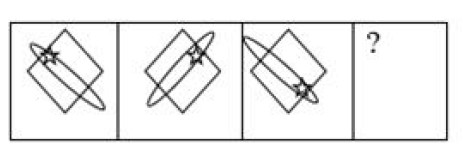
Option Figures: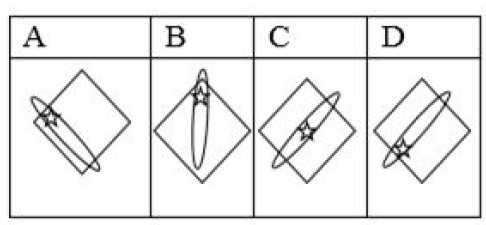
The problem involves identifying the pattern in a series of figures and selecting the option that completes the series.
Correct Option: D) In option D, the ellipse is vertical, and the star is at a different corner, matching the expected pattern.
This is a logical reasoning question where we need to determine which conclusions can be definitively drawn from the given statement. We must stick strictly to the information provided in the statement and avoid making assumptions.
B) Neither 1 nor 2 follows. The statement only indicates that Mr. X gets good thoughts in the morning. It does not exclude the possibility of him getting thoughts (good or otherwise) at other times of the day, nor does it state that mornings are the exclusive time for his thoughts.
The question asks to identify an alkali metal from the given options. To answer this, one needs to recall the classification of elements in the periodic table, specifically which groups constitute alkali metals.
Correct Option: A) Sodium is an alkali metal. It belongs to Group 1 of the periodic table, characterized by having one valence electron and high reactivity.
If \(\sqrt{45}\) + \(\sqrt{20}\) = 11.180 find the value of \(\sqrt{180}\) + 4\(\sqrt{5}\).
The problem provides the value of an expression involving square roots and asks for the value of another expression. The key is to simplify the square roots in both expressions to identify a common term or relationship. By expressing all square roots in terms of \(\sqrt{5}\), we can use the given information to find the required value.
The given expression is \(\sqrt{45} + \sqrt{20} = 11.180\).
Simplify each term:
Substitute these simplified terms back into the given equation:
\[ 3\sqrt{5} + 2\sqrt{5} = 11.180 \]\[ 5\sqrt{5} = 11.180 \]The expression we need to find the value of is \(\sqrt{180} + 4\sqrt{5}\).
Simplify \(\sqrt{180}\):
Substitute this into the expression:
\[ 6\sqrt{5} + 4\sqrt{5} \]\[ 10\sqrt{5} \]From step 1, we know that \(5\sqrt{5} = 11.180\).
We need to find the value of \(10\sqrt{5}\).
Notice that \(10\sqrt{5}\) is exactly twice \(5\sqrt{5}\).
\[ 10\sqrt{5} = 2 \times (5\sqrt{5}) \]\[ 10\sqrt{5} = 2 \times 11.180 \]\[ 10\sqrt{5} = 22.360 \]Correct Option: A) 22.360
The value of \(\sqrt{180} + 4\sqrt{5}\) is \(22.360\).
This problem requires the application of Newton's Second Law of Motion, which states that the force acting on an object is equal to the product of its mass and acceleration. We are given the mass and acceleration, and we need to calculate the force.
The formula for force (\(F\)) is given by:
\[ F = m \times a \]The standard unit for force in the International System of Units (SI) is the Newton (N), which is equivalent to \(\text{kg} \cdot \text{m}/\text{s}^2\).
Correct Option: A) 200 N is the correct answer because it represents the calculated force with the appropriate unit.
To find the Least Common Multiple (LCM) of two numbers, we can use the prime factorization method. This involves expressing each number as a product of its prime factors, then taking the highest power of all prime factors present in either number.
The calculated LCM is 540, which matches option C.
C) \(6 \times 10 \times 9\)
This option evaluates to \(6 \times 10 \times 9 = 60 \times 9 = 540\), which is the correct LCM of 60 and 54.