
This question tests knowledge about the chemical properties of white phosphorus, specifically its reactivity and how it is safely stored. White phosphorus is highly reactive and spontaneously ignites in air, so it must be stored in a medium that prevents its exposure to oxygen.
Correct Option: D) Water
This problem involves calculating the total number of elements in a group using the concept of means. We are given the mean of a subset of numbers, the mean of the remaining numbers, and the mean of all numbers combined. We can set up equations based on the definition of the mean (sum of numbers divided by count) and solve for the unknown total count.
Let \(N\) be the total number of numbers in the group.
Let \(S_{\text{total}}\) be the sum of all \(N\) numbers.
We are given that the mean of all numbers is 20. So, we can write:
\[ \frac{S_{\text{total}}}{N} = 20 \]\[ S_{\text{total}} = 20N \quad \text{(Equation 1)} \]We are given that the mean of the 8 smallest numbers is 17.
Let \(S_8\) be the sum of these 8 smallest numbers. Then:
\[ \frac{S_8}{8} = 17 \]\[ S_8 = 17 \times 8 = 136 \quad \text{(Equation 2)} \]The remaining numbers in the group are \(N - 8\).
The sum of these remaining numbers will be \(S_{\text{total}} - S_8\).
We are given that the mean of the numbers leaving the smallest eight out (i.e., the remaining \(N-8\) numbers) is 22. So, we can write:
\[ \frac{S_{\text{total}} - S_8}{N - 8} = 22 \]\[ S_{\text{total}} - S_8 = 22(N - 8) \quad \text{(Equation 3)} \]Now, substitute Equation 1 and Equation 2 into Equation 3:
\[ 20N - 136 = 22(N - 8) \]Expand the right side of the equation:
\[ 20N - 136 = 22N - 22 \times 8 \]\[ 20N - 136 = 22N - 176 \]Rearrange the terms to solve for \(N\):
\[ 176 - 136 = 22N - 20N \]\[ 40 = 2N \]\[ N = \frac{40}{2} \]\[ N = 20 \]Therefore, there were 20 numbers present in the group in all.
B) 20 — The calculations show that the total number of elements in the group is 20.
How many rectangles are there in this figure?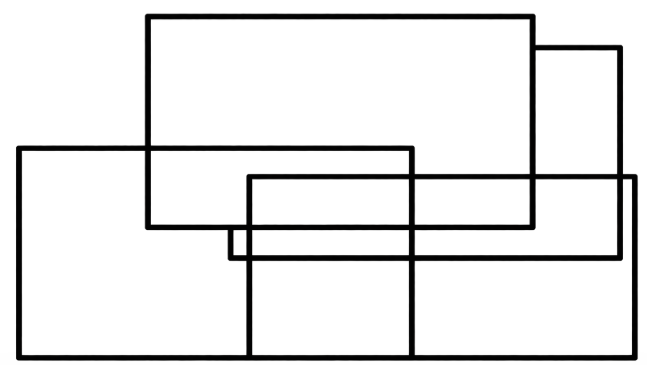
To determine the total number of rectangles in the given figure, we need to count all possible rectangles formed by the intersecting lines.
Correct Option: B) 14
The problem asks for the actual amount spent on procuring gold. We are given the total investment in raw material and the percentage of that raw material cost that was gold. We need to calculate this percentage of the total raw material cost.
Substituting the given values:
\[ \text{Amount spent on gold} = \frac{20}{100} \times 3,00,000 \]\[ \text{Amount spent on gold} = 0.20 \times 3,00,000 \]\[ \text{Amount spent on gold} = 60,000 \]Thus, the jeweller spent Rs 60,000 on procuring the gold.
D) 60,000 is the correct answer because it represents 20% of the raw material cost of Rs 3,00,000.
The problem asks us to complete a number series by finding the missing terms. To do this, we need to identify the pattern or rule governing the sequence of numbers. We will calculate the differences between consecutive terms to find a consistent pattern.
D) 52, 59 is the correct option because it follows the established pattern of alternating differences of +9 and +7.
The sum of the interior angles of a polygon is given by a standard formula involving the number of its sides. We will use this formula to find the number of sides.
The formula for the sum of the interior angles of a polygon with \(n\) sides is given by:
\[ \text{Sum of interior angles} = (n - 2) \times 180^\circ \]We are given that the sum of all interior angles of the polygon is \(1260^\circ\). So, we can set up the equation:
\[ (n - 2) \times 180^\circ = 1260^\circ \]Now, we need to solve for \(n\). Divide both sides by \(180^\circ\):
\[ n - 2 = \frac{1260}{180} \]Simplify the right side:
\[ n - 2 = 7 \]Add 2 to both sides to find \(n\):
\[ n = 7 + 2 \]\[ n = 9 \]Thus, the polygon has 9 sides.
Correct Option: D) 9
The question asks about the portfolio held by Smriti Irani as of May 2018. This requires knowledge of the Union Cabinet portfolios during that specific period.
Correct Option: A) Information and Broadcasting
As of May 2018, Smriti Irani was serving as the Union Minister for Information and Broadcasting. She held this portfolio from July 2017 until May 2018, when she was replaced by Rajyavardhan Singh Rathore. She also concurrently held the Ministry of Textiles during this period.
This is a work and time problem. We will use the concept of work rates. Let the rate of work for A be \(R_A\) (work per day) and for B be \(R_B\) (work per day). The total work is considered as 1 unit. We will set up equations based on the given information and solve for the individual rates, then calculate the time B takes to complete the work alone.
Define variables:
Let \(R_A\) be the rate at which A works (fraction of work per day).
Let \(R_B\) be the rate at which B works (fraction of work per day).
Formulate the first equation:
A and B together complete the task in 1.2 days. This means their combined rate is \(1/1.2\) work per day.
Formulate the second equation:
A completes half the job, and then B completes the rest. The total time taken is 2.5 days.
Time taken by A to complete half the job is \(\frac{0.5}{R_A}\).
Time taken by B to complete the other half of the job is \(\frac{0.5}{R_B}\).
So,
Solve the system of equations:
From Equation 2, we can write:
Substitute Equation 1 into the modified Equation 2:
\[ \frac{5}{6} = 5 R_A R_B \]\[ R_A R_B = \frac{5}{6 \times 5} = \frac{1}{6} \]Find individual rates:
We have \(R_A + R_B = \frac{5}{6}\) and \(R_A R_B = \frac{1}{6}\).
Consider a quadratic equation whose roots are \(R_A\) and \(R_B\):
Solve the quadratic equation:
Factor the quadratic equation:
The possible values for \(x\) are \(x = \frac{1}{3}\) or \(x = \frac{1}{2}\).
Assign rates based on efficiency:
We are given that B is more efficient than A. This means B has a higher work rate than A (\(R_B > R_A\)).
So, \(R_B = \frac{1}{2}\) work per day and \(R_A = \frac{1}{3}\) work per day.
Calculate time for B to complete the work alone:
Time taken by B alone to complete the work is \(\frac{1}{\text{Rate of B}}\).
Correct Option: C) 2.0
In a shopping mall, a handbag was sold for Rs 2,530 after giving a discount of P%. If the marked price of the handbag was Rs 4,600, find the value of P?
To find the percentage discount, we first need to calculate the actual discount amount given. The discount is the difference between the marked price and the selling price. Once we have the discount amount, we can express it as a percentage of the marked price.
The discount amount is the difference between the Marked Price and the Selling Price.
\[ \text{Discount Amount} = \text{MP} - \text{SP} \\ \text{Discount Amount} = 4600 - 2530 \\ \text{Discount Amount} = 2070 \text{ Rs} \]The discount percentage is calculated as the (Discount Amount / Marked Price) multiplied by 100.
\[ P = \left( \frac{\text{Discount Amount}}{\text{MP}} \right) \times 100 \\ P = \left( \frac{2070}{4600} \right) \times 100 \\ P = \left( \frac{207}{460} \right) \times 100 \\ P = \left( \frac{207}{46} \right) \times 10 \\ P = 4.5 \times 10 \\ P = 45 \]The value of P is 45.
B) 45 is the correct answer. The discount percentage P is 45%.
The question asks to identify the plant tissue where cells are loosely packed, leading to large intercellular spaces. This is a characteristic feature of a specific type of simple permanent tissue.
A) Parenchyma — Parenchyma cells are typically loosely packed, which results in the presence of large intercellular spaces between them. This arrangement facilitates gas exchange and storage functions.