
A constant force acts on an object of mass 5 kg for a period of 2 seconds. It increases the velocity of the object from 4 ms-1 to 7 ms-1. Find the amount of force applied.
To find the force applied, we need to use Newton's second law of motion, which states that force is equal to mass times acceleration (\(F = ma\)). First, we need to calculate the acceleration of the object using the given initial velocity, final velocity, and time period.
Identify the given values:
Calculate the acceleration (\(a\)):
Acceleration is the rate of change of velocity. The formula for acceleration is:
\[ a = \frac{v - u}{t} \]Substitute the values into the acceleration formula:
\[ a = \frac{7 \text{ m/s} - 4 \text{ m/s}}{2 \text{ s}} \]\[ a = \frac{3 \text{ m/s}}{2 \text{ s}} \]\[ a = 1.5 \text{ m/s}^2 \]Calculate the force (\(F\)) using Newton's second law:
The formula for force is:
\[ F = m \times a \]Substitute the mass and calculated acceleration into the force formula:
\[ F = 5 \text{ kg} \times 1.5 \text{ m/s}^2 \]\[ F = 7.5 \text{ N} \]The amount of force applied is \(7.5 \text{ N}\).
C) 7.5 N — This is the correct force calculated using Newton's second law after determining the acceleration from the change in velocity over time.
The question asks for the year in which the first amendment was made to the Indian Constitution. To answer this, one needs to recall the timeline of major constitutional events in India, specifically the date of the first amendment.
Correct Option: A) 1951 is the correct year when the first amendment was made to the Indian Constitution. This amendment was crucial for addressing early challenges in the implementation of the Constitution.
The properties of an element, especially its chemical behavior, are primarily determined by how its electrons are arranged, particularly the outermost electrons. This arrangement is described by the electronic configuration.
Correct Option: D) electronic configuration. The electronic configuration, particularly the valence shell configuration, determines an element's chemical properties, its position in the periodic table, and its reactivity.
The question asks for the location where Warren Hastings established a madrasa in 1781 for the study of Muslim law. This is a factual question related to the history of education in British India.
D) Calcutta — Warren Hastings established the Calcutta Madrasa in 1781 in Calcutta for the study and teaching of Muslim law. This was a significant step in promoting oriental studies and training local administrators.
To solve this problem, we need to follow the order of operations, often remembered by the acronym BODMAS/PEMDAS (Brackets/Parentheses, Orders/Exponents, Division and Multiplication (from left to right), Addition and Subtraction (from left to right)). We will evaluate the expressions within the brackets first, starting from the innermost ones, and then proceed with division.
The given expression is:
\[ -(-6) [3 - {8 - (-3)}] \div [4{12 + (-3) \times 6}] \]
Let's evaluate the left part of the division, \(-(-6) [3 - {8 - (-3)}]\), first.
So, the left part simplifies to \(-48\).
Now, let's evaluate the right part of the division, \([4\{12 + (-3) \times 6\}]\).
So, the right part simplifies to \(-24\).
Finally, perform the division:
\[ -48 \div (-24) \]
\[ \frac{-48}{-24} = 2 \]
D) The final calculated value is \(2\).
A booster pump can be used to fill a tank. Tank capacity is 2400 m3. The emptying speed is 10 m3/min more than its filling capacity and the pump needs 8 minutes lesser to empty the tank than it needs to fill it. What is the filling capacity of the pump?
This problem involves rates of work (filling and emptying a tank). We need to set up equations based on the given information about tank capacity, filling speed, emptying speed, and the time difference between filling and emptying. We will use the formula: \(\text{Time} = \frac{\text{Capacity}}{\text{Rate}}\).
Define variables:
Let the filling capacity of the pump be \(F\) m\(^3\)/min.
Express emptying capacity:
Given that the emptying speed is 10 m\(^3\)/min more than its filling capacity, the emptying capacity \(E\) will be:
\[ E = (F + 10) \text{ m}^3\text{/min} \]
Calculate time taken for filling:
The tank capacity is 2400 m\(^3\). The time taken to fill the tank, \(T_F\), is:
\[ T_F = \frac{\text{Capacity}}{\text{Filling Rate}} = \frac{2400}{F} \text{ minutes} \]
Calculate time taken for emptying:
The time taken to empty the tank, \(T_E\), is:
\[ T_E = \frac{\text{Capacity}}{\text{Emptying Rate}} = \frac{2400}{F + 10} \text{ minutes} \]
Formulate the equation based on time difference:
The pump needs 8 minutes lesser to empty the tank than it needs to fill it. So,
\[ T_F - T_E = 8 \]
Substitute the expressions for \(T_F\) and \(T_E\):
\[ \frac{2400}{F} - \frac{2400}{F + 10} = 8 \]
Solve the equation for \(F\):
Divide the entire equation by 8:
\[ \frac{300}{F} - \frac{300}{F + 10} = 1 \]
Find a common denominator and combine the terms:
\[ \frac{300(F + 10) - 300F}{F(F + 10)} = 1 \]
\[ \frac{300F + 3000 - 300F}{F^2 + 10F} = 1 \]
\[ \frac{3000}{F^2 + 10F} = 1 \]
\[ F^2 + 10F = 3000 \]
Rearrange into a quadratic equation:
\[ F^2 + 10F - 3000 = 0 \]
Solve the quadratic equation:
We can solve this by factoring or using the quadratic formula. By factoring, we need two numbers that multiply to -3000 and add to 10. These numbers are 60 and -50.
\[ (F + 60)(F - 50) = 0 \]
This gives two possible values for \(F\): \(F = -60\) or \(F = 50\).
Since capacity (rate) cannot be negative, we discard \(F = -60\).
Therefore, the filling capacity \(F = 50\) m\(^3\)/min.
Correct Option: A) 50 m\(^3\)/min
Identify the odd one.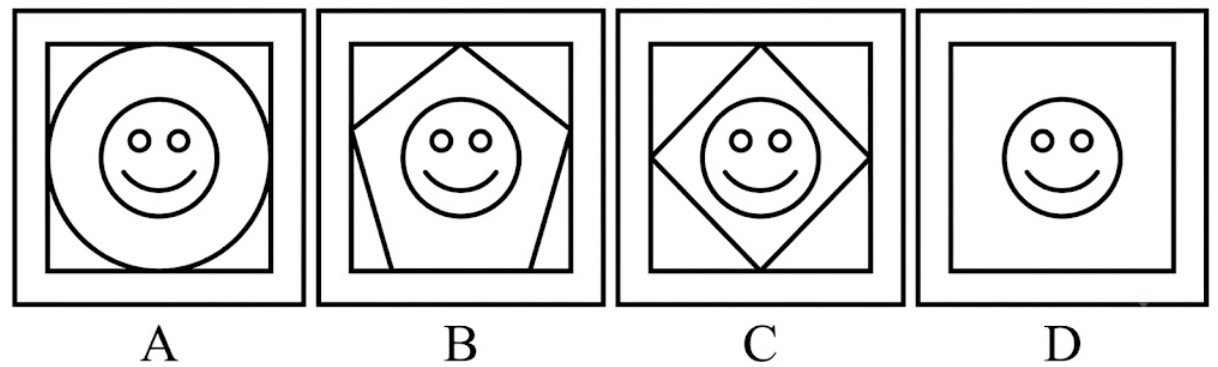
To identify the odd one out, we need to analyze the patterns and shapes within each diagram. Each option consists of a smiley face enclosed within different geometric shapes.
In Options A, B, and D, the smiley face is enclosed by a regular polygon or directly by a square. However, in Option C, the smiley face is enclosed by a diamond, which is not a regular polygon.
Correct Option: C) Option C is the odd one out because it uses a diamond shape, unlike the regular polygons or direct square enclosure in the other options.
To solve this problem, we need to trace Nitara's path step-by-step and determine her final position relative to her starting point. We can visualize her movements on a coordinate plane or by drawing a diagram, then use the Pythagorean theorem if necessary to find the shortest distance.
Correct Option: C) 550 m
The question asks to identify an amphoteric oxide among the given options. An amphoteric oxide is a metal oxide that exhibits both acidic and basic properties, meaning it can react with both acids and bases to form salt and water.
B) Aluminium
Aluminium oxide (\(\text{Al}_2\text{O}_3\)) is an amphoteric oxide. It reacts with acids to form salt and water, and also reacts with strong bases to form aluminates and water. For example:
\[ \text{Al}_2\text{O}_3 (s) + 6\text{HCl} (aq) \rightarrow 2\text{AlCl}_3 (aq) + 3\text{H}_2\text{O} (l) \]\[ \text{Al}_2\text{O}_3 (s) + 2\text{NaOH} (aq) \rightarrow 2\text{NaAlO}_2 (aq) + \text{H}_2\text{O} (l) \]The coordinates of a point, which internally divides the line segment joining the points (-1, 9) and (11, 1) in the ratio 3 : 1, are as follows:
To find the coordinates of a point that internally divides a line segment in a given ratio, we use the section formula. If a point \(P(x, y)\) divides the line segment joining \(A(x_1, y_1)\) and \(B(x_2, y_2)\) internally in the ratio \(m:n\), its coordinates are given by:
\[ x = \frac{m x_2 + n x_1}{m+n} \]\[ y = \frac{m y_2 + n y_1}{m+n} \]Correct Option: D) (8, 3)