
______ is the number of electrons involved in bond formation in N2.
To determine the number of electrons involved in bond formation in a molecule like N₂, we need to understand its Lewis structure and the type of covalent bond formed between the atoms. Nitrogen atoms achieve stability by forming a triple bond.
Each nitrogen atom contributes 3 electrons to form the triple bond, and each nitrogen atom has 1 lone pair (2 electrons).
The Lewis structure is: \(:N \equiv N:\)
C) 6 — In the N₂ molecule, the two nitrogen atoms are connected by a triple covalent bond. A triple bond consists of three shared pairs of electrons, meaning a total of 6 electrons are involved in the bond formation.
Based on the following table, on an average how many departures are there between 6 in the morning to 12 in the day?
| Flight time | Departure |
| 06:00 am to 07:00 am | 4 |
| 07:00 am to 08:00 am | 2 |
| 08:00 am to 09:00 am | 2 |
| 09:00 am to 10:00 am | 1 |
| 10:00 am to 11:00 am | 1 |
| 11:00 am to 12:00 am | 2 |
To find the average number of departures between 6 AM and 12 PM, we need to sum the total number of departures in this time frame and then divide by the number of hourly intervals.
Correct Option: B) 2
The question asks about the common characteristic of elements belonging to the same group in the modern periodic table. Understanding the organization principles of the periodic table is key to answering this question.
Correct Option: D) Valence electron. Elements in the same group have the same number of valence electrons. This is the fundamental reason why they exhibit similar chemical properties.
The problem involves a coding-decoding pattern. We need to identify the rule used to code "OATH" as "151208" and then apply the same rule to code "ALTER". The most common pattern in such problems is assigning numerical positions of letters in the English alphabet.
Correct Option: C) 11220518 is the correct code for ALTER based on the identified pattern.
The question asks to identify the initiative launched in 2010 to encourage voluntary savings for old age among workers in the unorganized sector. This requires knowledge of government schemes related to social security and pension for the unorganized sector.
Correct Option: B) Self-reliance scheme
To determine which pair is not a pair of prime numbers, we need to check each number in the given pairs for primality. A prime number is a natural number greater than 1 that has no positive divisors other than 1 and itself. If any number in a pair is not prime, then that pair is not a pair of prime numbers.
Correct Option: A) 161, 163. This is the correct answer because 161 is not a prime number (\(161 = 7 \times 23\)).
Which of the figures given in the alternative figure is combined to form the question figure?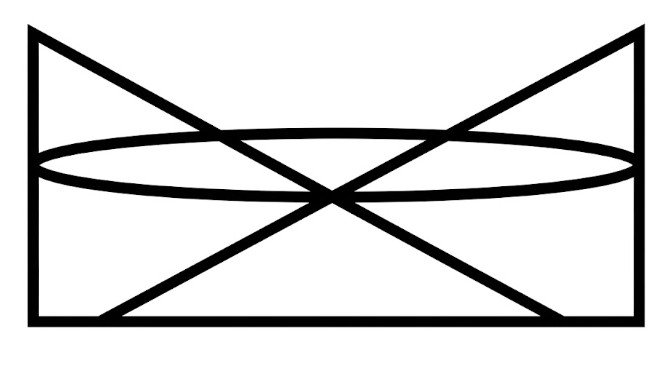
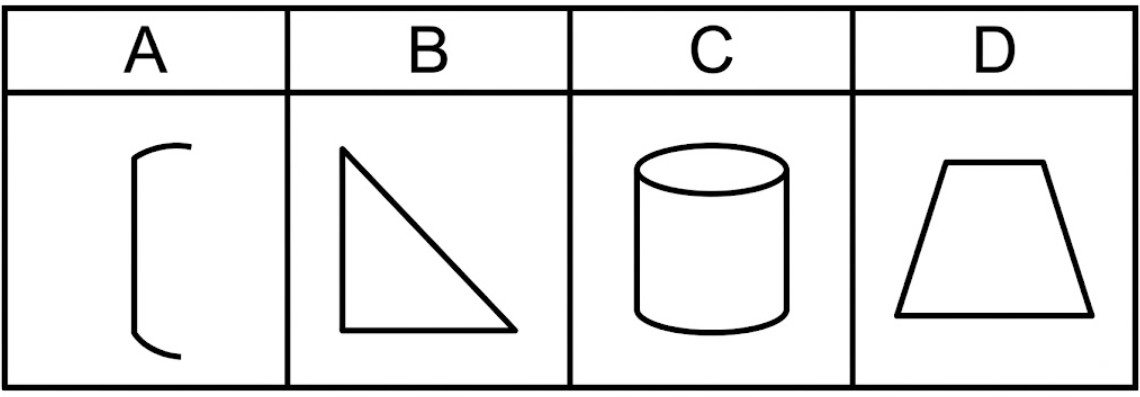
The task is to determine which of the given alternative figures can be combined to form the question figure. The question figure consists of a combination of geometric shapes including triangles and a cylinder.
Correct Option: D) Only B and C
The question asks to identify the specific type of oxidation reaction that produces both heat and light. We need to recall the definitions of the given options and determine which one fits this description.
Correct Option: B) Combustion — Combustion is a rapid oxidation reaction that releases energy in the form of heat and light, often visible as a flame.
From the top of the platform, the angle of elevation of the top of the tower at a distance of 50\(\sqrt{3}\) m is 30°. If the height of the tower is 60 m, what will be the height of the platform?
This problem involves trigonometry, specifically the tangent function, to relate the angle of elevation, the height difference, and the horizontal distance. We will use the given angle of elevation and horizontal distance to find the height of the tower above the platform, and then subtract this from the total height of the tower to find the height of the platform.
Let \(H\) be the total height of the tower, and \(h\) be the height of the platform.
The distance from the platform to the tower is given as \(D = 50\sqrt{3}\) m.
The angle of elevation from the top of the platform to the top of the tower is \(30^\circ\).
Let \(x\) be the height of the tower above the top of the platform. So, \(x = H - h\).
In the right-angled triangle formed by the horizontal distance, the height \(x\), and the line of sight, we can use the tangent function:
\[ \tan(\theta) = \frac{\text{Opposite}}{\text{Adjacent}} \]Here, the opposite side is \(x\) and the adjacent side is \(D\).
\[ \tan(30^\circ) = \frac{x}{D} \]We know that \(\tan(30^\circ) = \frac{1}{\sqrt{3}}\) and \(D = 50\sqrt{3}\) m.
\[ \frac{1}{\sqrt{3}} = \frac{x}{50\sqrt{3}} \]Now, solve for \(x\):
\[ x = \frac{50\sqrt{3}}{\sqrt{3}} \]\[ x = 50 \text{ m} \]This \(x\) is the height of the tower above the platform. The total height of the tower is given as \(H = 60\) m.
We have the relationship \(x = H - h\). Substitute the values:
\[ 50 = 60 - h \]Solve for \(h\):
\[ h = 60 - 50 \]\[ h = 10 \text{ m} \]A simple magnifying glass is an optical instrument used to produce a magnified image of an object. To achieve magnification, specific properties of lenses are required. We need to determine which type of lens (convex or concave) and what focal length (short or high) is suitable for this purpose.
D) convex lens of short focal length — A convex lens is a converging lens that can produce a magnified, virtual, and erect image when an object is placed within its focal length. A short focal length ensures higher magnifying power.