
The angle of depression of the base of a building from the top of a tower at a distance of 58 m is 60°. What is the height of the tower?
This problem involves trigonometry, specifically the concept of angles of depression. We need to use the tangent function in a right-angled triangle formed by the tower, the building, and the ground to find the height of the tower.
Correct Option: B) 58\(\sqrt{3}\) m
Consider the given statement and decide which of the given assumptions are implicit in the statement.
Statement:
Due to the acute water shortage in Cape Town, the government had issued orders to reduce water consumption.
Assumptions:
1. Most citizens can reduce water consumption.
2. Most of the citizens can protest against the order.
Either assumption 1 or 2 is implicit.
Only assumption 1 is implicit
Only assumption 2 is implicit.
Both assumptions 1 and 2 are implicit.
This question asks us to identify implicit assumptions in a given statement. An assumption is something taken for granted or accepted as true without proof. When the government issues an order, it generally assumes that the order can be followed and will achieve its intended purpose.
B) Only assumption 1 is implicit. The government's order to reduce water consumption is based on the fundamental assumption that citizens are capable of reducing their water usage. Without this assumption, the order would be futile.
Selina went from her home to the city at a speed of 8 km/hr, but while coming back by the same route, her speed was 6 km/hr. It took her a total of 24\( \frac{1}{2} \) hours for travel, how far does Selina live from the city?
This problem involves calculating distance, speed, and time. We are given the speeds for the journey to the city and back, and the total time taken. We need to find the distance between Selina's home and the city. We can use the formula \(\text{Distance} = \text{Speed} \times \text{Time}\) or \(\text{Time} = \frac{\text{Distance}}{\text{Speed}}\).
Let the distance between Selina's home and the city be \(D\) km.
Speed from home to city (onward journey) = \(S_1 = 8\) km/hr.
Time taken for the onward journey = \[T_1 = \frac{D}{S_1} = \frac{D}{8}\] hours.
Speed from city to home (return journey) = \(S_2 = 6\) km/hr.
Time taken for the return journey = \[T_2 = \frac{D}{S_2} = \frac{D}{6}\] hours.
The total time taken for the entire travel is given as \(24\frac{1}{2}\) hours. Convert this mixed fraction to an improper fraction:
\[ 24\frac{1}{2} = 24 + \frac{1}{2} = \frac{48}{2} + \frac{1}{2} = \frac{49}{2} \text{ hours} \]The total time is the sum of the time for the onward journey and the return journey:
\[ T_1 + T_2 = \frac{49}{2} \]Substitute the expressions for \(T_1\) and \(T_2\) into the equation:
\[ \frac{D}{8} + \frac{D}{6} = \frac{49}{2} \]Find a common denominator for the fractions on the left side. The least common multiple of 8 and 6 is 24.
\[ \frac{3D}{24} + \frac{4D}{24} = \frac{49}{2} \]Combine the terms on the left side:
\[ \frac{3D + 4D}{24} = \frac{49}{2} \]\[ \frac{7D}{24} = \frac{49}{2} \]Now, solve for \(D\). Multiply both sides by 24:
\[ 7D = \frac{49}{2} \times 24 \]\[ 7D = 49 \times 12 \]\[ 7D = 588 \]Divide by 7 to find \(D\):
\[ D = \frac{588}{7} \]\[ D = 84 \text{ km} \]B) The distance Selina lives from the city is 84 km.
The problem asks us to determine the number of items in the second basket. We are given the total number of items and the total number of baskets. We need to evaluate if the provided statements, individually or together, are sufficient to find the number of items in the second basket.
D) Statements 1 and 2 both are sufficient.
According to the World Economic Forum (WEF) report released in January 2018, what is the position of India in the list of 100 countries in its Global Manufacturing Index (GMI)?
The question asks for India's position in the World Economic Forum's (WEF) Global Manufacturing Index (GMI) report released in January 2018. This requires recalling specific information from that report.
A) 30th — India was indeed ranked 30th out of 100 countries in the World Economic Forum's Global Manufacturing Index (GMI) report released in January 2018. The report was titled "Readiness for the Future of Production Report 2018".
Select the odd one: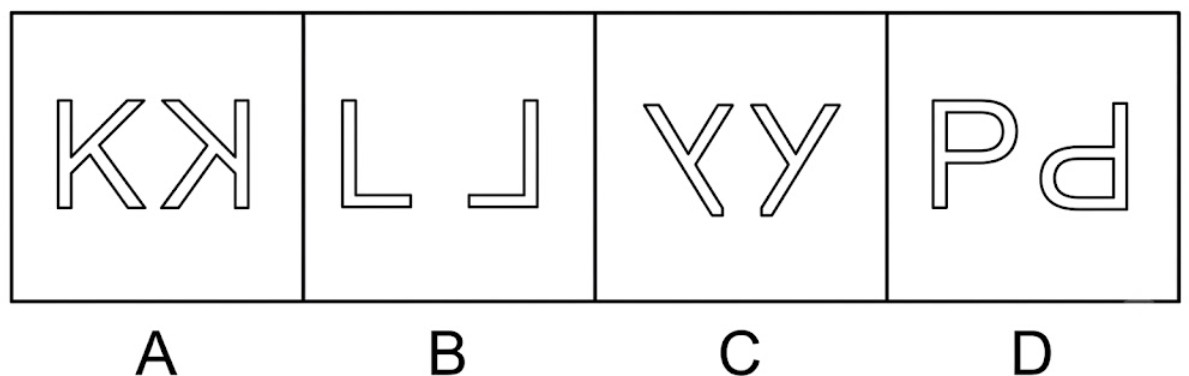
The task is to identify the odd one out among the given options based on the visual patterns in the diagram.
Thus, Option A is the odd one out as it differs in the type of symmetry compared to the others.
Correct Option: A) D
This is an analogy question where we need to find the relationship between the first pair of words and apply the same relationship to the second pair to find the missing word.
The wrist is a joint in the arm, and the shoulder is also a joint in the arm. More specifically, the wrist is at the distal (farther from the torso) end of the arm, and the shoulder is at the proximal (closer to the torso) end of the arm, connecting it to the trunk. Both are major joints of the upper limb.
The relationship is that both are major joints of the upper limb, with the shoulder being the joint connecting the limb to the torso, and the wrist being a joint further down the limb. Another way to see it is that the shoulder is a major joint higher up the arm, while the wrist is a major joint lower down the arm.
The ankle is a major joint in the leg, located at the distal end, connecting the foot to the leg. Following the pattern from the first pair (Wrist : Shoulder), we need to find a major joint in the leg that is analogous to the shoulder's position relative to the wrist. The shoulder is the joint connecting the arm to the torso. Similarly, we need the joint that connects the leg to the torso.
Therefore, the Hip is the correct answer as it holds the same positional relationship to the Ankle in the lower limb as the Shoulder does to the Wrist in the upper limb.
The wrist is a joint in the arm, and the shoulder is the joint that connects the arm to the torso. Similarly, the ankle is a joint in the leg, and the hip is the joint that connects the leg to the torso.
Sachin covers a distance of 360 km from Delhi to Hyderabad in 4 hours, some by plane and some by train. If he had done his entire journey by plane, he would have saved \( \frac{4}{5} \) of his train time and would have reached his destination 2 hours earlier. Find the distance traveled by train?
We are given the total distance, total time, and information about time saved if the entire journey was by plane. We need to find the distance traveled by train. We will set up equations based on the given information, using variables for time taken by plane and train, and then solve for the unknown distance.
Let the distance covered by plane be \(D_p\) and by train be \(D_t\). The total distance is 360 km.
\[ D_p + D_t = 360 \text{ km} \]Let the time taken by plane be \(T_p\) and by train be \(T_t\). The total time is 4 hours.
\[ T_p + T_t = 4 \text{ hours} \]If the entire journey was by plane, he would have saved \( \frac{4}{5} \) of his train time. This means the time taken by plane for the entire journey would be \[T_p + T_t - \frac{4}{5} T_t = T_p + \frac{1}{5} T_t\].
He would have reached his destination 2 hours earlier. The original total time is 4 hours. So, the time taken for the entire journey by plane would be \( 4 - 2 = 2 \) hours.
Equating the time taken for the entire journey by plane from steps 3 and 4:
\[ T_p + \frac{1}{5} T_t = 2 \text{ hours} \]Now we have a system of two equations with \(T_p\) and \(T_t\):
Subtract equation (b) from equation (a):
\[ (T_p + T_t) - (T_p + \frac{1}{5} T_t) = 4 - 2 \]\[ T_t - \frac{1}{5} T_t = 2 \]\[ \frac{4}{5} T_t = 2 \]\[ T_t = 2 \times \frac{5}{4} \]\[ T_t = \frac{10}{4} = 2.5 \text{ hours} \]Substitute \(T_t = 2.5\) hours into equation (a) to find \(T_p\):
\[ T_p + 2.5 = 4 \]\[ T_p = 4 - 2.5 \]\[ T_p = 1.5 \text{ hours} \]Let \(S_p\) be the speed of the plane and \(S_t\) be the speed of the train. If the entire journey (360 km) was by plane, it would take 2 hours. So, the speed of the plane is:
\[ S_p = \frac{360 \text{ km}}{2 \text{ hours}} = 180 \text{ km/h} \]The distance traveled by plane (\(D_p\)) is \(S_p \times T_p\):
\[ D_p = 180 \text{ km/h} \times 1.5 \text{ hours} \]\[ D_p = 270 \text{ km} \]The distance traveled by train (\(D_t\)) is the total distance minus the distance traveled by plane:
\[ D_t = 360 \text{ km} - D_p \]\[ D_t = 360 \text{ km} - 270 \text{ km} \]\[ D_t = 90 \text{ km} \]D) 90 km is the distance traveled by train.
The calculations confirm that only 90 km for the train journey satisfies all the given conditions.
The weight of an object is determined by its mass and the acceleration due to gravity. The mass of an object remains constant, but the acceleration due to gravity varies depending on the celestial body. The Moon's gravity is approximately one-sixth of Earth's gravity. Therefore, the weight of an object on the Moon will be one-sixth of its weight on Earth.
B) 3.33 N is the correct answer, as calculated by dividing the Earth's weight by 6.
Mr. X starts marathon running from point A. He runs 5 km towards north to reach point B, then takes a right turn and runs 6 km to reach point C, again takes a right turn and runs 8 km to reach point D, then turns right and runs 10 km to reach point E, then take a right turn and runs 6 km to reach point F, then takes a right turn and runs 1 km to reach point G, then takes a right turn and runs 3 km to reach point H.
At point H, Mr. X is facing which direction?
This problem involves tracking Mr. X's movements and turns to determine his final facing direction. We need to visualize each turn and the resulting direction.
Therefore, at point H, Mr. X is facing South.
A) South is the correct direction Mr. X is facing at point H, as determined by following his sequence of turns.