The question asks for the economic term that describes an increase in market prices. We need to identify the correct economic concept from the given options.
A) Inflation is the economic condition characterized by a sustained increase in the general price level of goods and services in an economy over a period of time, leading to a fall in the purchasing power of money.
The question asks about the specific type of ore for which the froth flotation method is primarily used. This method is a beneficiation process that separates hydrophobic materials from hydrophilic materials.
Correct Option: C) Sulfide. The froth flotation method is widely and effectively used for the concentration of sulfide ores, such as galena (lead sulfide), sphalerite (zinc sulfide), and chalcopyrite (copper iron sulfide). The chemical properties of sulfide minerals make them amenable to separation by this technique.
This is a blood relations question. We need to establish the relationships between the individuals mentioned and then determine the relationship between W and Y. We can use a family tree approach or simply trace the relationships step-by-step.
The father of one's mother is known as the maternal grandfather.
C) Maternal Grandfather — W is the father of Z, and Z is the mother of Y. Thus, W is Y's maternal grandfather.
What will be the remainder when 27x3 – 9x2 + 3x – 8 is divided by 3x + 2?
To find the remainder when a polynomial \(P(x)\) is divided by a linear polynomial \((ax + b)\), we can use the Remainder Theorem. The Remainder Theorem states that if a polynomial \(P(x)\) is divided by \((x - c)\), the remainder is \(P(c)\). If the divisor is of the form \((ax + b)\), we set \((ax + b) = 0\) to find the value of \(x\), which is \(x = -b/a\). Then, the remainder is \(P(-b/a)\).
The given polynomial is \(P(x) = 27x^3 - 9x^2 + 3x - 8\).
The divisor is \((3x + 2)\).
Set the divisor to zero:
\[ 3x + 2 = 0 \]\[ 3x = -2 \]\[ x = -\frac{2}{3} \]According to the Remainder Theorem, the remainder will be \(P\left(-\frac{2}{3}\right)\).
\[ P\left(-\frac{2}{3}\right) = 27\left(-\frac{2}{3}\right)^3 - 9\left(-\frac{2}{3}\right)^2 + 3\left(-\frac{2}{3}\right) - 8 \]Correct Option: A) -22
This problem can be solved by calculating the amount of work done by Charlie and Lola together, and then determining the remaining work. We can then use the time Charlie took to complete the remaining work to find his individual work rate and, subsequently, the total time he would take to complete the entire work alone.
Calculate the total work done by Charlie and Lola together:
Charlie and Lola together can complete the work in 20 days. So, their combined one-day work is:
Calculate the work done by Charlie and Lola in 15 days:
They worked together for 15 days. The amount of work completed in these 15 days is:
Calculate the remaining work:
After 15 days, Lola left. The remaining work is:
Calculate Charlie's time to complete the full work:
Charlie finished this remaining \(\frac{1}{4}\) of the work in 12 days. This means Charlie's rate for \(\frac{1}{4}\) of the work is 12 days. To find out how many days Charlie alone would take to complete the entire work (which is 1 unit of work), we can set up a proportion:
Solving for \(X\):
\[ X = 12 \times \frac{1}{1/4} = 12 \times 4 = 48 \text{ days} \]So, Charlie alone can complete the work in 48 days.
Correct Option: C) 48
To find the number of students from other communities, we first need to calculate the total percentage of students belonging to the specified communities (Muslim, Hindu, Sikh). Then, subtract this total percentage from 100% to find the percentage of students from other communities. Finally, calculate this percentage of the total number of students.
Calculate the total percentage of students from known communities:
Percentage of Muslim students \( = 44\% \)
Percentage of Hindu students \( = 28\% \)
Percentage of Sikh students \( = 10\% \)
Total percentage of students from these communities \( = 44\% + 28\% + 10\% \)
\[ = 82\% \]Calculate the percentage of students from other communities:
The total percentage of students in the school is \( 100\% \).
Percentage of students from other communities \( = 100\% - \text{Total percentage from known communities} \)
\[ = 100\% - 82\% = 18\% \]Calculate the number of students from other communities:
Total number of students in the school \( = 850 \)
Number of students from other communities \( = 18\% \text{ of } 850 \)
\[ = \frac{18}{100} \times 850 \]\[ = 18 \times 8.5 \]\[ = 153 \]C) 153 is the correct number of students from other communities.
To find the number of moles of atoms, we use the fundamental relationship between mass, molar mass, and the number of moles. The number of moles is calculated by dividing the given mass of the substance by its atomic mass (which is numerically equal to its molar mass in g/mol).
The atomic mass of an element, when expressed in grams, represents the molar mass of that element. So, the molar mass of Aluminum is 27 g/mol.
The number of moles (\(n\)) is given by the formula:
\[ n = \frac{\text{Given mass}}{\text{Molar mass}} \]For Aluminum:
\[ n = \frac{54 \text{ g}}{27 \text{ g/mol}} \]Therefore, there are 2 moles of Aluminum atoms in 54 g of Aluminum.
Correct Option: A) 2
If \(\sqrt{1369}\) = 37 then what will be the value of:
The problem provides the square root of 1369 and asks to calculate the sum of several square roots involving decimal points. The key is to understand how decimal points affect the square root. For every two decimal places inside the square root, there will be one decimal place in the result. We will calculate each term separately and then sum them up.
We are given that \(\sqrt{1369} = 37\).
Calculate the first term: \(\sqrt{13.69}\)
Since \(13.69 = \frac{1369}{100}\), we have:
\[ \sqrt{13.69} = \sqrt{\frac{1369}{100}} = \frac{\sqrt{1369}}{\sqrt{100}} = \frac{37}{10} = 3.7 \]Calculate the second term: \(\sqrt{0.1369}\)
Since \(0.1369 = \frac{1369}{10000}\), we have:
\[ \sqrt{0.1369} = \sqrt{\frac{1369}{10000}} = \frac{\sqrt{1369}}{\sqrt{10000}} = \frac{37}{100} = 0.37 \]Calculate the third term: \(\sqrt{0.001369}\)
Since \(0.001369 = \frac{1369}{1000000}\), we have:
\[ \sqrt{0.001369} = \sqrt{\frac{1369}{1000000}} = \frac{\sqrt{1369}}{\sqrt{1000000}} = \frac{37}{1000} = 0.037 \]Calculate the fourth term: \(\sqrt{0.00001369}\)
Since \(0.00001369 = \frac{1369}{100000000}\), we have:
\[ \sqrt{0.00001369} = \sqrt{\frac{1369}{100000000}} = \frac{\sqrt{1369}}{\sqrt{100000000}} = \frac{37}{10000} = 0.0037 \]Now, sum all the calculated values and add 2:
\[ 3.7 + 0.37 + 0.037 + 0.0037 + 2 \]Adding these values:
\[ \begin{array}{r} 3.7000 \\ 0.3700 \\ 0.0370 \\ 0.0037 \\ + \quad 2.0000 \\ \hline 6.1107 \end{array} \]C) The sum of the terms is \(3.7 + 0.37 + 0.037 + 0.0037 + 2 = 6.1107\).
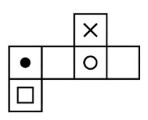
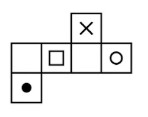
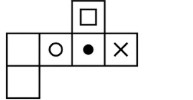
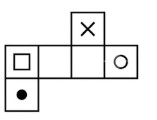
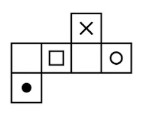
If the following cube is opened, then which pattern will it resemble?
To solve this problem, we need to determine which unfolded pattern corresponds to the given cube. The cube has specific symbols on its faces, and the task is to match these symbols correctly when the cube is opened into a flat pattern.
Correct Option: B) The pattern in Option B correctly matches the arrangement of symbols on the cube.
The question asks to identify the film that received the Best Film Award on Family Welfare at the National Film Awards 2017. This requires knowledge of the specific awards given out at that event.
Correct Option: B) Little Magician