
The question asks about the type of carbon-carbon bonds present in saturated hydrocarbons. To answer this, we need to recall the definition of saturated hydrocarbons and the types of bonds that characterize them.
Correct Option: C) There is a single bond between the carbon atoms.
The question asks to identify the oldest public sector bank in India as of 2018. This requires knowledge of the establishment dates of major Indian banks, particularly those that became public sector entities.
Correct Option: A) Allahabad Bank was established in 1865, making it the oldest public sector bank among the choices provided and one of the oldest joint-stock banks in India.
The question asks for the definition of alleles. To answer this, we need to recall fundamental concepts of genetics, specifically what alleles represent in relation to genes.
Correct Option: B) Gene variant
Alleles are indeed different forms or variants of a gene. They occupy the same locus (position) on homologous chromosomes and control the same trait, but they can lead to different expressions of that trait.
Which of the following closely resembles the question figure?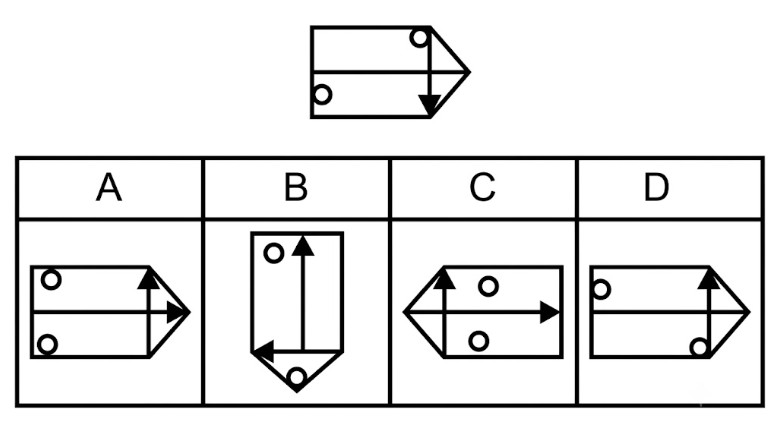
To solve this question, we need to identify the option that closely resembles the question figure based on its shape, orientation, and elements such as arrows and circles.
Correct Option: B) Option B matches the shape, orientation, and elements of the question figure.
We are given the difference between the height and base of a right-angled triangle and its area. We need to find the perimeter. We will use the formulas for the area of a right-angled triangle and the Pythagorean theorem to find the base, height, and hypotenuse, and then calculate the perimeter.
Let the height of the right-angled triangle be \(h\) and the base be \(b\).
From the problem statement, the difference between the height and the base is 7 cm. We can write this as:
\[ h - b = 7 \quad \text{or} \quad b - h = 7 \]Let's assume \(h > b\), so \(h - b = 7 \implies h = b + 7\). (The other case \(b - h = 7\) will lead to the same dimensions, just swapped roles for height and base).
The area of a right-angled triangle is given by the formula:
\[ \text{Area} = \frac{1}{2} \times \text{base} \times \text{height} \]We are given that the area is 30 sq. cm. Substitute the values into the area formula:
\[ 30 = \frac{1}{2} \times b \times h \]\[ 60 = b \times h \]Now substitute \(h = b + 7\) into the equation \(60 = b \times h\):
\[ 60 = b \times (b + 7) \]\[ 60 = b^2 + 7b \]\[ b^2 + 7b - 60 = 0 \]Solve this quadratic equation for \(b\). We can factorize the quadratic equation:
\[ b^2 + 12b - 5b - 60 = 0 \]\[ b(b + 12) - 5(b + 12) = 0 \]\[ (b - 5)(b + 12) = 0 \]This gives two possible values for \(b\): \(b = 5\) or \(b = -12\). Since the base cannot be negative, we take \(b = 5\) cm.
Now find the height \(h\) using \(h = b + 7\):
\[ h = 5 + 7 \]\[ h = 12 \text{ cm} \]So, the base is 5 cm and the height is 12 cm. Let's check the area: \(\frac{1}{2} \times 5 \times 12 = 30\) sq. cm, which is correct.
Next, we need to find the hypotenuse (\(c\)) using the Pythagorean theorem:
\[ c^2 = b^2 + h^2 \]\[ c^2 = 5^2 + 12^2 \]\[ c^2 = 25 + 144 \]\[ c^2 = 169 \]\[ c = \sqrt{169} \]\[ c = 13 \text{ cm} \]Finally, calculate the perimeter of the triangle:
\[ \text{Perimeter} = \text{base} + \text{height} + \text{hypotenuse} \]\[ \text{Perimeter} = 5 + 12 + 13 \]\[ \text{Perimeter} = 30 \text{ cm} \]C) 30 cm is the perimeter of the triangle.
To find the smallest cube number divisible by 15, 25, and 40, we first need to find the Least Common Multiple (LCM) of these numbers. Then, we will express the LCM in its prime factorization form. Finally, we will multiply the LCM by the smallest possible factors to make all the powers of its prime factors a multiple of 3, thus making it a perfect cube.
The LCM is found by taking the highest power of each prime factor present in the numbers.
\[ \text{LCM}(15, 25, 40) = 2^3 \times 3^1 \times 5^2 = 8 \times 3 \times 25 = 24 \times 25 = 600 \]For a number to be a perfect cube, the exponents of all its prime factors must be multiples of 3.
The prime factorization of the LCM is \(2^3 \times 3^1 \times 5^2\).
So, the smallest number to multiply the LCM by to make it a perfect cube is \(3^2 \times 5^1 = 9 \times 5 = 45\).
Multiply the LCM by the factors needed to make it a perfect cube:
\[ \text{Smallest cube number} = \text{LCM} \times (3^2 \times 5^1) = 600 \times 45 \] \[ 600 \times 45 = 27000 \]Let's check its prime factorization:
\[ 27000 = 2^3 \times 3^1 \times 5^2 \times 3^2 \times 5^1 = 2^3 \times 3^{(1+2)} \times 5^{(2+1)} = 2^3 \times 3^3 \times 5^3 \]Since all exponents (3, 3, 3) are multiples of 3, 27000 is a perfect cube. Also, \(27000 = (2 \times 3 \times 5)^3 = 30^3\).
Correct Option: D) 27000
To find the amount of electric charge, we use the fundamental relationship between current, charge, and time. The electric current is defined as the rate of flow of electric charge. Therefore, charge can be calculated by multiplying the current by the time, ensuring all units are consistent (SI units).
Identify the given values:
Convert time to SI units (seconds):
Since 1 minute = 60 seconds,
\[ t = 5 \text{ minutes} \times 60 \frac{\text{seconds}}{\text{minute}} = 300 \text{ seconds} \]Apply the formula for electric charge:
The relationship between current (\(I\)), charge (\(Q\)), and time (\(t\)) is given by:
\[ I = \frac{Q}{t} \]Rearranging the formula to solve for charge (\(Q\)):
\[ Q = I \times t \]Substitute the values and calculate the charge:
\[ Q = 0.75 \text{ A} \times 300 \text{ s} \] \[ Q = 225 \text{ C} \]Correct Option: A) 225 C
This question tests the understanding of divisibility rules and the concept of factors. If a number is divisible by another number, it means the latter is a factor of the former. We need to find the factors of 6 that must also be factors of any number divisible by 6.
Correct Option: A) 2 and 3. A number divisible by 6 can be written as \(6k\). Since \(6 = 2 \times 3\), the number can also be written as \(2 \times 3 \times k\). This clearly shows that the number is divisible by 2 and also by 3.
This problem involves calculating the time taken to fill a cistern by pipes. We need to determine the work rate of a single pipe and then calculate the time taken for the first half and the remaining half of the cistern, considering the change in the number of pipes.
A single pipe fills the cistern in 4 hours. This means its filling rate is:
\[ \text{Rate of one pipe} = \frac{1}{\text{Time taken}} = \frac{1}{4} \text{ cistern/hour} \]The first half of the cistern is filled by the single pipe. Since the pipe fills the whole cistern in 4 hours, it will fill half the cistern in half the time.
\[ \text{Time to fill half} = \frac{1}{2} \times 4 \text{ hours} = 2 \text{ hours} \]After half the cistern is filled, the remaining portion is:
\[ \text{Remaining portion} = 1 - \frac{1}{2} = \frac{1}{2} \text{ of the cistern} \]After half the cistern is filled, three more pipes of the same size are opened. So, the total number of pipes working now is \(1 + 3 = 4\) pipes.
The combined rate of 4 pipes will be 4 times the rate of one pipe:
\[ \text{Combined rate} = 4 \times \frac{1}{4} \text{ cistern/hour} = 1 \text{ cistern/hour} \]Now, we calculate the time taken by these 4 pipes to fill the remaining half of the cistern:
\[ \text{Time for remaining half} = \frac{\text{Remaining portion}}{\text{Combined rate}} = \frac{1/2 \text{ cistern}}{1 \text{ cistern/hour}} = \frac{1}{2} \text{ hour} \]Converting this to minutes:
\[ \frac{1}{2} \text{ hour} = \frac{1}{2} \times 60 \text{ minutes} = 30 \text{ minutes} \]The total time taken to fill the cistern is the sum of the time taken for the first half and the time taken for the remaining half.
\[ \text{Total time} = 2 \text{ hours} + 30 \text{ minutes} = 2 \text{ hours } 30 \text{ minutes} \]Correct Option: A) 2 hours 30 minutes
The question asks about the home state of the former President of India, Ram Nath Kovind. This is a factual question related to Indian politics and general knowledge. To answer this, one needs to recall the biographical details of the former President.
Correct Option: B) Uttar Pradesh