
This problem involves setting up and solving a system of linear equations based on the given age relationships at different points in time. We will define variables for the current ages of the mother and daughter and then translate the given conditions into algebraic equations.
Define variables for current ages:
Let the current age of the mother be \(M\) years.
Let the current age of the daughter be \(D\) years.
Formulate the first equation (6 years ago):
6 years ago, the mother's age was \(M-6\) years.
6 years ago, the daughter's age was \(D-6\) years.
According to the problem, 6 years ago, the mother’s age was 6 times her daughter’s age:
Formulate the second equation (3 years hence):
3 years hence (from now), the mother's age will be \(M+3\) years.
3 years hence, the daughter's age will be \(D+3\) years.
According to the problem, 3 years hence, the daughter will be one-third her mother’s age:
Solve the system of equations:
Now we have two expressions for \(M\). We can equate them to solve for \(D\):
Find the mother's current age:
Substitute the value of \(D\) into either Equation 1 or Equation 2. Using Equation 2:
Verify the solution:
Mother's current age \(M = 42\), Daughter's current age \(D = 12\).
The solution is consistent with both conditions.
Correct Option: D) 42
To find the total percentage increase, we need to calculate the final price of the product after all the intermediate profits and the seller's profit. We will start with the farmer's selling price and sequentially apply each profit margin to the previous price. Finally, we will calculate the percentage difference between the buyer's price and the farmer's price.
Let the farmer's selling price be \(X\).
First Middleman's Price: The first middleman makes a 10% profit.
\[ \text{Price}_1 = X \times \left(1 + \frac{10}{100}\right) = X \times 1.10 \]Second Middleman's Price: The second middleman makes a 20% profit on the price from the first middleman.
\[ \text{Price}_2 = \text{Price}_1 \times \left(1 + \frac{20}{100}\right) = (X \times 1.10) \times 1.20 = X \times 1.32 \]Third Middleman's Price: The third middleman makes a 30% profit on the price from the second middleman.
\[ \text{Price}_3 = \text{Price}_2 \times \left(1 + \frac{30}{100}\right) = (X \times 1.32) \times 1.30 = X \times 1.716 \]Seller's Price (Buyer's Price): The seller keeps a 15% profit on the price from the third middleman. This is the final price the buyer pays.
\[ \text{Buyer's Price} = \text{Price}_3 \times \left(1 + \frac{15}{100}\right) = (X \times 1.716) \times 1.15 = X \times 1.9734 \]Calculate the percentage increase: The buyer paid \(1.9734X\) and the farmer sold it for \(X\). The increase is \(1.9734X - X = 0.9734X\).
Percentage increase is calculated as:
\[ \text{Percentage Increase} = \frac{\text{Buyer's Price} - \text{Farmer's Price}}{\text{Farmer's Price}} \times 100 \]\[ \text{Percentage Increase} = \frac{1.9734X - X}{X} \times 100 \]\[ \text{Percentage Increase} = \frac{0.9734X}{X} \times 100 \]\[ \text{Percentage Increase} = 0.9734 \times 100 = 97.34\% \]C) The buyer paid 97.34% more than the farmer's selling price.
The question asks about the number of periods in the Modern Periodic Table. This is a fundamental concept in chemistry related to the organization of elements.
Correct Option: D) 7
The question asks about the method of reproduction for plants that have lost the ability to produce seeds. This points towards asexual reproduction methods in plants, specifically those that do not involve seeds.
Correct Option: B) Vegetative Propagation — This is a form of asexual reproduction in plants where new plants are produced from vegetative parts like stems, roots, or leaves, without the involvement of seeds. This method is crucial for plants that have lost the ability to produce seeds or for propagating plants with desirable traits.
Choose the option that closely resembles the mirror image of the given figure. If mirror is placed at right side of the given image.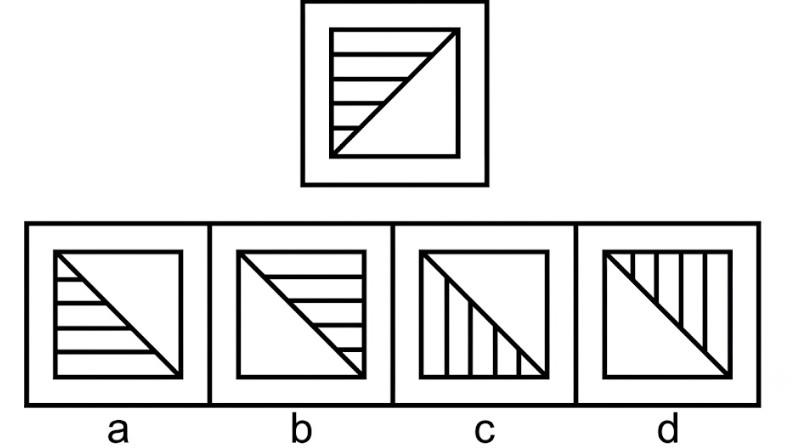
To find the mirror image of a given figure, imagine a mirror placed on the right side of the figure. The mirror image will have the same elements but reversed horizontally.
Correct Option: D) The lines in option D slant from the top right to the bottom left, matching the expected mirror image.
The question asks to identify the term for organisms that consume other organisms. This relates to different modes of nutrition found in living beings.
A) Holotrophic organisms — This term describes organisms (like animals) that ingest solid or liquid organic food, digest it internally, and then absorb the nutrients. This is precisely what is meant by "eating other organisms."
The question asks to identify the special type of proteins found in muscles. This requires knowledge of the primary function of muscles and the molecules responsible for that function.
Correct Option: B) Contractile proteins
Muscles contain special proteins called contractile proteins. The primary examples are actin and myosin, which are responsible for muscle contraction and relaxation, enabling movement.
The question asks for the specific metallurgical process involving heating of ores in the absence of oxygen. This is a fundamental concept in metallurgy, particularly in the extraction of metals from their ores.
B) Calcination is the process of heating an ore strongly in the absence or limited supply of air/oxygen to remove volatile impurities and convert it into a more reactive form, typically an oxide.
Who inaugurated the first edition of Khelo India School Games (KISG) that was held from 31st January to 8th February 2018 at Indira Gandhi Indoor Stadium?
The Chief Minister of Delhi
The Prime Minister of India
The Sports Minister
The Home Minister
The question asks about the dignitary who inaugurated the first edition of the Khelo India School Games (KISG) in 2018. This is a factual question related to a significant national sports initiative. Recalling key events and the high-profile individuals associated with their launch is important for competitive exams.
B) The Prime Minister of India. The first edition of the Khelo India School Games was inaugurated by the then Prime Minister of India, Narendra Modi, on January 31, 2018, at the Indira Gandhi Indoor Stadium in New Delhi.
To find the equivalent resistance of resistors connected in parallel, we use the formula for parallel resistances. The reciprocal of the equivalent resistance is equal to the sum of the reciprocals of individual resistances.
D) 1.7
The calculated equivalent resistance is approximately \(1.76 \, \Omega\). Among the given options, \(1.7 \, \Omega\) is the closest value.