
The square root of 732 - 552 is:
To find the square root of the given expression, we can use the algebraic identity \(a^2 - b^2 = (a - b)(a + b)\). This simplifies the calculation significantly, avoiding the need to calculate large squares first.
Identify the expression: We need to find the square root of \(73^2 - 55^2\).
Apply the algebraic identity \(a^2 - b^2 = (a - b)(a + b)\). Here, \(a = 73\) and \(b = 55\).
Substitute the values into the identity:
\[ 73^2 - 55^2 = (73 - 55)(73 + 55) \]Perform the subtractions and additions:
\(73 - 55 = 18\)
\(73 + 55 = 128\)
Multiply the results:
\[ 18 \times 128 \]To calculate \(18 \times 128\):
\[ 18 \times 128 = 2304 \]Now, we need to find the square root of \(2304\).
We can estimate or use prime factorization. Let's try to find a number whose square is \(2304\). We know that \(40^2 = 1600\) and \(50^2 = 2500\). So the number is between 40 and 50. Since the last digit of 2304 is 4, its square root must end in 2 or 8.
Let's check \(42^2\) or \(48^2\).
\(42^2 = (40 + 2)^2 = 40^2 + 2 \times 40 \times 2 + 2^2 = 1600 + 160 + 4 = 1764\)
\(48^2 = (50 - 2)^2 = 50^2 - 2 \times 50 \times 2 + 2^2 = 2500 - 200 + 4 = 2304\)
Thus, the square root of \(2304\) is \(48\).
Correct Option: B) 48
The question asks about the allocation of residuary powers under the Indian Constitution. This is a fundamental aspect of the distribution of legislative powers between the Union and the States, a key feature of India's federal structure.
A) centre — As per Article 248 of the Indian Constitution, the Parliament (representing the Centre) has exclusive power to legislate on any matter not enumerated in the Concurrent List or State List. This clearly assigns residuary powers to the Centre.
The question asks to identify the substance responsible for breaking down large fat globules into smaller ones, a process known as emulsification, which is crucial for fat digestion.
Correct Option: A) Bile salts are responsible for the emulsification of fats, breaking down large fat globules into smaller ones in the small intestine.
This problem involves understanding and applying the transitive property of inequalities. We are given a series of inequalities and need to determine which conclusion is definitely false based on these given conditions.
We are given the following relationships:
From the given inequalities, we can establish a clear order among the variables:
\[ W > X > Y > Z \]C) \(Z > W\)
From the given inequalities, we have \(X > Y\) and \(Y > Z\). By the transitive property, if \(X\) is greater than \(Y\) and \(Y\) is greater than \(Z\), then \(X\) must be greater than \(Z\). This conclusion is definitely true.
From the given inequalities, we have \(W > X\), \(X > Y\), and \(Y > Z\). By applying the transitive property multiple times, we can conclude that \(W\) is greater than \(Z\). This conclusion is definitely true.
From the given inequalities, we have \(W > X\) and \(X > Y\). By the transitive property, if \(W\) is greater than \(X\) and \(X\) is greater than \(Y\), then \(W\) must be greater than \(Y\). This conclusion is definitely true.
Which pattern most closely resembles the following pattern?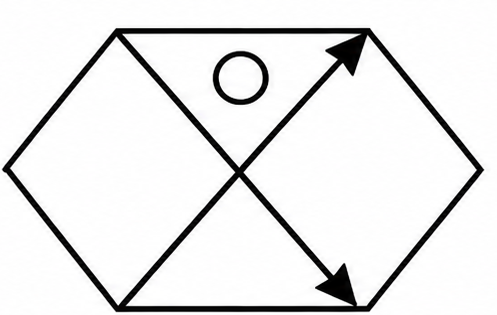
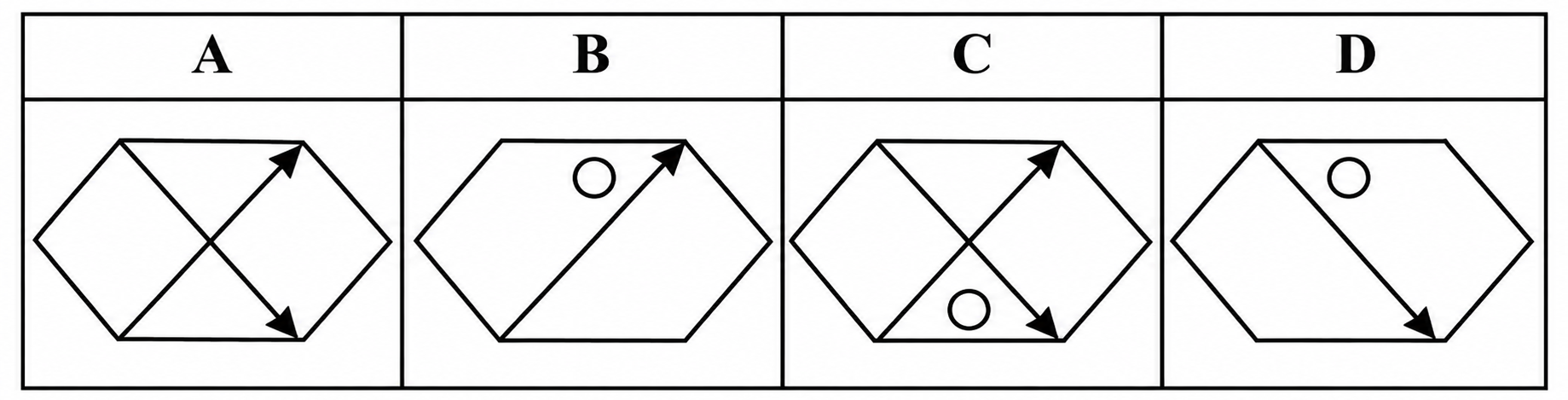
To determine which pattern most closely resembles the given pattern, we need to compare the elements and their arrangement in the question's diagram with those in the options.
Correct Option: B) The pattern matches the question's diagram with the correct placement of the circle and the diagonal arrow.
Ramesh raises an object of 12 kg through a height of 2.0 m. The work done by him is ________. (take g = 10 m/s2)
To calculate the work done when an object is raised against gravity, we use the formula for work done, which is the product of force and displacement. In this case, the force required to raise the object is equal to its weight, and the displacement is the height through which it is raised.
The force required is equal to the weight of the object.
\[ \text{Force} (F) = \text{mass} (m) \times \text{acceleration due to gravity} (g) \]\[ F = 12 \text{ kg} \times 10 \text{ m/s}^2 \]\[ F = 120 \text{ N} \]Work done is the product of force and displacement (height in this case).
\[ \text{Work Done} (W) = \text{Force} (F) \times \text{height} (h) \]\[ W = 120 \text{ N} \times 2.0 \text{ m} \]\[ W = 240 \text{ J} \]Correct Option: B) The work done by Ramesh is 240 J. This is calculated by multiplying the force (weight of the object, \(m \times g\)) by the height through which it is raised. \(W = mgh = 12 \text{ kg} \times 10 \text{ m/s}^2 \times 2.0 \text{ m} = 240 \text{ J}\).
The question asks about the physical process that occurs when a light bulb is switched on. This involves understanding the basic principle of how incandescent light bulbs produce light.
Correct Option: C) The filament or wire inside it gets heated and glows. This option accurately describes the process: the electrical energy is converted into heat due to resistance, and this heat causes the filament to glow and produce light.
This is a coding-decoding type of question where words are given new names. The task is to identify the real-world object and then find its actual characteristic (like color), and finally, determine what that characteristic is called in the given coded language.
Therefore, the color of the clear sky, in this coded language, is 'white'.
C) White — The actual color of a clear sky is blue. In the given code, 'blue' is called 'white'. Hence, the answer is White.
This problem involves work and time concepts. We will use the efficiency method, where the amount of work done is inversely proportional to the time taken. We'll set up equations based on the given information and solve for the individual efficiencies to find the time A takes alone.
Define total work and efficiencies:
Let the total work be 60 units (LCM of 12 and 15 for easier calculation).
Let the efficiency of A, B, and C be \(e_A\), \(e_B\), and \(e_C\) units/day, respectively.
Formulate equations from given data:
A and B together complete the work in 12 days. So, their combined efficiency is:
B and C together complete the work in 15 days. So, their combined efficiency is:
\[ e_B + e_C = \frac{60 \text{ units}}{15 \text{ days}} = 4 \text{ units/day} \quad \text{(Equation 2)} \]Use the relationship between A and C's efficiency:
A is twice as good a workman as C, which means A's efficiency is twice C's efficiency:
Solve the system of equations:
Substitute Equation 3 into Equation 1:
Now we have two equations with \(e_B\) and \(e_C\):
\[ 2e_C + e_B = 5 \]\[ e_C + e_B = 4 \]Subtract Equation 2 from Equation 4:
\[ (2e_C + e_B) - (e_C + e_B) = 5 - 4 \]\[ e_C = 1 \text{ unit/day} \]Find \(e_A\):
Using Equation 3, \(e_A = 2e_C\):
Calculate the time A takes alone:
Time taken by A alone = Total work / Efficiency of A
D) 30 days. Based on our calculations, A alone will complete the work in 30 days.
Which one of these is an example of displacement reaction?
Fe(s) + CuSO4(aq) = FeSO4(aq) + Cu(s)
2FeSO4(s) = Fe2O3(s) + SO2(g) + SO3(g)
CaO(s) + H2O(l) = Ca(OH)2(aq)
C(s) + O2(g) = CO2(g)
The question asks to identify a displacement reaction from the given options. A displacement reaction is a type of chemical reaction where a more reactive element displaces a less reactive element from its compound. To solve this, we need to analyze each reaction and determine if it fits the definition of a displacement reaction.
Based on the analysis, only Option A fits the definition of a displacement reaction.
Correct Option: A) \( \text{Fe(s)} + \text{CuSO}_4\text{(aq)} = \text{FeSO}_4\text{(aq)} + \text{Cu(s)} \) is a displacement reaction because iron (Fe), being more reactive than copper (Cu), displaces copper from copper sulfate.