A sum of Rs. 1,000 is invested at a rate of 30% per annum at compound interest, compounded every four months, will give an amount of Rs. _____ in one year.
To find the amount after one year when interest is compounded every four months, we need to adjust the annual interest rate and the number of compounding periods per year. We will use the compound interest formula.
The interest is compounded every four months. In one year, there are \(12 / 4 = 3\) compounding periods. So, \(n = 3\).
The rate per period (\(r\)) is the annual rate divided by the number of compounding periods per year.
\[ r = \frac{R}{n} = \frac{0.30}{3} = 0.10 \]The formula for the amount (\(A\)) with compound interest is:
\[ A = P \left(1 + \frac{R}{n}\right)^{n \times T} \]Substituting the values:
\[ A = 1000 \left(1 + 0.10\right)^{3 \times 1} \]\[ A = 1000 \left(1.1\right)^3 \]So, the amount after one year will be Rs. 1,331.
A) 1,331 — This is the correct amount calculated using the compound interest formula with interest compounded every four months.
In NGO Colony, the people are classified into four different groups as given in the following figure: the rectangle represents men, the triangle represents educated, the circle represents urban and the square represents government employees.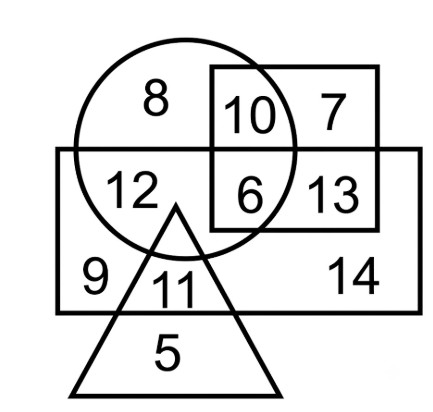
Which one of the following represents the educated men who are NOT urban?
To solve this problem, we need to identify the section of the diagram that represents educated men who are not urban. This involves understanding the relationships between the shapes: rectangle for men, triangle for educated, and circle for urban.
Correct Option: C) 11
To find the number of factors of a number that are perfect squares, we first need to find the prime factorization of the given number. Then, we identify the factors that can be expressed as a perfect square. A number is a perfect square if all the exponents in its prime factorization are even.
D) 6 is the correct answer. There are 6 factors of 4000 that are perfect squares: \(2^0 5^0 = 1\), \(2^2 5^0 = 4\), \(2^4 5^0 = 16\), \(2^0 5^2 = 25\), \(2^2 5^2 = 100\), \(2^4 5^2 = 400\).
This is a blood relation problem. We need to decode the statement made by Haritha step-by-step to establish the relationship between Haritha and Nag. We will break down the statement from the end to the beginning to simplify the complex relationship.
D) Sister or brother — As Nag and Haritha share the same father, they are siblings. Haritha could be Nag's sister, or Nag could be Haritha's brother. Since the gender of Nag and Haritha is not specified beyond their names (which can sometimes be ambiguous or unisex in different cultures), the most accurate relationship is sister or brother.
The question asks to identify the Portuguese Viceroy who was responsible for the conquest of Goa in 1510 CE. This requires knowledge of key figures in early Portuguese colonial history in India.
Correct Option: B) Albuquerque was the Portuguese Viceroy (or Governor, as he was officially known) who conquered Goa in 1510 CE. He is considered one of the greatest naval commanders in history and played a crucial role in establishing Portuguese power in Asia.
Suresh alone takes 20 days to do a piece of work. Rajesh alone takes 30 days to do the same piece of work. The total wages for the entire work is Rs. 10,000. How much should Suresh be paid if they work together for the entire duration of the work?
When two or more individuals work together, their wages should be distributed in proportion to the amount of work they do, or equivalently, in proportion to their individual efficiencies. Efficiency is inversely proportional to the time taken to complete a task. We will calculate the individual work rates (efficiency) of Suresh and Rajesh, find the ratio of their efficiencies, and then distribute the total wages according to this ratio.
Calculate Suresh's daily work rate:
Suresh takes 20 days to complete the work. So, in one day, Suresh completes:
Calculate Rajesh's daily work rate:
Rajesh takes 30 days to complete the work. So, in one day, Rajesh completes:
Determine the ratio of their efficiencies (work rates):
The ratio of their work rates is:
To simplify this ratio, find a common multiple of 20 and 30, which is 60. Multiply both sides by 60:
\[ \left(\frac{1}{20} \times 60\right) : \left(\frac{1}{30} \times 60\right) \]\[ 3 : 2 \]So, the ratio of their efficiencies is \(3:2\).
Distribute the total wages according to the efficiency ratio:
The total wages for the entire work is Rs. 10,000. The wages will be divided in the ratio \(3:2\).
The sum of the ratio parts is \(3 + 2 = 5\).
Suresh's share of the wages will be:
\[ \text{Suresh's share} = \frac{\text{Suresh's ratio part}}{\text{Sum of ratio parts}} \times \text{Total wages} \]\[ \text{Suresh's share} = \frac{3}{5} \times 10,000 \]\[ \text{Suresh's share} = 3 \times 2,000 \]\[ \text{Suresh's share} = \text{Rs. } 6,000 \]C) Rs. 6,000 — Based on their efficiencies, Suresh's share of the total wages is Rs. 6,000.
The question asks for the location of Candolim beach. This is a factual recall question related to Indian geography and tourism. To answer this, one needs to know the popular beaches and their respective states/union territories.
Correct Option: B) Candolim beach is famously located in Goa. It is one of the most popular beaches in North Goa, known for its serene environment and water sports activities.
Select the missing figure that will complete the following analogy.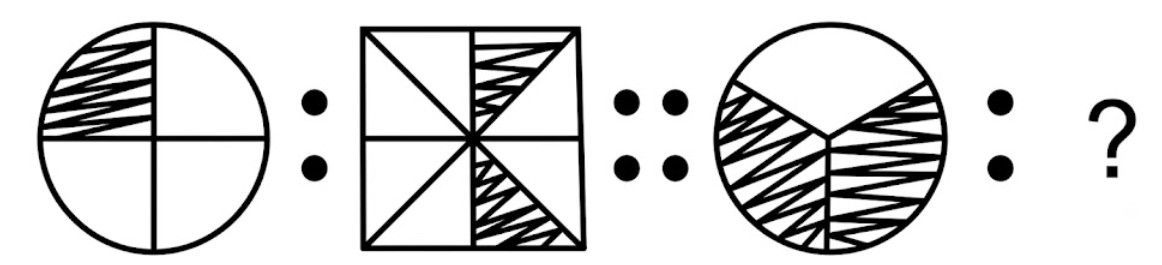
The question involves completing an analogy using visual patterns. The first pair of figures shows a transformation that must be applied to the second pair to find the missing figure.
Correct Option: D) The hexagon is divided into three sections, with two sections shaded, matching the pattern from the circle.
If the following data is plotted in a pie chart, find the measure of the central angle for the sector that denotes the third week. Choose the closest option.
| Week | Number of shirts sold |
| 1 | 800 |
| 2 | 900 |
| 3 | 1200 |
| 4 | 940 |
| 5 | 1460 |
To find the central angle for a sector in a pie chart, we first need to calculate the total number of items. Then, for the specific category (in this case, the third week), we determine its proportion of the total. Finally, we multiply this proportion by \(360^\circ\) (the total angle in a circle) to get the central angle.
Let's perform the calculations:
The closest option to \(81.51^\circ\) is \(81.5^\circ\).
B) \(81.5^\circ\) is the closest value to the calculated central angle of \(81.51^\circ\).
Which of the statements is sufficient to answer the question? Question: Find the value of n.
Statements:
1. \(A\; = \;\left[ {\begin{array}{*{20}{c}} n&1\\ 0&-1 \end{array}}\right]\)
2. \(B\; = \;\left[ {\begin{array}{*{20}{c}} 1&-1\\ 0&1 \end{array}}\right]\)
3. A + B = O, where O is a null matrix of 2 × 2
All statements 1, 2 and 3 are sufficient
Only statement 2 is sufficient
Only statement 1 is sufficient
Only statement 3 is sufficient
The problem asks us to determine which combination of the given statements is sufficient to find the value of 'n'. We need to analyze each statement and their combinations to see if they provide enough information to solve for 'n'.
Statement 1 gives us the matrix A:
\[ A\; = \;\left[ {\begin{array}{*{20}{c}} n&1\ 0&-1 \end{array}}\right] \]This statement alone defines matrix A in terms of 'n', but it does not provide any equation or relationship to find the value of 'n'. Therefore, Statement 1 alone is not sufficient.
Statement 2 gives us the matrix B:
\[ B\; = \;\left[ {\begin{array}{*{20}{c}} 1&-1\ 0&1 \end{array}}\right] \]This statement defines matrix B, but it does not contain 'n' and does not provide any information to find 'n'. Therefore, Statement 2 alone is not sufficient.
Statement 3 states that \(A + B = O\), where \(O\) is a null matrix of \(2 \times 2\). A null matrix \(O\) of \(2 \times 2\) is given by:
\[ O\; = \;\left[ {\begin{array}{*{20}{c}} 0&0\ 0&0 \end{array}}\right] \]This statement provides a relationship between A, B, and O, but it does not define A or B. Therefore, Statement 3 alone is not sufficient.
Let's use all three statements together.
From Statement 1:
\[ A\; = \;\left[ {\begin{array}{*{20}{c}} n&1\ 0&-1 \end{array}}\right] \]From Statement 2:
\[ B\; = \;\left[ {\begin{array}{*{20}{c}} 1&-1\ 0&1 \end{array}}\right] \]From Statement 3:
\[ A + B = O \]Substitute the expressions for A and B into the equation from Statement 3:
\[ \left[ {\begin{array}{*{20}{c}} n&1\ 0&-1 \end{array}}\right] + \left[ {\begin{array}{*{20}{c}} 1&-1\ 0&1 \end{array}}\right] = \left[ {\begin{array}{*{20}{c}} 0&0\ 0&0 \end{array}}\right] \]Perform the matrix addition on the left side:
\[ \left[ {\begin{array}{*{20}{c}} n+1&1+(-1)\ 0+0&-1+1 \end{array}}\right] = \left[ {\begin{array}{*{20}{c}} 0&0\ 0&0 \end{array}}\right] \] \[ \left[ {\begin{array}{*{20}{c}} n+1&0\ 0&0 \end{array}}\right] = \left[ {\begin{array}{*{20}{c}} 0&0\ 0&0 \end{array}}\right] \]For two matrices to be equal, their corresponding elements must be equal. Therefore, we can equate the element in the first row, first column:
\[ n+1 = 0 \]Solving for 'n':
\[ n = -1 \]Since we were able to find a unique value for 'n' using all three statements, all statements 1, 2, and 3 together are sufficient to answer the question.
A) All statements 1, 2 and 3 are sufficient. This is correct because by combining the definitions of matrices A and B from statements 1 and 2, and the relationship A + B = O from statement 3, we can form an equation that allows us to uniquely solve for 'n'.