
The question asks for the SI unit of work. To answer this, we need to recall the definition of work in physics and its standard unit in the International System of Units (SI).
A) Joule is the SI unit of work. This aligns with our derivation that \(1 \text{ Joule} = 1 \text{ Newton} \cdot \text{meter}\).
This problem can be solved using the concept of similar triangles. At any given time, the angle of elevation of the sun is the same for all objects in a particular location. This means that a vertical object and its shadow form a right-angled triangle, and all such triangles formed at the same time will be similar. Therefore, the ratio of the height of an object to the length of its shadow will be constant.
Since the triangles formed are similar, the ratio of height to shadow is constant.
\[ \frac{H_p}{S_p} = \frac{30 \text{ m}}{20 \text{ m}} = \frac{3}{2} \]The ratio of the building's height to its shadow length must be the same as that of the pole.
\[ \frac{H_b}{S_b} = \frac{3}{2} \]Correct Option: D) 90 m
The question asks what the area under a velocity-time graph represents. To answer this, we need to recall the definitions of velocity, displacement, acceleration, and speed, and how they relate to graphical representations in kinematics.
Correct Option: A) Displacement
The area under a velocity-time graph represents the displacement of the object. This is because displacement is the product of velocity and time. Graphically, the area under the curve is calculated by integrating velocity with respect to time, which yields displacement.
The question asks for the medical imaging technique used to visualize internal organs like the liver, gallbladder, and uterus. We need to identify the option that correctly describes this common diagnostic procedure.
A) Ultrasonography is the correct technique. It uses high-frequency sound waves to produce images of organs such as the liver, gall bladder, uterus, kidneys, and many other soft tissue structures in the body. It is non-invasive and does not involve ionizing radiation.
To find the perfect squares between 1 and 600 that have the digit 6 in the unit's place, we first need to understand the property of perfect squares regarding their unit's digit. A perfect square ends in 6 only if its base number ends in 4 or 6. We will then list perfect squares ending in 4 or 6 and check if they fall within the given range (1 to 600).
Determine the range of base numbers:
We are looking for perfect squares between 1 and 600. This means \(1 < n^2 < 600\).
Taking the square root of the boundaries:
So, the base numbers \(n\) must be integers such that \(1 < n < 24.49\). This means \(n\) can range from 2 to 24.
Identify base numbers whose squares end in 6:
A number's square ends in 6 if the number itself ends in 4 or 6. We need to check numbers between 2 and 24 that end in 4 or 6.
So, the possible base numbers are 4, 6, 14, 16, 24.
Calculate the squares of these base numbers:
Check if these perfect squares are between 1 and 600:
All the calculated squares (16, 36, 196, 256, 576) are greater than 1 and less than 600.
Count the number of such perfect squares:
There are 5 such perfect squares: 16, 36, 196, 256, and 576.
D) 5. There are 5 perfect squares (16, 36, 196, 256, 576) between 1 and 600 that have the digit 6 in the unit's place.
A tap can fill a tank in 10 hours and another tap can empty the tank in 15 hours. If both the taps are opened together how much time will be taken to fill \( \frac{2}{3} \) of the tank?
To solve this problem, we need to calculate the effective filling rate of the tank when both taps are open. One tap fills, and the other empties, so their rates will counteract each other. Once the net filling rate is found, we can determine the time required to fill a specific fraction of the tank.
The first tap fills the tank in 10 hours. So, in 1 hour, it fills \(\frac{1}{10}\) of the tank.
The second tap empties the tank in 15 hours. So, in 1 hour, it empties \(\frac{1}{15}\) of the tank.
When both taps are open, the net amount of tank filled per hour is the filling rate minus the emptying rate.
\[ \text{Net filling rate} = \frac{1}{10} - \frac{1}{15} \]To subtract these fractions, find a common denominator, which is 30.
\[ \text{Net filling rate} = \frac{3}{30} - \frac{2}{30} = \frac{1}{30} \]This means that with both taps open, \(\frac{1}{30}\) of the tank is filled every hour.
If \(\frac{1}{30}\) of the tank is filled in 1 hour, then the entire tank will be filled in 30 hours.
To find the time taken to fill \(\frac{2}{3}\) of the tank, multiply the total time to fill the tank by \(\frac{2}{3}\).
\[ \text{Time to fill } \frac{2}{3} \text{ of tank} = 30 \text{ hours} \times \frac{2}{3} \] \[ \text{Time to fill } \frac{2}{3} \text{ of tank} = 10 \times 2 = 20 \text{ hours} \]Correct Option: C) 20 hours
The question asks to identify the tissue type characterized by striped, short, branched cells joined by intercalated discs. This description points directly to a specific type of muscle tissue found in the heart.
Correct Option: C) Cardiac Muscle Tissue. This tissue is found only in the heart. Its cells are indeed striped (striated), short, and branched, and they are connected end-to-end by specialized junctions called intercalated discs, which allow for rapid communication and coordinated contraction.
Find the odd figure out from among the given figures.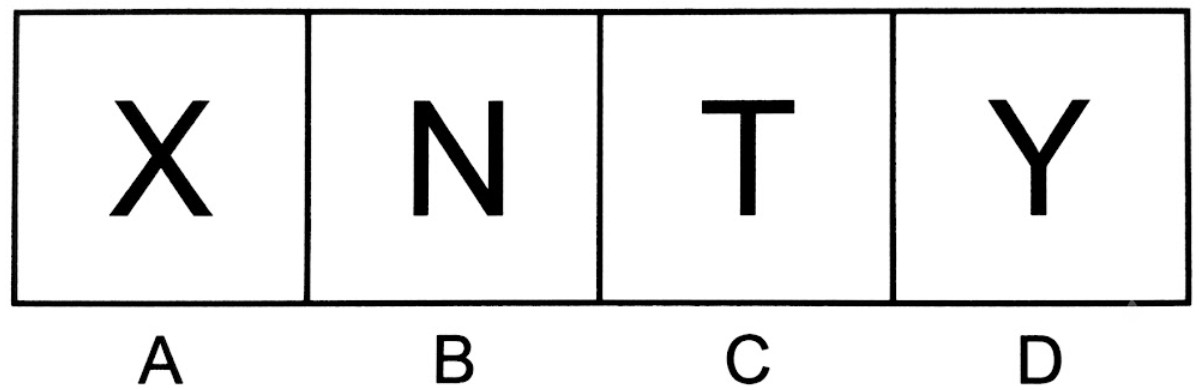
The task is to identify the figure that does not belong with the others based on a common characteristic or pattern.
Correct Option: B) N is the odd figure out as it lacks symmetry.
The problem asks us to determine which conclusions logically follow from the given statements about the ages of Ram, Shyam, and Krishna. We need to analyze each statement and conclusion to establish the correct order of ages.
B) Only conclusion I follows