
This problem involves understanding directions and turns. We need to trace the car's path and its orientation after a specific turn. We'll use the standard compass directions (North, South, East, West) to determine the final direction of the car's bonnet.
A) North — As explained in the step-by-step analysis, after entering from the east (moving west) and taking a 90° right turn, the car's bonnet will face North.
Choose one of the following options which is equal to:
\(\frac{1+\cos\theta}{\sin\theta}\)
\(\frac{\sin\theta}{1-\cos\theta}\)
\(\frac{1+\sin^2\theta}{\sin\theta\cos\theta}\)
\(\frac{1+2\cos\theta}{\sin\theta\cos\theta}\)
\(\frac{1-2\sin^2\theta}{\cos\theta}\)
The problem asks us to find an expression equivalent to \(\frac{1+\cos\theta}{\sin\theta}\). We can simplify the given expression or manipulate the options to match the given expression. A common technique for trigonometric identities is to multiply the numerator and denominator by the conjugate of the numerator or denominator, or to use fundamental identities like \(\sin^2\theta + \cos^2\theta = 1\).
Correct Option: A) \(\frac{\sin\theta}{1-\cos\theta}\)
This question asks about the trends of electronegativity and electropositivity across a period (from left to right) in the periodic table. Understanding these periodic trends is fundamental to inorganic chemistry.
Correct Option: A) increases, decreases
This problem involves calculating the original amount when a percentage increase has been applied. We are given the final amount (taxi fare with surcharge) and the percentage of the surcharge. We need to find the base amount before the surcharge was added.
C) Rs. 450 — As calculated, the original fare before the 18% surcharge was Rs. 450. If you add 18% of Rs. 450 (which is \(0.18 \times 450 = 81\)) to Rs. 450, you get \(450 + 81 = 531\), which matches the given final fare.
The problem presents a series of alphanumeric terms. To find the next term, we need to identify the pattern in the letters and the numbers separately. We will analyze the progression of the first letter, the first number, the second letter, and the second number in each term.
The next term should have: K (from step 1), 11 (from step 2), O (from step 3), 15 (from step 4).
Therefore, the next term is K11O15.
A) K11O15 — This matches our derived term by following the established pattern for letters and numbers.
The problem involves calculating the total distance traveled and total time taken to find the average speed. We are given the speed and time for the first part of the journey and the desired overall average speed. We need to find the time for the second part of the journey. The key formula is:
\[ \text{Average Speed} = \frac{\text{Total Distance}}{\text{Total Time}} \]We will calculate the distance covered in the first part, then set up an equation using the overall average speed to find the unknown time for the second part.
Therefore, Ritesh should drive for 12 hours at a speed of 80 km/h.
B) 12 hours is the correct answer, as calculated above.
This problem involves simple interest. We are given the final amount (maturity value), the interest rate, and the time period. We need to find the original principal amount. We can use the formula for simple interest and the formula for the amount to solve this.
\[ \text{SI} = \frac{P \times R \times T}{100} \]
\[ A = P + \text{SI} \]
Substitute the SI formula into the Amount formula:
\[ A = P + \frac{P \times R \times T}{100} \]
Factor out \(P\):
\[ A = P \left(1 + \frac{R \times T}{100}\right) \]
\[ 689 = P \left(1 + \frac{7.5 \times 4}{100}\right) \]
\[ 7.5 \times 4 = 30 \]
\[ \frac{30}{100} = 0.3 \]
So, the equation becomes:
\[ 689 = P (1 + 0.3) \]
\[ 689 = P (1.3) \]
\[ P = \frac{689}{1.3} \]
To simplify the division, multiply the numerator and denominator by 10:
\[ P = \frac{6890}{13} \]
\[ P = 530 \]
The original sum invested was Rs. 530.
Correct Option: C) Rs. 530
How many lines are used to create the below figure?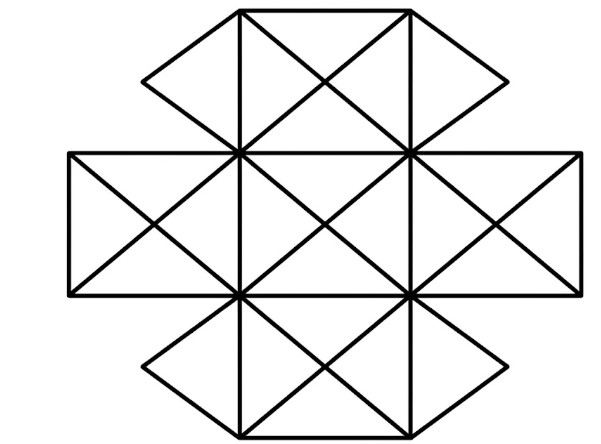
To determine the number of lines used to create the figure, we will count each line segment carefully, ensuring not to double-count any shared lines.
Correct Option: C) 19
The question asks to find the value of 'm', which is the slope of a line. We need to determine if the given statements individually or together are sufficient to find 'm'. The standard form of a linear equation is \(y = mx + c\), where \(m\) is the slope and \(c\) is the y-intercept.
D) Both statements 1 and 2 are sufficient. As shown in the step-by-step analysis, combining the equation from Statement 1 and the point from Statement 2 allows us to solve for the unique value of the slope \(m\).
The question asks to identify the type of cells that are embedded in a hard matrix composed of calcium and phosphorus. This describes the characteristic composition of a specific connective tissue in the human body.
C) Bone cells (osteocytes) are embedded in a hard, mineralized extracellular matrix primarily composed of calcium phosphate, which contains calcium and phosphorus. This matrix provides the rigidity and strength characteristic of bone.