
The question asks for the full form of the acronym FICCI. This requires knowledge of common organizations and their abbreviations, which is a standard component of general awareness sections in competitive exams.
Correct Option: B) Federation of Indian Chambers of Commerce and Industry
Mendel's laws of inheritance (Law of Segregation, Law of Independent Assortment) describe how traits are passed from parents to offspring. These laws were formulated based on experiments with pea plants. For these laws to hold true and for the observed ratios to appear, specific conditions must be met regarding the genetic makeup of the parents and the nature of the characters being studied.
A) Parents are pure breeding — Mendel's experiments and the resulting laws are fundamentally based on starting with pure breeding (homozygous) parents. This ensures clear segregation and independent assortment of alleles, leading to predictable ratios in subsequent generations.
The question asks to identify the tissue or structure that smoothens the bone surface at a joint. This requires knowledge of the components of a joint and their functions.
A) Cartilage — Articular cartilage is a smooth, elastic tissue that covers the ends of bones in synovial joints. It reduces friction between bones during movement and acts as a shock absorber, thereby ensuring smooth articulation.
This question tests knowledge of common chemical compounds and their common names. We need to identify the common name for calcium sulfate hemihydrate.
Calcium sulfate hemihydrate is widely known as Plaster of Paris. It is a white powdery chemical compound that hardens when mixed with water. Its primary uses include making casts for broken bones, sculptures, and decorative elements.
Correct Option: D) Plaster of Paris
To solve this problem, we need to follow the order of operations, often remembered by the acronym BODMAS/PEMDAS. This means we first perform operations inside brackets (parentheses), then 'of' (which implies multiplication), then multiplication, division, addition, and subtraction in that order from left to right.
The expression becomes:
\[ 11 \text{ of } 31 \times 216 \]"11 of 31" means \(11 \times 31\).
\[ 11 \times 31 = 341 \]The expression is now:
\[ 341 \times 216 \]A) 73656 is the correct answer obtained by following the order of operations.
What will be the horizontal mirror image of 'PUMP'?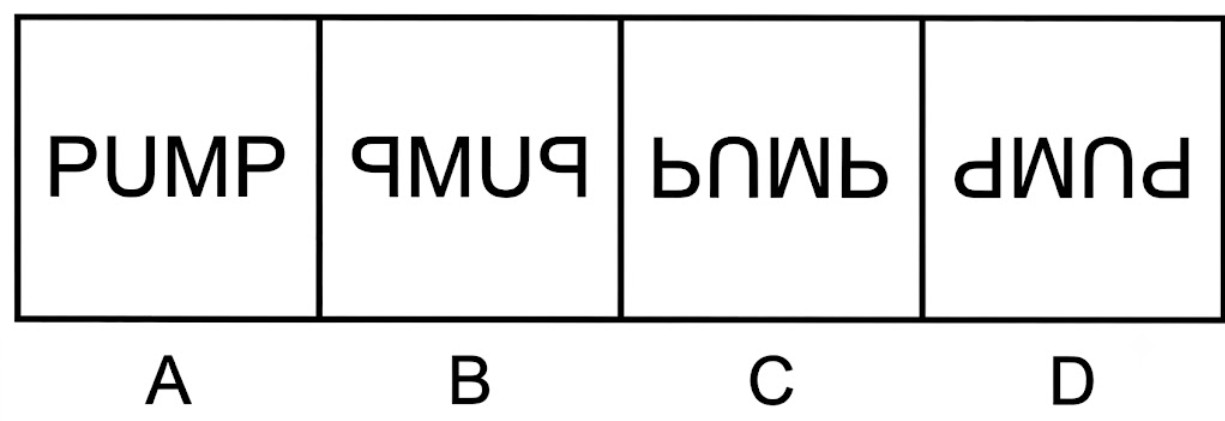
To find the horizontal mirror image of the word 'PUMP', we need to visualize how each letter would appear if reflected across a vertical axis.
Option C visually represents this mirror image correctly.
Correct Option: C) ꟼᴜᴍꟼ
This problem involves work and time, where one entity (builder) performs positive work and another (destroyer) performs negative work. We need to calculate the net work done in the initial phase and then the time taken to complete the remaining work by the builder alone.
Calculate the builder's work rate:
The builder can build a wall in 5 hours. So, in 1 hour, the builder builds \(\frac{1}{5}\) of the wall.
\[ \text{Builder's rate} = \frac{1}{5} \text{ wall/hour} \]Calculate the destroyer's work rate:
The destroyer can destroy the wall in 7 hours. So, in 1 hour, the destroyer destroys \(\frac{1}{7}\) of the wall.
\[ \text{Destroyer's rate} = -\frac{1}{7} \text{ wall/hour} \](The negative sign indicates destruction).
Calculate the net work rate when both work together:
When both work together, their combined rate is the builder's rate minus the destroyer's rate.
\[ \text{Combined rate} = \frac{1}{5} - \frac{1}{7} = \frac{7 - 5}{35} = \frac{2}{35} \text{ wall/hour} \]Calculate the work done in the first 3.5 hours:
They work together for 3.5 hours. So, the amount of wall built in this time is:
\[ \text{Work done in 3.5 hours} = \text{Combined rate} \times \text{Time} = \frac{2}{35} \times 3.5 = \frac{2}{35} \times \frac{7}{2} = \frac{1}{5} \text{ of the wall} \]Calculate the remaining work:
The total work to be done is 1 (representing the whole wall). The remaining work is:
\[ \text{Remaining work} = 1 - \frac{1}{5} = \frac{4}{5} \text{ of the wall} \]Calculate the time taken to complete the remaining work by the builder alone:
After 3.5 hours, the destroyer stops. Only the builder continues to work at their original rate of \(\frac{1}{5}\) wall/hour.
\[ \text{Time to complete remaining work} = \frac{\text{Remaining work}}{\text{Builder's rate}} = \frac{\frac{4}{5}}{\frac{1}{5}} = \frac{4}{5} \times 5 = 4 \text{ hours} \]Calculate the total time required to build the wall:
Total time = Time both worked together + Time builder worked alone
\[ \text{Total time} = 3.5 \text{ hours} + 4 \text{ hours} = 7.5 \text{ hours} \]A) 7.5
To evaluate the strength of an argument, we need to determine if it directly supports or refutes the statement with logical and generally accepted facts, without being based on personal inconvenience or assumptions.
Correct Option: B) Only argument I is strong
Argument I provides a scientifically supported reason (production of good hormones, disease prevention) for doctors to recommend walking to diabetics, making it a strong argument. Argument II focuses on individual practical difficulties, which does not weaken the medical validity of the recommendation itself.
The problem asks us to find the new, reduced milk consumption given the original consumption and the ratio in which it is to be reduced. We can set up a proportion or use the ratio directly to calculate the new consumption.
Correct Option: D) 10 liters
An object travels 24 meters in 4 seconds and then another 15 meters in 2 seconds. What is the average speed of the object?
To find the average speed of an object, we need to calculate the total distance traveled and the total time taken. The average speed is then the total distance divided by the total time.
The object travels 24 meters in the first part and 15 meters in the second part.
\[ \text{Total Distance} = \text{Distance}_1 + \text{Distance}_2 \]\[ \text{Total Distance} = 24\text{ m} + 15\text{ m} = 39\text{ m} \]The object takes 4 seconds for the first part and 2 seconds for the second part.
\[ \text{Total Time} = \text{Time}_1 + \text{Time}_2 \]\[ \text{Total Time} = 4\text{ s} + 2\text{ s} = 6\text{ s} \]Average speed is defined as the total distance divided by the total time.
\[ \text{Average Speed} = \frac{\text{Total Distance}}{\text{Total Time}} \]\[ \text{Average Speed} = \frac{39\text{ m}}{6\text{ s}} \]\[ \text{Average Speed} = 6.5\text{ m/s} \]The unit for speed is meters per second, which can also be written as \(\text{ms}^{-1}\).
Correct Option: B) 6.5 ms \(^{-1}\)