Neha bought a book at 30% discount for Rs. 1,300 and sold it at 30% profit. How much did she earn?
To find the profit earned, we first need to determine the original marked price of the book. Since Neha bought the book at a 30% discount for Rs. 1,300, this Rs. 1,300 represents 70% of the marked price. Once we find the marked price, we can calculate the cost price (which is Rs. 1,300). Then, we calculate the selling price by applying a 30% profit on the cost price. Finally, the profit earned is the difference between the selling price and the cost price.
Neha bought the book for Rs. 1,300 after a 30% discount. This means Rs. 1,300 is 100% - 30% = 70% of the Marked Price.
\[ 0.70 \times \text{MP} = \text{Rs. } 1,300 \]\[ \text{MP} = \frac{1,300}{0.70} \]\[ \text{MP} = \text{Rs. } 1,857.14 \text{ (approximately)} \]The price at which Neha bought the book is her cost price.
\[ \text{CP} = \text{Rs. } 1,300 \]Neha sold the book at a 30% profit on her cost price.
\[ \text{Profit percentage} = 30\% \]\[ \text{Profit amount} = 30\% \text{ of CP} \]\[ \text{Profit amount} = 0.30 \times 1,300 \]\[ \text{Profit amount} = \text{Rs. } 390 \]The amount Neha earned is the profit she made.
\[ \text{Profit earned} = \text{SP} - \text{CP} \]\[ \text{Profit earned} = 1,690 - 1,300 \]\[ \text{Profit earned} = \text{Rs. } 390 \]Correct Option: B) Rs. 390
The question asks to identify the recipient of the Padma Bhushan award in the field of art music from Maharashtra in 2018. This requires knowledge of the Padma Awards recipients for the specific year and category.
C) Arvind Parikh was indeed honored with the Padma Bhushan in 2018 for his contributions to Art - Music. He is a renowned Hindustani classical sitar player from Maharashtra, making him the correct answer.
The question asks to identify the Indian boxer who received the 'Legend Award' from the Amateur International Boxing Association (AIBA). This is a factual question related to sports awards and prominent Indian athletes.
Correct Option: C) MC Mary Kom was honored with the 'Legend Award' by the Amateur International Boxing Association (AIBA) in 2019. She is one of India's most celebrated boxers, a six-time world champion, and an Olympic medalist.
This question asks us to evaluate the strength of arguments for and against buying a double-door refrigerator. A strong argument is one that is logical, relevant, and provides a valid reason to support or refute the statement. We need to assess each argument independently.
Correct Option: C) Either I or II is strong
Both arguments I and II are strong because they present valid and significant points relevant to the decision of buying a double-door refrigerator. Argument I highlights a functional advantage, while Argument II points out practical disadvantages. Depending on an individual's priorities (e.g., convenience vs. cost/energy), either argument could be a deciding factor.
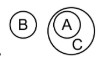
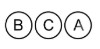
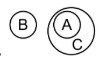
Which of the following Venn diagrams correctly depicts the relationship between the following classes?
A) Biscuits B) Pakoras C) Baked food items
To determine the correct Venn diagram, we need to understand the relationship between biscuits, pakoras, and baked food items. Biscuits are a type of baked food, while pakoras are not typically baked; they are fried.
Correct Option: A) The diagram correctly shows biscuits as a subset of baked food items, with pakoras separate.
The problem involves a coding-decoding pattern where letters are assigned numerical values. We need to identify the rule used to code "EGG" as "577" and then apply the same rule to find the code for "TELL". The most common pattern in such problems is assigning numbers based on the alphabetical position of letters.
Correct Option: B) 2051212 is the correct code for TELL based on the alphabetical position of each letter.
This problem involves setting up a system of linear equations based on the given relationships between the ages of Rani, Ragini, and Nag. We will define variables for each person's age, express their ages in terms of a single variable, and then use the sum of their ages to solve for that variable. Finally, we will calculate Ragini's age.
Define variables:
Let Nag's age be \(N\) years.
Let Ragini's age be \(R_g\) years.
Let Rani's age be \(R_i\) years.
Formulate equations based on the given relationships:
"Rani is two years older than Ragini":
\[ R_i = R_g + 2 \quad (1) \]"Ragini, whose age is twice the age of Nag":
\[ R_g = 2N \quad (2) \]From equation (2), we can express Nag's age in terms of Ragini's age:
\[ N = \frac{R_g}{2} \quad (3) \]Use the sum of ages:
"The sum of ages of Rani, Ragini and Nag is 27 years":
\[ R_i + R_g + N = 27 \quad (4) \]Substitute and solve for Ragini's age (\(R_g\)):
Substitute equations (1) and (3) into equation (4):
\[ (R_g + 2) + R_g + \left(\frac{R_g}{2}\right) = 27 \]Combine the terms with \(R_g\):
\[ 2R_g + \frac{R_g}{2} + 2 = 27 \]Subtract 2 from both sides:
\[ 2R_g + \frac{R_g}{2} = 27 - 2 \]\[ 2R_g + \frac{R_g}{2} = 25 \]To combine the terms on the left, find a common denominator:
\[ \frac{4R_g}{2} + \frac{R_g}{2} = 25 \]\[ \frac{4R_g + R_g}{2} = 25 \]\[ \frac{5R_g}{2} = 25 \]Multiply both sides by 2:
\[ 5R_g = 25 \times 2 \]\[ 5R_g = 50 \]Divide by 5:
\[ R_g = \frac{50}{5} \]\[ R_g = 10 \]So, Ragini's age is 10 years.
Verify the ages:
Ragini's age (\(R_g\)) = 10 years.
Nag's age (\(N\)) = \(R_g / 2 = 10 / 2 = 5\) years.
Rani's age (\(R_i\)) = \(R_g + 2 = 10 + 2 = 12\) years.
Sum of ages = \(12 + 10 + 5 = 27\) years. This matches the given information.
Correct Option: C) 10
The question asks to identify the Chief Minister who also served as the head priest (Mahant) of the Gorakhnath Temple. This requires knowledge of prominent political figures in India and their religious affiliations or roles.
Correct Option: A) Yogi Adityanath is the current Chief Minister of Uttar Pradesh. He was the Mahant (head priest) of the Gorakhnath Math, a prominent Hindu monastery in Gorakhpur, Uttar Pradesh, succeeding his guru Mahant Avaidyanath. He held this position for many years before becoming a Member of Parliament and subsequently the Chief Minister.
A rectangle whose dimensions are 4 cm and 2 cm is bent to form an equilateral triangle. What will be the area of the equilateral triangle so formed?
4\(\sqrt{3}\) cm2
6\(\sqrt{3}\) cm2
\( \frac{9}{4} \)\(\sqrt{3}\) cm2
2\(\sqrt{3}\) cm2
When a rectangle is bent to form an equilateral triangle, the perimeter of the rectangle remains the same as the perimeter of the equilateral triangle. First, calculate the perimeter of the rectangle. Then, use this perimeter to find the side length of the equilateral triangle. Finally, calculate the area of the equilateral triangle using its side length.
Calculate the perimeter of the rectangle:
The dimensions of the rectangle are given as 4 cm and 2 cm.
Length \(L = 4\) cm
Width \(W = 2\) cm
The perimeter of a rectangle is given by the formula:
\[ P_{\text{rectangle}} = 2 \times (L + W) \]Substitute the given values:
\[ P_{\text{rectangle}} = 2 \times (4 \text{ cm} + 2 \text{ cm}) \] \[ P_{\text{rectangle}} = 2 \times (6 \text{ cm}) \] \[ P_{\text{rectangle}} = 12 \text{ cm} \]Determine the side length of the equilateral triangle:
When the rectangle is bent to form an equilateral triangle, their perimeters are equal.
\[ P_{\text{triangle}} = P_{\text{rectangle}} = 12 \text{ cm} \]An equilateral triangle has three equal sides. Let the side length of the equilateral triangle be \(a\).
The perimeter of an equilateral triangle is given by:
\[ P_{\text{triangle}} = 3a \]Equate the perimeter to 12 cm:
\[ 3a = 12 \text{ cm} \]Solve for \(a\):
\[ a = \frac{12 \text{ cm}}{3} \] \[ a = 4 \text{ cm} \]Calculate the area of the equilateral triangle:
The area of an equilateral triangle with side length \(a\) is given by the formula:
\[ \text{Area} = \frac{\sqrt{3}}{4} a^2 \]Substitute the side length \(a = 4\) cm:
\[ \text{Area} = \frac{\sqrt{3}}{4} (4 \text{ cm})^2 \] \[ \text{Area} = \frac{\sqrt{3}}{4} \times 16 \text{ cm}^2 \] \[ \text{Area} = \sqrt{3} \times 4 \text{ cm}^2 \] \[ \text{Area} = 4\sqrt{3} \text{ cm}^2 \]Correct Option: A) \(4\sqrt{3}\) cm\(^2\)
On an average, Pramod uses 10% of his monthly salary to fill petrol in his car. The remaining 80% is spent on domestic work and he saves 10% of his salary.
If his monthly spending on domestic work is Rs. 24,000, then what is his annual income?
The problem provides information about Pramod's monthly salary distribution: percentages spent on petrol, domestic work, and savings. We are given the absolute amount spent on domestic work and need to find his annual income. The approach involves first finding his total monthly salary using the percentage spent on domestic work, and then calculating his annual income.
Total percentage: \(10\% + 80\% + 10\% = 100\%\). This confirms all parts of the salary are accounted for.
Monthly spending on domestic work = Rs. 24,000.
We know that 80% of his monthly salary is Rs. 24,000.
Let \(M\) be his monthly salary.
\[ 80\% \times M = \text{Rs. } 24,000 \]\[ \frac{80}{100} \times M = 24,000 \]\[ M = \frac{24,000 \times 100}{80} \]\[ M = \frac{2,400,000}{80} \]\[ M = 30,000 \]Therefore, Pramod's monthly salary is Rs. 30,000.There are 12 months in a year. To find the annual income, multiply the monthly salary by 12.
\[ \text{Annual Income} = \text{Monthly Salary} \times 12 \]\[ \text{Annual Income} = 30,000 \times 12 \]\[ \text{Annual Income} = 360,000 \]So, Pramod's annual income is Rs. 3,60,000.Correct Option: A) Rs. 3,60,000