The mirror image of the above figure with respect to the line AB is: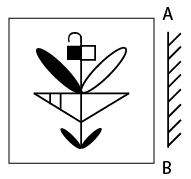
To find the mirror image of a figure with respect to a line, each point of the figure must be reflected across that line. The orientation and position of elements will be reversed relative to the line.
Option C correctly represents the mirror image of the original figure. The orientation and position of each element are accurately mirrored across the line AB.
Correct Option: C) Option C accurately reflects the figure across line AB.
This problem involves two objects moving towards each other. To find the time it takes for them to meet, we can use the concept of relative speed. When two objects move in opposite directions towards each other, their relative speed is the sum of their individual speeds. The time taken to meet is the total distance divided by their relative speed.
Since the two cars are moving towards each other, their relative speed is the sum of their individual speeds.
\[ \text{Relative Speed} = S_1 + S_2 \]\[ \text{Relative Speed} = 45 \text{ km/hr} + 53 \text{ km/hr} \]\[ \text{Relative Speed} = 98 \text{ km/hr} \]The time taken for them to pass each other is the total distance divided by their relative speed.
\[ \text{Time} = \frac{\text{Distance}}{\text{Relative Speed}} \]\[ \text{Time} = \frac{1029 \text{ km}}{98 \text{ km/hr}} \]\[ \text{Time} = 10.5 \text{ hours} \]D) 10.5 — The calculation shows that it will take 10.5 hours for the two cars to pass each other.
How many triangles are there in the following figure?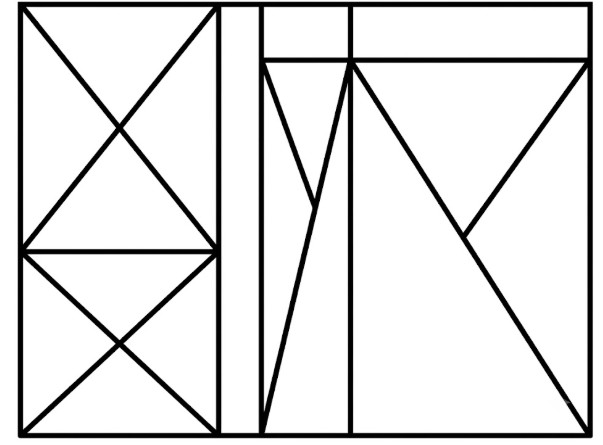
To solve this problem, we need to count all the triangles present in the given figure. This involves identifying both the smaller triangles and those formed by combining smaller triangles.
Correct Option: B) 27
This problem involves setting up a system of linear equations based on the given age conditions at different points in time (10 years ago, present, 10 years hence). We will define variables for the present ages of the mother and son, then translate the given statements into algebraic equations. Solving these simultaneous equations will give us their present ages, from which we can find the ratio.
Define variables: Let the present age of the mother be \(M\) years. Let the present age of the son be \(S\) years.
Formulate the first equation (10 years ago): 10 years ago, the mother's age was \(M - 10\) and the son's age was \(S - 10\). The problem states that the mother's age was thrice the age of her son:
\[ M - 10 = 3(S - 10) \] \[ M - 10 = 3S - 30 \] \[ M - 3S = -20 \quad \text{(Equation 1)} \]Formulate the second equation (10 years hence): 10 years hence (from now), the mother's age will be \(M + 10\) and the son's age will be \(S + 10\). The problem states that the mother's age will be twice that of her son:
\[ M + 10 = 2(S + 10) \] \[ M + 10 = 2S + 20 \] \[ M - 2S = 10 \quad \text{(Equation 2)} \]Solve the system of equations: We have two linear equations: (1) \(M - 3S = -20\) (2) \(M - 2S = 10\)
Subtract Equation 1 from Equation 2:
\[ (M - 2S) - (M - 3S) = 10 - (-20) \] \[ M - 2S - M + 3S = 10 + 20 \] \[ S = 30 \]So, the present age of the son is 30 years.
Find the mother's present age: Substitute \(S = 30\) into Equation 2 (or Equation 1):
\[ M - 2(30) = 10 \] \[ M - 60 = 10 \] \[ M = 70 \]So, the present age of the mother is 70 years.
Calculate the ratio of their present ages: The ratio of the mother's age to the son's age is \(M : S\).
\[ \text{Ratio} = \frac{M}{S} = \frac{70}{30} = \frac{7}{3} \]The ratio is \(7 : 3\).
Correct Option: C) 7 : 3
The question asks for the native place of Sagar Baheti, the first visually impaired Indian runner to complete the Boston Marathon. This is a factual recall question related to current affairs or general knowledge about notable Indian personalities.
Correct Option: B) Bengaluru
Sagar Baheti, a visually impaired runner, made history by becoming the first Indian to complete the Boston Marathon. He is originally from Bengaluru, Karnataka. He ran the marathon to raise awareness about corneal blindness and encourage organ donation.
Find the odd one out.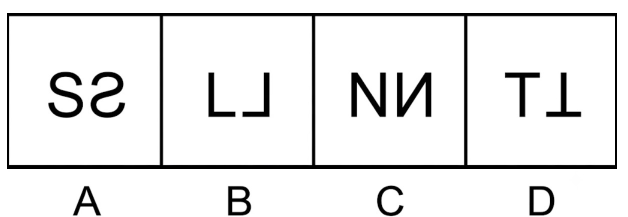
To find the odd one out, we need to identify a pattern or characteristic that three of the options share, which the fourth does not. Each option contains a pair of letters arranged in a specific orientation.
Correct Option: C) Option C is the odd one out because the letters "NN" are oriented in opposite directions, unlike the other options.
To answer this question, we need to recall the classification of the plant kingdom, specifically the characteristics of Thallophyta (Algae) and Bryophyta. Thallophytes are simple, undifferentiated plant bodies, while Bryophytes show some differentiation into stem-like and leaf-like structures, but lack true roots, stems, and leaves.
Correct Option: C) Riccia
In a garden of 42 trees, \( \frac{3}{7} \) of them are Neem trees and the rest are Mango trees. Find the number of Mango trees.
The problem asks us to find the number of Mango trees in a garden. We are given the total number of trees and the fraction of Neem trees. We can solve this by first calculating the number of Neem trees, and then subtracting that from the total number of trees to find the number of Mango trees. Alternatively, we can find the fraction of Mango trees and then calculate the number of Mango trees directly.
Alternative Method:
Both methods yield the same result.
Correct Option: B) 24
The question asks to identify the 16th Honourable Speaker of the Lok Sabha. This requires knowledge of the history of Lok Sabha Speakers and their tenures.
Correct Option: A) Sumitra Mahajan was the Speaker of the 16th Lok Sabha, serving from 2014 to 2019. She was the second woman to hold the office of Speaker of the Lok Sabha, after Meira Kumar.
The problem requires calculating the fund allocated for product development this year. We are given the total fund allocated last year and the percentage of this fund that went to product development. We are also told that this year's fund for product development increased by one-third compared to last year.
Last year, the total fund allocated for various activities was Rs. 20,00,000. Product development accounted for 30% of this fund.
\[ \text{Fund for product development last year} = 30\% \text{ of } 20,00,000 \]\[ = \frac{30}{100} \times 20,00,000 \]\[ = 30 \times 20,000 \]\[ = 6,00,000 \text{ Rs.} \]The fund for new product development has increased by one-third of the fund allocated last year for product development.
\[ \text{Increase in fund} = \frac{1}{3} \times \text{Fund for product development last year} \]\[ = \frac{1}{3} \times 6,00,000 \]\[ = 2,00,000 \text{ Rs.} \]The fund for this year is the sum of last year's fund and the increase.
\[ \text{Fund for product development this year} = \text{Fund last year} + \text{Increase} \]\[ = 6,00,000 + 2,00,000 \]\[ = 8,00,000 \text{ Rs.} \]A) The calculated fund for product development this year is Rs. 8,00,000.