
If the intensity of the rustle of the leaves is 10-11 Wm-2, what will be the level of intensity due to that rustle?
To determine the level of intensity (in decibels) from a given sound intensity, we use the formula for sound intensity level. This formula relates the measured intensity to a reference intensity, which is typically the threshold of human hearing.
Thus, the level of intensity due to the rustle of leaves is 10 dB.
B) 10 dB — This is the correct calculation based on the formula for sound intensity level using the given intensity and the standard reference intensity.
The problem is a letter-coding analogy. We need to identify the pattern or rule that transforms the first word (SANDY) into the second word (HZMWB). Once the rule is found, we apply the same rule to the third word (CRATE) to find the fourth word.
Let's write down the letters and their corresponding positions in the English alphabet (A=1, B=2, ..., Z=26):
Now, let's look for a pattern. Notice that the letters in the second word are often 'opposite' or related by a fixed sum to the letters in the first word.
The pattern is that each letter in the first word is replaced by its opposite letter in the alphabet.
We will find the opposite letter for each letter in CRATE:
So, CRATE becomes XIZGV.
B) XIZGV is the correct option as it matches the derived pattern where each letter is replaced by its opposite letter in the alphabet.
The question asks for the language in which the award-winning film 'Little Magician' was made. This requires knowledge of specific film details, particularly its origin language.
D) Malayalam — The film 'Little Magician' is the English title for the Malayalam film 'Kuttichathan', which was India's first 3D film and was originally made in Malayalam.
A man lifts a weight of 20 kg to a height of 5 m from the ground. The work done by him is _____. [g = 10 ms-2]
The problem asks us to calculate the work done by a man lifting a weight. Work done against gravity is calculated as the product of the force required to lift the object (which is equal to its weight) and the vertical distance through which it is lifted. The formula for work done is \(W = F \times d\), where \(F\) is the force and \(d\) is the distance. In this case, the force is the weight of the object, which is \(m \times g\).
The force \(F\) required to lift the weight against gravity is equal to its weight.
\[ F = m \times g \]\[ F = 20 \text{ kg} \times 10 \text{ ms}^{-2} \]\[ F = 200 \text{ N} \]Work done \(W\) is the product of the force applied and the distance moved in the direction of the force.
\[ W = F \times h \]\[ W = 200 \text{ N} \times 5 \text{ m} \]\[ W = 1000 \text{ Nm} \]The unit of work (Newton-meter) is also known as Joule (J).
\[ W = 1000 \text{ J} \]C) 1000 J — The calculation shows that the work done is 1000 Joules, which is the correct unit for work.
The following bar graph shows the sales of personal computers by the company XYZ in the last 11 years.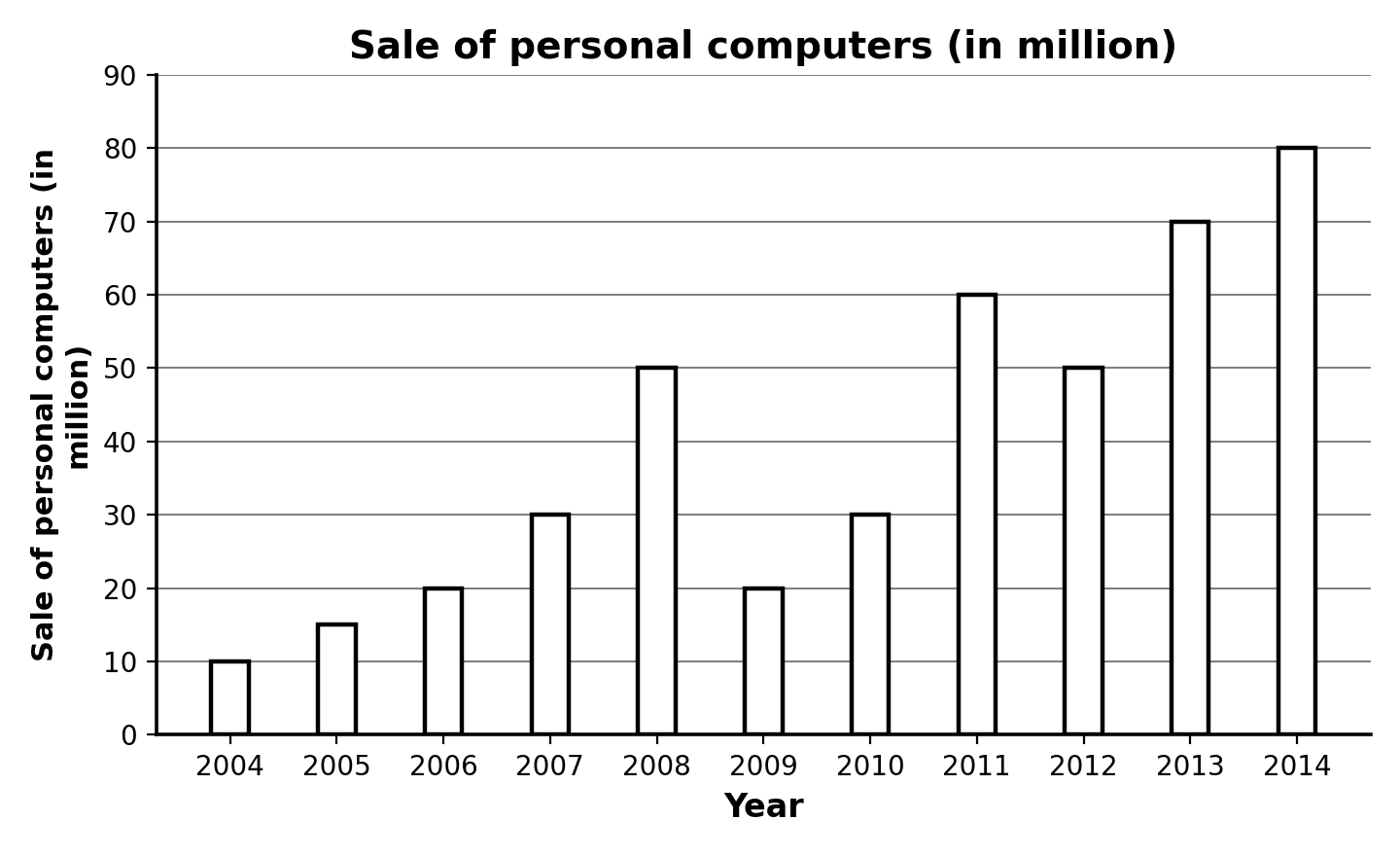
How many units (in million) of personal computers were sold by the company XYZ in the year 2007?
To determine the number of personal computers sold by company XYZ in 2007, we need to refer to the bar graph provided. The graph displays the sales in millions for each year from 2004 to 2014.
Correct Option: C) 30
This question tests general knowledge about significant political appointments in India during a specific period. To answer correctly, one needs to recall the Union Cabinet reshuffles and ministerial portfolios around March 2018.
B) Smriti Irani was the Union Minister for Information and Broadcasting in March 2018. She held this portfolio from July 2017 to May 2018.
The problem presents a series of terms, each consisting of a letter, a number, and another letter. To find the next term, we need to identify the pattern in the letters and the numbers separately.
The first letters are W, U. Let's find their positions in the English alphabet:
The pattern is \(23 - 2 = 21\). So, the next first letter should be \(21 - 2 = 19\). The 19th letter of the alphabet is S.
The numbers are 23, 21. The pattern is \(23 - 2 = 21\). So, the next number should be \(21 - 2 = 19\).
The second letters are T, R. Let's find their positions in the English alphabet:
The pattern is \(20 - 2 = 18\). So, the next second letter should be \(18 - 2 = 16\). The 16th letter of the alphabet is P.
The third numbers are 7, 9. The pattern is \(7 + 2 = 9\). So, the next third number should be \(9 + 2 = 11\).
Combining the next first letter (S), the next number (19), the next second letter (P), and the next third number (11), we get S19P11.
A) S19P11 is the correct answer because it follows all the identified patterns for letters and numbers.
This question asks us to evaluate two conclusions based on given statements. We need to determine which conclusions logically follow from the provided information. The key is to stick strictly to the information given in the statements and not introduce outside knowledge or assumptions.
D) Only conclusion (2) follows.
Conclusion (2) directly follows from the statement that "Population explosion is the major cause of the lack of natural resources." If population explosion causes a lack of resources, it means population growth is a burden on those resources.
To solve this problem, we first need to determine the Cost Price (CP) of the article using the given Selling Price (SP) and the percentage loss. Once the CP is known, we can calculate the new Selling Price required to achieve a 5% profit.
Correct Option: C) Rs 241.5
The question asks to identify the odd one out from the given options. We need to find a common characteristic among three of the options and identify the one that does not share that characteristic.
Correct Option: B) London