
The following picture shows the color preferences of a group of girls. The circle represents the pink color, the triangle represents the blue color and the rectangle represents the white color. Which group of girls like blue or pink color but not the white color?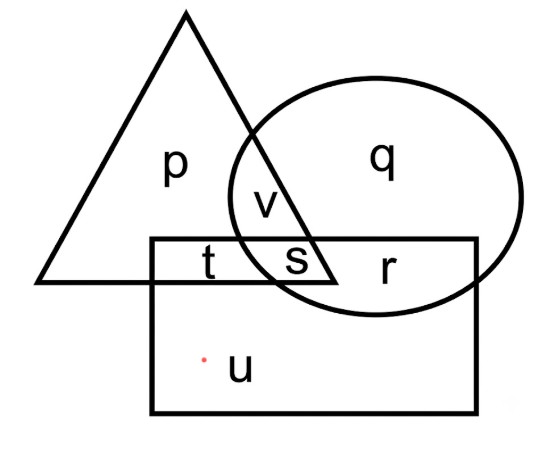
To find the group of girls who like either blue or pink color but not the white color, we need to identify the sections of the diagram that are part of the circle (pink) or triangle (blue) but not the rectangle (white).
Correct Option: B) p + v + q
The question asks for the founding date of the Telugu Desam Party (TDP) by N.T. Rama Rao. This is a factual recall question related to Indian political history.
Correct Option: B) 29 March 1982
The question asks to identify the state government that launched the 'Ammavin Arann' app for women's safety in 2017. This is a factual question related to government initiatives and current affairs.
Correct Option: B) Tamil Nadu
The 'Ammavin Arann' app was formally launched by the Government of Tamil Nadu in February 2017. The name "Amma" (meaning mother) is a popular reference to the late Chief Minister J. Jayalalithaa, and many welfare schemes in Tamil Nadu are named after her. The app was designed to enhance women's safety by allowing them to send distress signals to pre-selected contacts and the police.
What will be the next term of the given series?
G - 7, K - 11, O - 15, S - 19
The problem presents a series of terms, each consisting of a letter and a number. We need to identify the pattern in both the letters and the numbers separately to find the next term in the series.
The given letters are G, K, O, S.
Let's find the difference in their alphabetical positions:
The pattern for the letters is that each subsequent letter is 4 positions ahead in the alphabet. So, the next letter will be 4 positions after S.
S is the 19th letter. The next letter will be the \(19 + 4 = 23\text{rd}\) letter, which is W.
The given numbers are 7, 11, 15, 19.
Let's find the difference between consecutive numbers:
The pattern for the numbers is that each subsequent number increases by 4. So, the next number will be \(19 + 4 = 23\).
The next letter is W and the next number is 23. Therefore, the next term in the series is W - 23.
D) W - 23 — This option correctly follows both the letter and number patterns identified.
The question asks for the winner of the 2016-17 Deodhar Trophy. This requires specific knowledge of Indian domestic cricket tournament results for that particular season.
C) Tamil Nadu — Tamil Nadu won the 2016-17 Deodhar Trophy by defeating India B in the final.
The question asks to identify the recipient of the Padma Vibhushan in 2018 for contributions to literature and education. This requires knowledge of the Padma Awards recipients for that specific year and their respective fields.
B) P. Parameswaran was a prominent Indian philosopher, writer, and social worker. He was awarded the Padma Vibhushan in 2018 for his exceptional and distinguished service in the field of literature and education, particularly for his work in propagating nationalist and spiritual thought.
If cos 3x = 4cos3 x – 3cos x, then sec 135° =?
The problem asks for the value of \(\sec 135^\circ\). The given identity \(\cos 3x = 4\cos^3 x - 3\cos x\) is a standard trigonometric identity and is not directly needed to solve for \(\sec 135^\circ\). We need to evaluate \(\sec 135^\circ\) and then compare it with the given options by evaluating each option.
We know that \(\sec \theta = \frac{1}{\cos \theta}\). So, \(\sec 135^\circ = \frac{1}{\cos 135^\circ}\).
The angle \(135^\circ\) is in the second quadrant. In the second quadrant, cosine is negative.
We can write \(\cos 135^\circ = \cos (180^\circ - 45^\circ)\).
Using the identity \(\cos (180^\circ - \theta) = -\cos \theta\), we get:
\[ \cos 135^\circ = -\cos 45^\circ \]We know that \(\cos 45^\circ = \frac{1}{\sqrt{2}}\).
Therefore,
\[ \cos 135^\circ = -\frac{1}{\sqrt{2}} \]Now, substitute this back into the expression for \(\sec 135^\circ\):
\[ \sec 135^\circ = \frac{1}{-1/\sqrt{2}} = -\sqrt{2} \]We know that \(\cosec \theta = \frac{1}{\sin \theta}\). So, \(\cosec 45^\circ = \frac{1}{\sin 45^\circ}\).
We know that \(\sin 45^\circ = \frac{1}{\sqrt{2}}\).
Therefore, \(\cosec 45^\circ = \frac{1}{1/\sqrt{2}} = \sqrt{2}\).
So, \(-\cosec 45^\circ = -\sqrt{2}\).
We know that \(\cos 45^\circ = \frac{1}{\sqrt{2}}\).
From Option A, we found \(\cosec 45^\circ = \sqrt{2}\).
We know that \[\sec 45^\circ = \frac{1}{\cos 45^\circ} = \frac{1}{1/\sqrt{2}} = \sqrt{2}\].
We found that \(\sec 135^\circ = -\sqrt{2}\).
Comparing this with the evaluated options:
Thus, \(\sec 135^\circ = -\cosec 45^\circ\).
The identity \(\cos 3x = 4\cos^3 x - 3\cos x\) is a standard triple angle formula for cosine and is true, but it is extraneous information for this specific question.
A) \(-\cosec 45^\circ\) is correct because \(\sec 135^\circ = -\sqrt{2}\) and \(-\cosec 45^\circ = -\sqrt{2}\).
This question tests knowledge about the speed of sound in different gaseous mediums. The speed of sound varies depending on the properties of the medium, such as its density and elasticity. For gases, the speed of sound is generally higher in lighter gases at the same temperature.
Correct Option: D) Both A and B are correct.
To calculate the total energy consumed by the bulb in a week, we need to first determine the daily energy consumption and then multiply it by the number of days in a week. Energy consumption is typically measured in "units", where 1 unit is equal to 1 kilowatt-hour (kWh).
The power of the bulb is given as 100 W. It is used for 8 hours per day.
\[ \text{Daily Energy Consumption (in Watt-hours)} = \text{Power (in Watts)} \times \text{Time (in hours)} \]Substituting the given values:
\[ \text{Daily Energy Consumption} = 100 \text{ W} \times 8 \text{ h} = 800 \text{ Wh} \]Since 1 kWh = 1000 Wh, we convert the daily consumption:
\[ \text{Daily Energy Consumption (in kWh)} = \frac{800 \text{ Wh}}{1000} = 0.8 \text{ kWh} \]So, the bulb consumes 0.8 units of energy per day.
There are 7 days in a week. To find the total energy consumed in a week, multiply the daily consumption by 7:
\[ \text{Weekly Energy Consumption (in kWh)} = \text{Daily Energy Consumption (in kWh)} \times 7 \text{ days} \]Substituting the daily consumption:
\[ \text{Weekly Energy Consumption} = 0.8 \text{ kWh/day} \times 7 \text{ days} = 5.6 \text{ kWh} \]Therefore, the bulb will consume 5.6 units of energy in a week.
Correct Option: B) 5.6
To find the work done in moving a charge between two points, we use the fundamental relationship between work done, charge, and potential difference. The potential difference is defined as the work done per unit charge.
Identify the given values:
Recall the formula relating work done (\(W\)), charge (\(Q\)), and potential difference (\(V\)):
\[ V = \frac{W}{Q} \]Rearrange the formula to solve for work done (\(W\)):
\[ W = V \times Q \]Substitute the given values into the formula:
\[ W = 11 \, \text{V} \times 5 \, \text{C} \]Calculate the work done:
\[ W = 55 \, \text{J} \]The unit of work done is Joules (J).
Correct Option: C) 55 J is the correct work done, calculated by multiplying the potential difference by the charge.