
The question asks to identify an organism that reproduces by binary fission. Binary fission is a type of asexual reproduction where a single organism divides into two identical daughter organisms. We need to evaluate each option based on its known mode of reproduction.
Correct Option: A) Amoeba reproduces by binary fission, where one parent cell divides into two identical daughter cells.
The problem describes a triangular park with sides in the ratio 3:4:5 and a given perimeter. This ratio indicates a right-angled triangle. We need to find the perpendicular distance from the vertex opposite the largest side (which is the hypotenuse) to that side. This distance is essentially the altitude to the hypotenuse.
B) 24 — The perpendicular distance from the vertex opposite the largest side (hypotenuse) is 24 meters, as calculated by equating the area using different bases.
The question asks for the sequential order of the Mathura Refinery among Indian Oil's refineries. This requires knowledge of the history and commissioning of Indian Oil's various refineries.
Correct Option: C) The Mathura Refinery was the 6th refinery of Indian Oil to be commissioned, in 1982.
The following pie chart shows information on sales of a toy making company “XYZ” during 2017-18 financial year.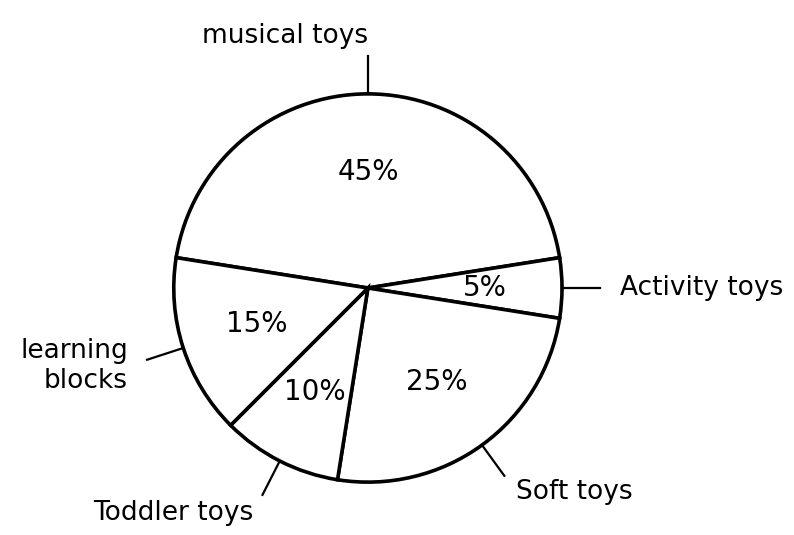
The total revenue made by sales of the toys was Rs. 38,72,000/-. Which type of toys made the highest revenue for the company?
Toddler toys
Musical toys
Soft toys
Learning blocks
To determine which type of toys generated the highest revenue for the company, we need to analyze the pie chart provided. The chart shows the percentage of total sales revenue contributed by each type of toy.
Correct Option: B) Musical toys
The question asks to identify the statement that is NOT true about the vascular system. We need to evaluate each option based on biological facts related to the human circulatory system.
Based on the evaluation, Option C contains an incorrect description of blood's color.
C) Blood is white or red vascular connective tissue
This statement is NOT true. Blood is a red vascular connective tissue. While plasma is yellowish and white blood cells are colorless, the presence of hemoglobin in red blood cells gives blood its characteristic red color. There is no such thing as "white blood" in the human vascular system in the context of its overall appearance.
To find the square root of 14161, we can use the estimation method by looking at the last digit and the range of squares, or by prime factorization, or by the long division method. Given the options, estimation is the quickest way to narrow down the possibilities.
A) 119 is the correct answer because its square is 14161.
To find the time when the two hands of a clock are at a right angle (90 degrees) between 4 and 5 o'clock, we can use the relative speed of the minute hand and the hour hand. The minute hand moves 6 degrees per minute, and the hour hand moves 0.5 degrees per minute. The relative speed is \(5.5\) degrees per minute. We need to consider the initial angle between the hands at 4 o'clock and then determine when the 90-degree angle is formed for the first time.
Calculate the angle covered by the minute hand in one minute:
The minute hand completes 360 degrees in 60 minutes.
\[ \text{Angle covered by minute hand in 1 minute} = \frac{360^{\circ}}{60} = 6^{\circ} \]Calculate the angle covered by the hour hand in one minute:
The hour hand completes 360 degrees in 12 hours (720 minutes).
\[ \text{Angle covered by hour hand in 1 minute} = \frac{360^{\circ}}{720} = 0.5^{\circ} \]Calculate the relative speed of the minute hand with respect to the hour hand:
The minute hand gains on the hour hand at a rate of:
\[ \text{Relative speed} = 6^{\circ} - 0.5^{\circ} = 5.5^{\circ} \text{ per minute} \]Determine the initial angle between the hands at 4 o'clock:
At 4 o'clock, the hour hand is exactly at 4, and the minute hand is at 12. The angle between two consecutive numbers on a clock face is \(360^{\circ} / 12 = 30^{\circ}\). So, at 4 o'clock, the angle between the hands is:
\[ \text{Initial angle} = 4 \times 30^{\circ} = 120^{\circ} \]Calculate the time when the hands are at a right angle for the first time:
For the hands to be at a right angle (90 degrees) for the first time between 4 and 5 o'clock, the minute hand must gain on the hour hand such that the angle between them becomes 90 degrees. Since the initial angle is 120 degrees, the minute hand needs to reduce this angle to 90 degrees. This means the minute hand needs to cover an additional \(120^{\circ} - 90^{\circ} = 30^{\circ}\) relative to the hour hand to reach the first 90-degree position. However, this is incorrect. The minute hand moves past the hour hand. The minute hand starts at 12 (0 degrees) and the hour hand is at 4 (120 degrees). For the first right angle, the minute hand must be 90 degrees behind the hour hand, or 90 degrees ahead of the hour hand. Since the minute hand is moving faster, it will first be 90 degrees behind the hour hand, which means the minute hand will have covered an angle such that its position is \(120^{\circ} - 90^{\circ} = 30^{\circ}\) from the 12 position. This is the angle the minute hand must cover from 12 to be at 90 degrees with the hour hand.
Let \(t\) be the number of minutes past 4 o'clock. The angle covered by the minute hand is \(6t\). The angle covered by the hour hand is \(120 + 0.5t\). For the first right angle, the minute hand will be behind the hour hand. The angle between them will be \( (120 + 0.5t) - 6t = 90^{\circ} \).
Alternatively, we can use the formula for angles between hands:
Angle \( \theta = |30H - \frac{11}{2}M| \)
Here, \(H = 4\), and we want \( \theta = 90^{\circ} \).
So, \( 90 = |30(4) - \frac{11}{2}M| \)
\[ 90 = |120 - \frac{11}{2}M| \]Two possibilities:
Case 1: \( 120 - \frac{11}{2}M = 90 \)
\[ 120 - 90 = \frac{11}{2}M \]\[ 30 = \frac{11}{2}M \]\[ M = \frac{30 \times 2}{11} = \frac{60}{11} \]This is the first time the hands are at a right angle.
Case 2: \( 120 - \frac{11}{2}M = -90 \)
\[ 120 + 90 = \frac{11}{2}M \]\[ 210 = \frac{11}{2}M \]\[ M = \frac{210 \times 2}{11} = \frac{420}{11} \]This is the second time the hands are at a right angle.
The question asks for the first time, which is \( \frac{60}{11} \) minutes past 4 o'clock.
C) \( \frac{60}{11} \) min past 4 o’clock. This is derived from the first case where the angle between the hands is 90 degrees, calculated as \( \frac{60}{11} \) minutes past 4 o'clock.
This problem involves substituting given symbol transformations into a mathematical expression and then evaluating the expression using the order of operations (BODMAS/PEMDAS).
Correct Option: A) 411
The solubility of a substance depends on the principle "like dissolves like". This means that polar solutes tend to dissolve in polar solvents, and nonpolar solutes tend to dissolve in nonpolar solvents. We need to identify the nature of MgCl₂ (magnesium chloride) and then determine which of the given solvents matches its polarity.
Correct Option: D) Water. MgCl₂ is an ionic compound. Water is a highly polar solvent, and according to the "like dissolves like" principle, ionic compounds readily dissolve in polar solvents like water. The water molecules surround and separate the Mg²⁺ and Cl⁻ ions through hydration.
This question tests knowledge of the male reproductive system and the path of secretions from accessory glands. Understanding the anatomy and function of the prostate gland and its connection to the ejaculatory ducts and urethra is key.
Correct Option: C) Urethra