
Find odd one among following: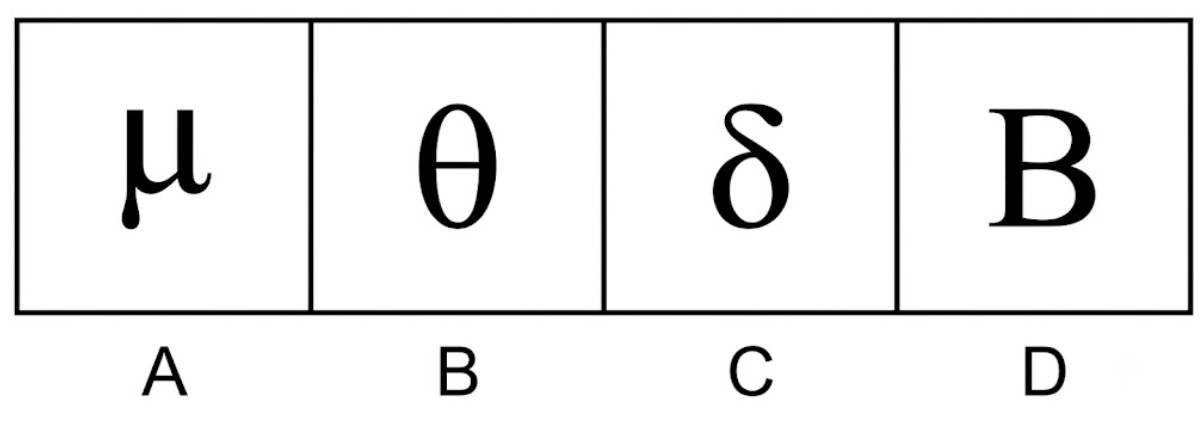
To find the odd one out, we need to identify which option does not belong to the same category as the others. In this case, we are looking at symbols that could be Greek letters or Latin letters.
The odd one out is the symbol that does not belong to the Greek alphabet. In this case, Option D is the Latin letter B, while the others are Greek letters.
Correct Option: B) D
A 73\( \frac{1}{2} \) m long wire is cut into 28 equal parts, then what is the length (in meters) of each piece?
2\( \frac{3}{5} \)
2\( \frac{5}{8} \)
2\( \frac{1}{4} \)
2\( \frac{6}{25} \)
To find the length of each piece, we need to divide the total length of the wire by the number of equal parts it is cut into. First, convert the mixed fraction representing the total length into an improper fraction, then perform the division.
Convert the total length to an improper fraction:
The total length of the wire is given as \(73\frac{1}{2}\) meters.
To convert a mixed fraction \(a\frac{b}{c}\) to an improper fraction, use the formula \(\frac{(a \times c) + b}{c}\).
So, \[73\frac{1}{2} = \frac{(73 \times 2) + 1}{2} = \frac{146 + 1}{2} = \frac{147}{2}\] meters.
Divide the total length by the number of parts:
The wire is cut into 28 equal parts.
Length of each piece \(=\) Total length \(\div\) Number of parts
Length of each piece \(=\frac{147}{2} \div 28\)
To divide by a whole number, we can write the whole number as a fraction (e.g., \(28 = \frac{28}{1}\)) and then multiply by its reciprocal.
Length of each piece \[=\frac{147}{2} \times \frac{1}{28}\]
Simplify the expression:
We can simplify the fraction by finding common factors between the numerator and the denominator.
Both 147 and 28 are divisible by 7.
\(147 \div 7 = 21\)
\(28 \div 7 = 4\)
So, Length of each piece \[=\frac{21}{2} \times \frac{1}{4} = \frac{21 \times 1}{2 \times 4} = \frac{21}{8}\] meters.
Convert the improper fraction back to a mixed fraction:
To convert \(\frac{21}{8}\) to a mixed fraction, divide 21 by 8.
\(21 \div 8 = 2\) with a remainder of \(21 - (8 \times 2) = 21 - 16 = 5\).
So, \[\frac{21}{8} = 2\frac{5}{8}\] meters.
Correct Option: B) \(2\frac{5}{8}\)
Read the given argument and assumptions carefully and select the assumption(s) that logically follows from the argument.
Argument:
Promotion in the security forces should be based on merit and not on seniority.
Assumptions:
1. Seniority does not reflect the abilities of individuals.
2. It is possible to measure the abilities of a person.
Neither of the assumptions 1 and 2 follows.
Both assumptions 1 and 2 follow.
Only assumption 2 follows.
Only assumption 1 follows.
The problem asks us to identify which assumptions logically follow from the given argument. An assumption is an unstated premise that must be true for the argument to hold. We need to evaluate each assumption in relation to the argument's core statement.
If seniority *did* reflect the abilities of individuals, then basing promotion on seniority would, by extension, be basing it on ability (merit). In such a scenario, there would be no need to argue for promotion based on merit *instead* of seniority. The argument's insistence on merit *over* seniority strongly suggests that the speaker believes seniority is not an adequate indicator of merit or ability. Therefore, this assumption is necessary for the argument to be logical.
The argument advocates for promotion based on "merit." Merit, in this context, refers to the abilities or performance of individuals. If it were impossible to measure or assess a person's abilities, then advocating for promotion based on "merit" would be impractical and meaningless. For the argument to be a viable recommendation, the underlying premise must be that such measurement is feasible. Therefore, this assumption is also necessary for the argument to be logical.
B) Both assumptions 1 and 2 follow. Both assumptions are crucial for the argument. The argument proposes a shift from seniority to merit, which implies that seniority is not a good proxy for merit (Assumption 1). Furthermore, for merit-based promotion to be implemented, it must be possible to measure merit (Assumption 2).
The question asks for the structural unit of the kidney. This requires knowledge of basic human anatomy and physiology, specifically the organs of the excretory system and their microscopic structures.
The kidney is composed of millions of tiny filtering units. These units are responsible for the entire process of blood filtration, reabsorption of useful substances, and secretion of waste, ultimately forming urine. This functional and structural unit is known as the nephron.
D) Nephron — The nephron is indeed the fundamental structural and functional unit of the kidney. Each human kidney contains about one million nephrons, which are responsible for filtering blood and forming urine.
This problem involves a reduction in price and a corresponding increase in the quantity of items that can be purchased for a fixed amount of money. We can solve this by first calculating the effective reduction in money spent per mango, then finding the reduced price per mango, and finally working backward to find the original price.
Understand the Price Reduction: The price of mangoes is reduced by 20%. This means the new price is 80% of the original price.
Calculate the Value of Extra Mangoes: Due to the 20% price reduction, a person can buy 12 more mangoes for Rs. 15. This implies that the Rs. 15 now effectively buys the original quantity plus 12 extra mangoes. The 20% reduction in Rs. 15 is the amount of money that allows the purchase of these 12 extra mangoes.
Amount saved (which buys 12 mangoes) \( = 20\% \) of Rs. 15
\[ = \frac{20}{100} \times 15 = \frac{1}{5} \times 15 = \text{Rs. } 3 \]Calculate the Reduced Price per Mango: The Rs. 3 saved is enough to buy 12 mangoes at the reduced price. Therefore, the reduced price per mango is:
\[ \text{Reduced price per mango} = \frac{\text{Rs. } 3}{12 \text{ mangoes}} = \text{Rs. } 0.25 \text{ per mango} \]Convert to Paisa: Since the options are in paisa, convert Rs. 0.25 to paisa.
\[ \text{Rs. } 0.25 = 0.25 \times 100 \text{ paisa} = 25 \text{ paisa/mango} \]Calculate the Original Price per Mango: The reduced price (25 paisa) is 80% of the original price. Let the original price be \(P\).
\[ 80\% \text{ of } P = 25 \text{ paisa} \]\[ \frac{80}{100} \times P = 25 \]\[ P = \frac{25 \times 100}{80} \]\[ P = \frac{25 \times 10}{8} \]\[ P = \frac{250}{8} \]\[ P = 31.25 \text{ paisa/mango} \]C) 31.25 paisa/mango — This is the calculated original price of the mangoes before the reduction.
The question asks to identify the field with which Mallika Sarabhai is associated. This requires general knowledge about prominent Indian personalities and their contributions.
Mallika Sarabhai is a renowned Indian classical dancer and activist. She is the daughter of the celebrated classical dancer Mrinalini Sarabhai and the space scientist Vikram Sarabhai. She is particularly known for her performances in Bharatanatyam and Kuchipudi, and for using her art for social change.
B) Classical dance — Mallika Sarabhai is an internationally acclaimed classical dancer, known for her expertise in Bharatanatyam and Kuchipudi, and for her work as a choreographer and activist.
This problem can be solved using the Pythagorean theorem. The ladder, the wall, and the ground form a right-angled triangle. The length of the ladder is the hypotenuse, the height of the window is one leg, and the distance between the bottom of the ladder and the wall is the other leg.
The Pythagorean theorem states that in a right-angled triangle, the square of the hypotenuse (the side opposite the right angle) is equal to the sum of the squares of the other two sides.
\[ a^2 + b^2 = c^2 \]B) The distance between the bottom of the ladder and the wall is 8 m.
This problem involves relating distance, speed, and time. We can set up equations based on the given information about different speeds and the corresponding time differences from the scheduled arrival time. By finding the difference in time taken for the two given speeds, we can calculate the total distance.
Let the distance be \(D\) km and the scheduled time be \(T\) hours.
Case 1: Speed = 57 km/hr
Manav reached 3 minutes earlier. So, the time taken is \(T - 3 \text{ minutes}\).
Convert minutes to hours: \[3 \text{ minutes} = \frac{3}{60} = \frac{1}{20} \text{ hours}\].
Time taken \(= T - \frac{1}{20}\) hours.
Using the formula \(\text{Distance} = \text{Speed} \times \text{Time}\):
\[ D = 57 \left(T - \frac{1}{20}\right) \quad \text{(Equation 1)} \]Case 2: Speed = 51 km/hr
Manav reached 1 minute late. So, the time taken is \(T + 1 \text{ minute}\).
Convert minutes to hours: \(1 \text{ minute} = \frac{1}{60} \text{ hours}\).
Time taken \(= T + \frac{1}{60}\) hours.
Using the formula \(\text{Distance} = \text{Speed} \times \text{Time}\):
\[ D = 51 \left(T + \frac{1}{60}\right) \quad \text{(Equation 2)} \]Equate Equation 1 and Equation 2 to solve for \(T\):
\[ 57 \left(T - \frac{1}{20}\right) = 51 \left(T + \frac{1}{60}\right) \] \[ 57T - \frac{57}{20} = 51T + \frac{51}{60} \] \[ 57T - 51T = \frac{51}{60} + \frac{57}{20} \] \[ 6T = \frac{51}{60} + \frac{57 \times 3}{20 \times 3} \] \[ 6T = \frac{51}{60} + \frac{171}{60} \] \[ 6T = \frac{51 + 171}{60} \] \[ 6T = \frac{222}{60} \] \[ T = \frac{222}{60 \times 6} = \frac{222}{360} \] \[ T = \frac{37}{60} \text{ hours} \]Substitute the value of \(T\) into either Equation 1 or Equation 2 to find \(D\). Using Equation 1:
\[ D = 57 \left(T - \frac{1}{20}\right) \] \[ D = 57 \left(\frac{37}{60} - \frac{1}{20}\right) \] \[ D = 57 \left(\frac{37}{60} - \frac{3}{60}\right) \] \[ D = 57 \left(\frac{37 - 3}{60}\right) \] \[ D = 57 \left(\frac{34}{60}\right) \] \[ D = 57 \times \frac{17}{30} \] \[ D = \frac{969}{30} \] \[ D = 32.3 \text{ km} \]Alternative Method (using time difference):
Let \(D\) be the distance. Let \(t_1\) be the time taken at 57 km/hr and \(t_2\) be the time taken at 51 km/hr.
\[ t_1 = \frac{D}{57} \text{ hours} \] \[ t_2 = \frac{D}{51} \text{ hours} \]The difference in arrival times is \(3 \text{ minutes early} - (-1 \text{ minute late}) = 3 + 1 = 4 \text{ minutes}\).
Convert 4 minutes to hours: \[4 \text{ minutes} = \frac{4}{60} = \frac{1}{15} \text{ hours}\].
Since the second speed is slower, \(t_2\) will be greater than \(t_1\).
\[ t_2 - t_1 = \frac{1}{15} \] \[ \frac{D}{51} - \frac{D}{57} = \frac{1}{15} \]Find the LCM of 51 and 57. \(51 = 3 \times 17\), \(57 = 3 \times 19\). LCM \(= 3 \times 17 \times 19 = 969\).
\[ \frac{19D - 17D}{969} = \frac{1}{15} \] \[ \frac{2D}{969} = \frac{1}{15} \] \[ 2D = \frac{969}{15} \] \[ D = \frac{969}{30} \] \[ D = 32.3 \text{ km} \]Correct Option: B) 32.3 km
To find the second highest common factor (HCF) of two numbers, we first need to list all the factors of each number. Then, we identify the common factors and arrange them in descending order. The second number in this ordered list will be our answer.
Factors of 56 are numbers that divide 56 exactly without leaving a remainder.
\[ 56 = 1 \times 56 \]\[ 56 = 2 \times 28 \]\[ 56 = 4 \times 14 \]\[ 56 = 7 \times 8 \]Thus, the factors of 56 are \(1, 2, 4, 7, 8, 14, 28, 56\).Factors of 84 are numbers that divide 84 exactly without leaving a remainder.
\[ 84 = 1 \times 84 \]\[ 84 = 2 \times 42 \]\[ 84 = 3 \times 28 \]\[ 84 = 4 \times 21 \]\[ 84 = 6 \times 14 \]\[ 84 = 7 \times 12 \]Thus, the factors of 84 are \(1, 2, 3, 4, 6, 7, 12, 14, 21, 28, 42, 84\).The common factors are the numbers that appear in both lists of factors.
Common factors of 56 and 84 are \(1, 2, 4, 7, 14, 28\).
Arranging the common factors in descending order, we get: \(28, 14, 7, 4, 2, 1\).
The highest common factor (HCF) is 28. The second highest common factor is the next number in the descending list, which is 14.
C) 14 — As determined in the step-by-step solution, the common factors of 56 and 84 are \(1, 2, 4, 7, 14, 28\). When arranged in descending order, the second highest is 14.
To find out when both bells will ring together again, we need to find the least common multiple (LCM) of the time intervals at which each bell rings. The LCM will give us the smallest time duration after which both events will coincide.
First, find the prime factorization of each number:
\[ 18 = 2 \times 3^2 \] \[ 60 = 2^2 \times 3 \times 5 \]To find the LCM, take the highest power of all prime factors present:
\[ \text{LCM}(18, 60) = 2^2 \times 3^2 \times 5 \] \[ \text{LCM}(18, 60) = 4 \times 9 \times 5 \] \[ \text{LCM}(18, 60) = 36 \times 5 \] \[ \text{LCM}(18, 60) = 180 \text{ seconds} \]Since 1 minute = 60 seconds, divide the total seconds by 60:
\[ \text{Time in minutes} = \frac{180 \text{ seconds}}{60 \text{ seconds/minute}} = 3 \text{ minutes} \]Both bells rang together at 4:00 p.m. They will ring together again after 3 minutes.
\[ 4:00 \text{ p.m.} + 3 \text{ minutes} = 4:03 \text{ p.m.} \]Correct Option: C) 4:03 p.m.