
To find the median of a set of data, we first need to arrange the data in ascending order. Then, we determine if the number of data points is odd or even. If it's odd, the median is the middle value. If it's even, the median is the average of the two middle values.
The given points are: 6, 17, 8, 9, 16, 10, 15, 21, 9, 11, 12, 16.
Arranging them in ascending order:
6, 8, 9, 9, 10, 11, 12, 15, 16, 16, 17, 21
There are 12 data points. So, \(n = 12\).
Since \(n = 12\), it is an even number.
When \(n\) is even, the median is the average of the \((n/2)\)-th term and the \((n/2 + 1)\)-th term.
From the sorted list (6, 8, 9, 9, 10, 11, 12, 15, 16, 16, 17, 21):
The median is the average of these two terms:
\[ \text{Median} = \frac{11 + 12}{2} = \frac{23}{2} = 11.5 \]Correct Option: A) 11.5
A person has divided a total of ₹3,70,000 into three parts and deposited them in three banks offering simple interests of 4%, 5%, and 6% respectively. At the end of 1st year, the interests received from all three banks are the same. How much has he deposited in those three banks?
₹1,50,000, ₹1,20,000, ₹1,00,000
₹1,00,000, ₹2,00,000, ₹70,000
₹70,000, ₹2,00,000, ₹1,00,000
₹1,20,000, ₹1,00,000, ₹1,50,000
This problem involves simple interest. We are given the total principal amount, the interest rates for three different banks, and the condition that the simple interest earned from all three banks is the same at the end of the first year. We need to find the individual amounts deposited in each bank. We can set up equations based on the simple interest formula and the given conditions to solve for the principal amounts.
Let the amounts deposited in the three banks be \(P_1\), \(P_2\), and \(P_3\) respectively.
The total amount deposited is ₹3,70,000. So, we have the equation:
\[ P_1 + P_2 + P_3 = 3,70,000 \quad \text{(Equation 1)} \]The simple interest formula is \(I = \frac{P \times R \times T}{100}\). Here, the time \(T = 1\) year for all banks.
The interest rates are \(R_1 = 4\%\), \(R_2 = 5\%\), and \(R_3 = 6\%\).
The problem states that the interests received from all three banks are the same. Let this common interest be \(I\).
\[ I = \frac{P_1 \times 4 \times 1}{100} = \frac{4P_1}{100} \] \[ I = \frac{P_2 \times 5 \times 1}{100} = \frac{5P_2}{100} \] \[ I = \frac{P_3 \times 6 \times 1}{100} = \frac{6P_3}{100} \]From the above, we can establish relationships between \(P_1\), \(P_2\), and \(P_3\):
\[ \frac{4P_1}{100} = \frac{5P_2}{100} = \frac{6P_3}{100} \] \[ 4P_1 = 5P_2 = 6P_3 \]Let \(4P_1 = 5P_2 = 6P_3 = k\) (where \(k\) is some constant).
\[ P_1 = \frac{k}{4} \] \[ P_2 = \frac{k}{5} \] \[ P_3 = \frac{k}{6} \]Substitute these values into Equation 1:
\[ \frac{k}{4} + \frac{k}{5} + \frac{k}{6} = 3,70,000 \]Find the least common multiple (LCM) of 4, 5, and 6, which is 60.
\[ \frac{15k}{60} + \frac{12k}{60} + \frac{10k}{60} = 3,70,000 \] \[ \frac{(15 + 12 + 10)k}{60} = 3,70,000 \] \[ \frac{37k}{60} = 3,70,000 \]Solve for \(k\):
\[ k = \frac{3,70,000 \times 60}{37} \] \[ k = 10,000 \times 60 \] \[ k = 6,00,000 \]Now, calculate \(P_1\), \(P_2\), and \(P_3\):
\[ P_1 = \frac{k}{4} = \frac{6,00,000}{4} = 1,50,000 \] \[ P_2 = \frac{k}{5} = \frac{6,00,000}{5} = 1,20,000 \] \[ P_3 = \frac{k}{6} = \frac{6,00,000}{6} = 1,00,000 \]Check if the sum is correct: \(1,50,000 + 1,20,000 + 1,00,000 = 3,70,000\). This matches the total amount.
Check if the interests are equal:
\[ I_1 = \frac{1,50,000 \times 4 \times 1}{100} = 6,000 \] \[ I_2 = \frac{1,20,000 \times 5 \times 1}{100} = 6,000 \] \[ I_3 = \frac{1,00,000 \times 6 \times 1}{100} = 6,000 \]All interests are equal, as required.
A) The amounts deposited are ₹1,50,000, ₹1,20,000, and ₹1,00,000, which matches our calculated values.
The question asks for the state where Nainital Lake is located. This is a factual question related to Indian geography. To answer this, one needs to recall the geographical location of prominent lakes in India.
Correct Option: C) Uttarakhand is the correct answer because Nainital Lake is a well-known geographical feature of this state.
The question asks to identify the recipient of the 2017 Hridaynath Mangeshkar Award. This is a factual question related to awards and honors, requiring knowledge of current affairs or general knowledge from that period.
Correct Option: C) Javed Akhtar was indeed conferred with the 2017 Hridaynath Mangeshkar Award for his significant contributions to Indian cinema as a lyricist and screenwriter.
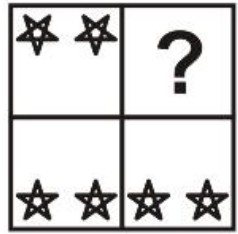
Select the correct figure that replaces the (?) symbol above the given options: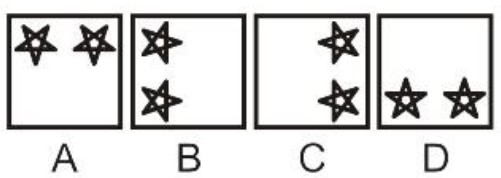
To solve this problem, we need to identify the pattern in the given figures and determine which option correctly completes the sequence.
Correct Option: D) Two stars
To determine the nature of the reciprocal of a negative rational number, we need to understand what a rational number is, what a negative number is, and how to find a reciprocal. We will then apply these definitions to a general negative rational number.
C) is a negative rational number. As shown in the step-by-step explanation, if we take any negative rational number, say \(-\frac{2}{3}\), its reciprocal is \(-\frac{3}{2}\), which is also a negative rational number. The sign of a number does not change when finding its reciprocal.
You are given a question and two statements. Identify which of the statements is/are sufficient to answer the question.
Question:
Find the total number of cubes in a box.
Statements:
1. The box contains some blue, yellow, and white cubes.
2. The number of blue cubes is twice that of yellow cubes and the number of white cubes is 12.
Only 1 is sufficient
Only 2 is sufficient
Either 1 or 2 is sufficient
Both 1 and 2 are not sufficient
To determine if the statements are sufficient, we need to check if, using the information provided in each statement (individually or combined), we can find a unique numerical value for the total number of cubes in the box.
D) Both 1 and 2 are not sufficient
PM Narendra Modi launched the UDAN scheme on 25th April 2017 with a flight between ________ and New Delhi at subsidised rates.
The question asks about the inaugural flight route of the UDAN (Ude Desh ka Aam Naagrik) scheme launched by PM Narendra Modi on April 25, 2017. To answer this, one needs to recall the specific details of the scheme's launch, particularly the cities connected by its first subsidized flight.
B) Shimla — The first flight under the UDAN scheme was indeed between Shimla and New Delhi, making air travel accessible at subsidized rates.
If 8 sec2x − 7 tan2x = 11 and 0° ≤ x ≤ 90°, then x =?
The problem requires finding the value of \(x\) given a trigonometric equation and a range for \(x\). We will use the fundamental trigonometric identity relating \(\sec^2 x\) and \(\tan^2 x\) to simplify the given equation into a solvable form.
The given equation is:
\[ 8 \sec^2 x - 7 \tan^2 x = 11 \]Recall the trigonometric identity:
\[ \sec^2 x = 1 + \tan^2 x \]Substitute this identity into the given equation:
\[ 8 (1 + \tan^2 x) - 7 \tan^2 x = 11 \]Distribute the 8:
\[ 8 + 8 \tan^2 x - 7 \tan^2 x = 11 \]Combine the \(\tan^2 x\) terms:
\[ 8 + (8 - 7) \tan^2 x = 11 \]\[ 8 + \tan^2 x = 11 \]Isolate \(\tan^2 x\):
\[ \tan^2 x = 11 - 8 \]\[ \tan^2 x = 3 \]Take the square root of both sides:
\[ \tan x = \pm \sqrt{3} \]The given range for \(x\) is \(0^\circ \le x \le 90^\circ\). In this range, the tangent function is non-negative. Therefore, we consider only the positive value:
\[ \tan x = \sqrt{3} \]We know that \(\tan 60^\circ = \sqrt{3}\). Therefore:
\[ x = 60^\circ \]C) \(60^\circ\) is the correct value for \(x\) that satisfies the given equation and the condition \(0^\circ \le x \le 90^\circ\).
The question asks to identify the most malleable metal among the given options. Malleability is a property of metals that allows them to be hammered or pressed into thin sheets without breaking. This property is due to the metallic bonding where metal atoms can slide past each other without disrupting the overall metallic structure.
Correct Option: D) Gold