
To solve this problem, we need to add a series of decimal numbers. The most straightforward way to do this is to align the decimal points vertically and then perform standard addition.
0.295 2.950 29.500 295.000 -------Notice that we've added trailing zeros to ensure all numbers have the same number of decimal places (three in this case), which helps in aligning the digits correctly.
A) \(327.745\) is the correct sum obtained by aligning the decimal points and adding the numbers.
The data below shows the consumption of rice for different cities in India for 2012: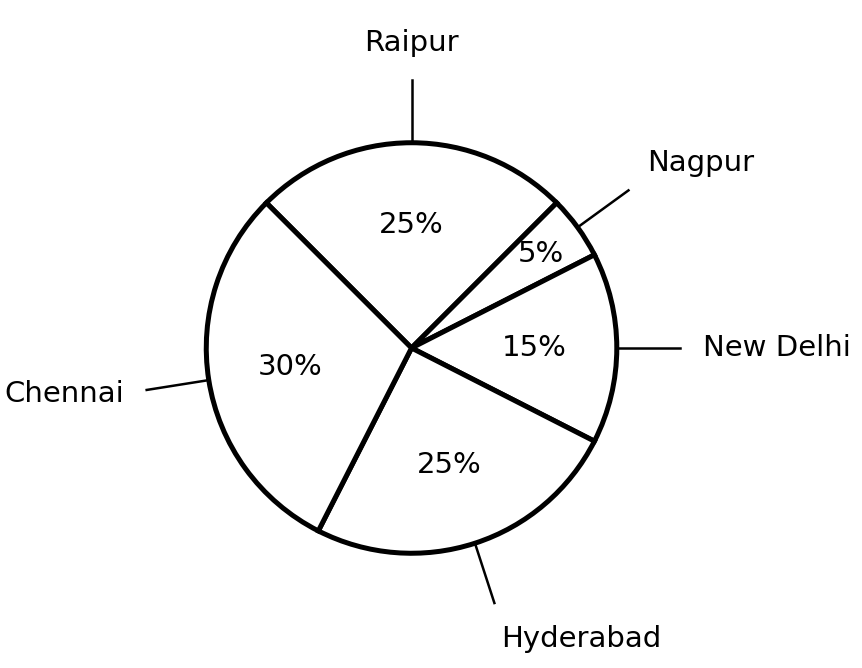
If the total rice consumption for the year 2012 is 2 lakh tonnes then how much was consumed by Nagpur?
To determine the rice consumption in Nagpur, we need to use the percentage given in the pie chart and apply it to the total consumption for the year 2012.
\[ \text{Consumption by Nagpur} = \frac{5}{100} \times 200,000 = 10,000 \text{ tonnes} \]
Thus, the rice consumption by Nagpur is 10,000 tonnes.
Correct Option: B) 10,000 tons
This is a blood relation question. We need to deduce the relationship between Raj and Sheetal's mother by breaking down the given statement step-by-step.
Correct Option: C) Husband — As deduced, if Raj is Sheetal's father, then he must be married to Sheetal's mother, making him her husband.
The question asks to identify the primary element used in solar panels. Solar panels, specifically photovoltaic (PV) cells, convert sunlight into electricity. This process relies on semiconductor materials.
Correct Option: B) Silicon is the most common and crucial element used in the manufacturing of photovoltaic solar panels due to its semiconductor properties.
If cosec θ + cot θ = 2.5, then cosec θ =?
The problem can be solved using a fundamental trigonometric identity involving cosec \(\theta\) and cot \(\theta\). We are given an equation relating cosec \(\theta\) and cot \(\theta\), and we need to find the value of cosec \(\theta\).
Recall the trigonometric identity:
\[ \text{cosec}^2 \theta - \text{cot}^2 \theta = 1 \]Factor the left side of the identity using the difference of squares formula \((a^2 - b^2) = (a-b)(a+b)\):
\[ (\text{cosec } \theta - \text{cot } \theta)(\text{cosec } \theta + \text{cot } \theta) = 1 \]We are given that \(\text{cosec } \theta + \text{cot } \theta = 2.5\). Substitute this value into the factored identity:
\[ (\text{cosec } \theta - \text{cot } \theta)(2.5) = 1 \]Solve for \(\text{cosec } \theta - \text{cot } \theta\):
\[ \text{cosec } \theta - \text{cot } \theta = \frac{1}{2.5} \]\[ \text{cosec } \theta - \text{cot } \theta = \frac{10}{25} \]\[ \text{cosec } \theta - \text{cot } \theta = 0.4 \]Now we have a system of two linear equations:
Equation (1): \(\text{cosec } \theta + \text{cot } \theta = 2.5\)
Equation (2): \(\text{cosec } \theta - \text{cot } \theta = 0.4\)
Add Equation (1) and Equation (2) to eliminate cot \(\theta\):
\[ (\text{cosec } \theta + \text{cot } \theta) + (\text{cosec } \theta - \text{cot } \theta) = 2.5 + 0.4 \]\[ 2 \text{ cosec } \theta = 2.9 \]Solve for cosec \(\theta\):
\[ \text{cosec } \theta = \frac{2.9}{2} \]\[ \text{cosec } \theta = 1.45 \]A) 1.45 is the correct value for cosec \(\theta\).
The question asks for the location of India's first uranium mines, specifically the Jaduguda mines. This requires knowledge of the geographical distribution of mineral resources in India.
Correct Option: B) Jharkhand
The Jaduguda uranium mines, which were the first to be operational in India, are located in the East Singhbhum district of Jharkhand. They are operated by Uranium Corporation of India Limited (UCIL).
Read the following information carefully and answer the question that’s given below.
A medical representative plans to visit each of six hospitals A, B, C, D, E, and F exactly once during the course of one day. He is setting up his schedule for the day according to the following conditions:
i. He must visit B before D.
ii. He must visit A before B and E.
iii. The third hospital he visits must be C.
Which of the following must be true of the medical representative’s schedule?
He visited A before D
He visited C before A
He visited B before E
He visited D before E
This problem involves scheduling visits to six hospitals (A, B, C, D, E, F) exactly once, subject to certain conditions. We need to determine which statement must be true based on these conditions. We will analyze each condition and deduce the necessary relationships between the hospital visits.
A) He visited A before D
From condition (ii), we know \(A \rightarrow B\). From condition (i), we know \(B \rightarrow D\). Combining these two, we get the transitive relationship \(A \rightarrow B \rightarrow D\). This implies that A must always be visited before D, regardless of C's position or the other hospitals. Therefore, this statement must be true.
What day would it be on 21st March 2020?
To determine the day of the week for a specific date, we use the concept of "odd days" or "extra days". Odd days are the remainder when the number of days is divided by 7. We calculate the total number of odd days from a reference date (e.g., 1st January 1 AD) to the given date and then map this number to a day of the week.
Reference Point: We usually consider 1st January 1 AD as the starting point. However, for practical purposes, we can use a known date, or calculate odd days from the start of centuries.
This pattern repeats every 400 years.
Odd days up to 2000 years:
\(2000 \text{ years} = 4 \times 500 \text{ years}\). Since \(400 \text{ years}\) have \(0\) odd days, \(2000 \text{ years}\) also have \(0\) odd days.
Odd days in 2019 years (from 2001 to 2019):
We need to calculate odd days for the years from 2001 to 2019. This is a period of 19 years.
Odd days in 2020 until 21st March:
2020 is a leap year (divisible by 4).
Total Odd Days:
Total odd days = (Odd days up to 2000 years) + (Odd days in 2019 years) + (Odd days in 2020 up to 21st March)
Total odd days = \(0 + 2 + 4 = 6\) odd days.
Determine the Day:
We map the odd days to days of the week, usually starting with Sunday as 0 or Monday as 1.
Since we have 6 odd days, the day would be Saturday.
A) Saturday is the correct day for 21st March 2020.
The kinetic energy of an object of mass m, which is moving with a velocity of 5 m s-1, is 25 J. What will be its kinetic energy when its velocity is doubled?
The problem asks us to find the new kinetic energy of an object when its velocity is doubled, given its initial kinetic energy and velocity. We will use the formula for kinetic energy, which relates it to mass and velocity.
The kinetic energy (\(KE\)) of an object of mass \(m\) moving with velocity \(v\) is given by:
\[ KE = \frac{1}{2} m v^2 \]Given initial kinetic energy \(KE_1 = 25 \, \text{J}\) and initial velocity \(v_1 = 5 \, \text{m s}^{-1}\).
\[ 25 = \frac{1}{2} m (5)^2 \]\[ 25 = \frac{1}{2} m (25) \]To find \(m\):
\[ m = \frac{25 \times 2}{25} \]\[ m = 2 \, \text{kg} \]The problem states that the velocity is doubled. So, the new velocity \(v_2\) will be:
\[ v_2 = 2 \times v_1 \]\[ v_2 = 2 \times 5 \, \text{m s}^{-1} \]\[ v_2 = 10 \, \text{m s}^{-1} \]Now, use the mass \(m = 2 \, \text{kg}\) and the new velocity \(v_2 = 10 \, \text{m s}^{-1}\) to find the new kinetic energy \(KE_2\):
\[ KE_2 = \frac{1}{2} m v_2^2 \]\[ KE_2 = \frac{1}{2} (2) (10)^2 \]\[ KE_2 = 1 \times 100 \]\[ KE_2 = 100 \, \text{J} \]B) 100 J. When the velocity is doubled, the kinetic energy becomes four times the original kinetic energy because kinetic energy is proportional to the square of the velocity (\(KE \propto v^2\)). If \(v\) becomes \(2v\), then \(KE\) becomes \((2v)^2 = 4v^2\), so the new kinetic energy is \(4 \times 25 \, \text{J} = 100 \, \text{J}\).
Find the next one for the series given below:
Q-10 ,O-12 ,M-14,?
The problem presents a series of letter-number pairs. We need to identify the pattern in both the letters and the numbers separately to find the next element in the series.
D) K-16 is the correct option because it follows both the letter pattern (decreasing by 2 in alphabetical order) and the number pattern (increasing by 2).