
The value of acceleration due to gravity on the Moon is how many times the value of acceleration due to gravity on Earth?
The acceleration due to gravity on any celestial body depends on its mass and radius. We need to compare the acceleration due to gravity on the Moon to that on Earth using their respective masses and radii.
The formula for acceleration due to gravity (\(g\)) on a celestial body is given by:
\[ g = \frac{GM}{R^2} \]where \(G\) is the universal gravitational constant, \(M\) is the mass of the celestial body, and \(R\) is its radius.
Let \(g_E\) be the acceleration due to gravity on Earth and \(g_M\) be the acceleration due to gravity on the Moon.
For Earth:
\[ g_E = \frac{GM_E}{R_E^2} \]where \(M_E\) is the mass of Earth and \(R_E\) is the radius of Earth.
For Moon:
\[ g_M = \frac{GM_M}{R_M^2} \]where \(M_M\) is the mass of the Moon and \(R_M\) is the radius of the Moon.
We need to find the ratio \( \frac{g_M}{g_E} \). Let's divide the expression for \(g_M\) by the expression for \(g_E\):
\[ \frac{g_M}{g_E} = \frac{\frac{GM_M}{R_M^2}}{\frac{GM_E}{R_E^2}} = \frac{M_M}{M_E} \times \frac{R_E^2}{R_M^2} \]We know the following approximate values:
Substitute these values into the ratio:
\[ \frac{g_M}{g_E} = \frac{0.0123 M_E}{M_E} \times \frac{R_E^2}{(0.27 R_E)^2} = 0.0123 \times \frac{1}{0.27^2} \]\[ \frac{g_M}{g_E} = 0.0123 \times \frac{1}{0.0729} \approx 0.0123 \times 13.71 \approx 0.168 \]This value is approximately \( \frac{1}{6} \).
Therefore, \(g_M \approx \frac{1}{6} g_E\).
A) \( \frac{1}{6} \) is the correct ratio. The acceleration due to gravity on the Moon is approximately one-sixth the acceleration due to gravity on Earth. This is a commonly known and accepted value in physics.
The problem is a coding-decoding question. We need to identify the pattern used to convert 'CODE' into '31545' and then apply the same pattern to convert 'FEAR'. The pattern usually involves assigning numerical values to letters based on their alphabetical position.
D) 65118 is the correct code for 'FEAR' based on the identified pattern.
If the numerator of a fraction \( \frac{y}{x} \) is increased by 12%, and its denominator is decreased by 2%, the value of that fraction becomes \( \frac{6}{7} \). Find the original fraction
\( \frac{3}{4} \)
\( \frac{4}{3} \)
\( \frac{2}{5} \)
\( \frac{1}{5} \)
We are given an original fraction \( \frac{y}{x} \) and told how its numerator and denominator change, leading to a new fraction value. We need to set up an equation based on these changes and solve for the original fraction.
Let the original fraction be \( \frac{y}{x} \).
The numerator \( y \) is increased by 12%. The new numerator will be:
\[ y + 0.12y = y(1 + 0.12) = 1.12y \]The denominator \( x \) is decreased by 2%. The new denominator will be:
\[ x - 0.02x = x(1 - 0.02) = 0.98x \]The new fraction formed by these changes is \( \frac{1.12y}{0.98x} \). We are given that this new fraction is equal to \( \frac{6}{7} \).
\[ \frac{1.12y}{0.98x} = \frac{6}{7} \]Now, we need to solve for the original fraction \( \frac{y}{x} \). We can rewrite the equation as:
\[ \frac{y}{x} \times \frac{1.12}{0.98} = \frac{6}{7} \]To find \( \frac{y}{x} \), we isolate it:
\[ \frac{y}{x} = \frac{6}{7} \times \frac{0.98}{1.12} \]Perform the multiplication. It's often easier to convert decimals to fractions or simplify them first.
\[ \frac{0.98}{1.12} = \frac{98}{112} \]Simplify the fraction \( \frac{98}{112} \). Both are divisible by 14:
\[ 98 \div 14 = 7 \]\[ 112 \div 14 = 8 \]\[ \frac{98}{112} = \frac{7}{8} \]Substitute this back into the equation for \( \frac{y}{x} \):
\[ \frac{y}{x} = \frac{6}{7} \times \frac{7}{8} \]Cancel out the 7s and simplify:
\[ \frac{y}{x} = \frac{6}{8} = \frac{3}{4} \]A) \( \frac{3}{4} \) is the original fraction, as derived from the calculations.
Select the alternative figure which is related to the third figure in the same way that the second figure is related to the first.
Question figures: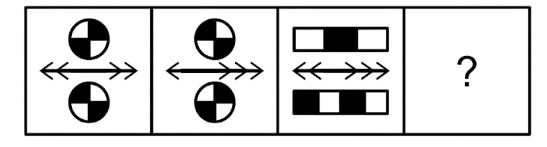
Answer figures: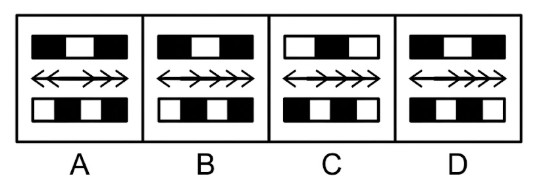
The problem involves identifying a pattern between pairs of figures. The first pair of figures shows a transformation, and the task is to apply a similar transformation to the second pair.
Correct Option: D) The rectangles are rotated 180 degrees, matching the transformation pattern.
The question asks to identify the other region, besides Madras, where the Ryotwari system was initially implemented. This requires knowledge of the historical context and geographical spread of British land revenue systems in India.
Correct Option: A) The Ryotwari system was primarily introduced and implemented in the Madras Presidency and the Bombay Presidency. Therefore, Bombay is the correct answer.
This problem involves relative speed. We can set up a system of two linear equations based on the given conditions (bodies moving towards each other and moving in the same direction) and then solve for the individual speeds.
Let the speed of the first body be \(v_1\) m/s and the speed of the second body be \(v_2\) m/s.
Condition 1: Bodies moving towards each other.
When two bodies move towards each other, their relative speed is the sum of their individual speeds. The distance between them decreases at this relative speed.
Given that the distance decreases at the rate of 6 m/s, we have:
\[ v_1 + v_2 = 6 \quad \text{(Equation 1)} \]Condition 2: Bodies moving in the same direction.
When two bodies move in the same direction, their relative speed is the absolute difference between their individual speeds. The distance between them increases at this relative speed (assuming \(v_1 > v_2\)).
Given that the distance increases at the rate of 4 m/s, we have:
Let's assume \(v_1 > v_2\). Then:
\[ v_1 - v_2 = 4 \quad \text{(Equation 2)} \]Solve the system of equations.
We have two linear equations:
Equation 1: \(v_1 + v_2 = 6\)
Equation 2: \(v_1 - v_2 = 4\)
Add Equation 1 and Equation 2:
\[ (v_1 + v_2) + (v_1 - v_2) = 6 + 4 \] \[ 2v_1 = 10 \] \[ v_1 = \frac{10}{2} \] \[ v_1 = 5 \text{ m/s} \]Substitute the value of \(v_1\) into Equation 1:
\[ 5 + v_2 = 6 \] \[ v_2 = 6 - 5 \] \[ v_2 = 1 \text{ m/s} \]Thus, the speeds of the two bodies are 5 m/s and 1 m/s.
B) 5 m/s, 1 m/s. This matches our calculated speeds.
Match the following.
| List I | List II |
| I. Atomic theory of matter | A. Compounds |
| II. Potassium Sulphate | B. Co |
| III. Sodium | C. John Dalton |
| IV. Cobalt | D. Na |
I - C, II - A, III - D, IV - B
I - B, II - A, III - D, IV - C
I - C, II - D, III - A, IV - B
I - A, II - C, III - D, IV - B
The question asks us to match items from List I with their corresponding descriptions or symbols from List II. This requires knowledge of fundamental chemistry concepts, including atomic theory, chemical formulas, and elemental symbols.
Combining these matches, we get: I - C, II - A, III - D, IV - B.
Correct Option: A) I - C, II - A, III - D, IV - B
From the top of a platform 18 m high, the angle of elevation of the top of the tower is 30°. If the platform is located 75\(\sqrt{3}\) m away from the tower, then what is the height of the tower?
This problem involves trigonometry, specifically the concept of angles of elevation. We need to use the tangent function to relate the angle of elevation, the horizontal distance, and the vertical height. We will first find the height of the part of the tower above the platform and then add the height of the platform to get the total height of the tower.
Let the height of the platform be \(h_p = 18 \text{ m}\).
Let the horizontal distance between the platform and the tower be \(d = 75\sqrt{3} \text{ m}\).
Let the angle of elevation of the top of the tower from the top of the platform be \(\theta = 30^\circ\).
Let the height of the tower above the platform be \(x\). This forms a right-angled triangle where \(x\) is the opposite side to the angle \(\theta\), and \(d\) is the adjacent side.
Using the tangent function:
\[ \tan(\theta) = \frac{\text{opposite}}{\text{adjacent}} \] \[ \tan(30^\circ) = \frac{x}{d} \]We know that \(\tan(30^\circ) = \frac{1}{\sqrt{3}}\). Substitute the values:
\[ \frac{1}{\sqrt{3}} = \frac{x}{75\sqrt{3}} \]Solve for \(x\):
\[ x = \frac{75\sqrt{3}}{\sqrt{3}} \] \[ x = 75 \text{ m} \]The total height of the tower, \(H\), is the sum of the height of the platform and the height of the tower above the platform:
\[ H = h_p + x \] \[ H = 18 \text{ m} + 75 \text{ m} \] \[ H = 93 \text{ m} \]A) 93 m is the correct height of the tower, as calculated by adding the height of the platform to the height of the tower above the platform.
The question asks to identify the first Indian to receive the Ihsan Doğramacı Family Health Foundation Award from the WHO in January 2018. This is a factual question related to awards and recognitions in the medical field, often covered in current affairs sections of competitive exams.
Correct Option: C) Dr Vinod Paul. Dr. Vinod Paul, a renowned pediatrician and member of NITI Aayog, was awarded the Ihsan Doğramacı Family Health Foundation Award by the World Health Organization (WHO) in January 2018. He was recognized for his significant contributions to child health, particularly in reducing child mortality and promoting newborn care in India. This made him the first Indian to receive this prestigious award.
Select the figure that is different from the others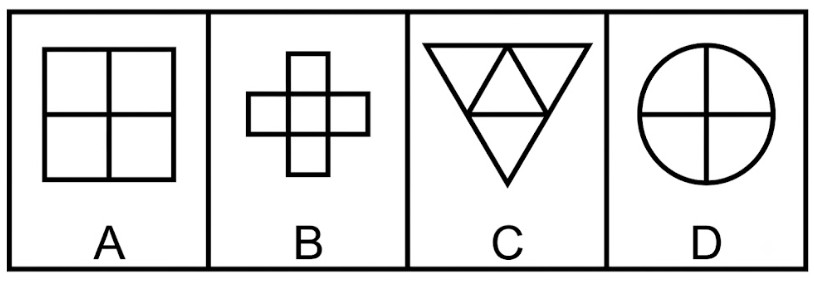
The task is to identify the figure that is different from the others based on their geometric properties.
Correct Option: C) Figure C is different because it uses triangles instead of squares or circles.