
Based on the given graph, which two farms have the same number of sheep?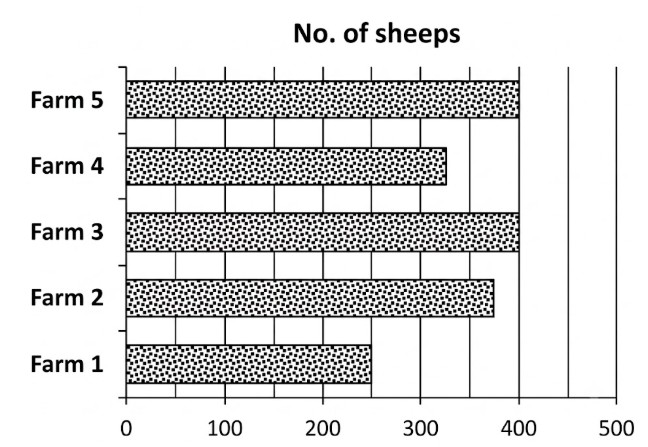
farm 3 and farm 2
farm 3 and farm 1
farm 4 and farm 5
farm 3 and farm 5
To determine which two farms have the same number of sheep, we need to analyze the bar graph provided and compare the lengths of the bars representing each farm.
Correct Option: D) farm 3 and farm 5
The force of attraction between two bodies at a distance r is F. If the force becomes \( \frac{1}{9} \)F, then what will be the new distance between the bodies (compared with r)?
This problem involves understanding Newton's Law of Universal Gravitation, which describes the force of attraction between two bodies. The key is to recognize the inverse square relationship between the force and the distance between the bodies. We will set up an equation for the initial force and then for the new force, and solve for the new distance.
According to Newton's Law of Universal Gravitation, the force of attraction (\(F\)) between two bodies with masses \(m_1\) and \(m_2\) separated by a distance \(r\) is given by the formula:
\[ F = G \frac{m_1 m_2}{r^2} \]where \(G\) is the gravitational constant.
We are given that the initial force is \(F\) when the distance is \(r\). So, we can write:
\[ F = G \frac{m_1 m_2}{r^2} \quad \text{(Equation 1)} \]The new force is given as \(F' = \frac{1}{9}F\). Let the new distance be \(r'\). Then, the new force can be written as:
\[ F' = G \frac{m_1 m_2}{(r')^2} \quad \text{(Equation 2)} \]Substitute \(F' = \frac{1}{9}F\) into Equation 2:
\[ \frac{1}{9}F = G \frac{m_1 m_2}{(r')^2} \quad \text{(Equation 3)} \]Now, substitute the expression for \(F\) from Equation 1 into Equation 3:
\[ \frac{1}{9} \left( G \frac{m_1 m_2}{r^2} \right) = G \frac{m_1 m_2}{(r')^2} \]We can cancel out the common terms \(G m_1 m_2\) from both sides of the equation:
\[ \frac{1}{9 r^2} = \frac{1}{(r')^2} \]Rearrange the equation to solve for \((r')^2\):
\[ (r')^2 = 9 r^2 \]Take the square root of both sides to find \(r'\):
\[ r' = \sqrt{9 r^2} \] \[ r' = 3r \]Thus, the new distance between the bodies will be three times the original distance.
A) Three times — As derived, the new distance \(r'\) is \(3r\), which means it is three times the original distance \(r\).
An object covers a distance of 20 m in 6 seconds and then another distance of 30 m in the next 4 seconds. What is the average speed of the object?
To find the average speed of an object, we need to calculate the total distance covered and divide it by the total time taken. The problem provides two segments of motion with their respective distances and times.
The object covers a distance of 20 m in the first segment and 30 m in the second segment.
\[ \text{Total Distance} = \text{Distance}_1 + \text{Distance}_2 \]\[ \text{Total Distance} = 20 \text{ m} + 30 \text{ m} = 50 \text{ m} \]The object takes 6 seconds for the first segment and 4 seconds for the second segment.
\[ \text{Total Time} = \text{Time}_1 + \text{Time}_2 \]\[ \text{Total Time} = 6 \text{ s} + 4 \text{ s} = 10 \text{ s} \]Average speed is defined as the total distance divided by the total time.
\[ \text{Average Speed} = \frac{\text{Total Distance}}{\text{Total Time}} \]\[ \text{Average Speed} = \frac{50 \text{ m}}{10 \text{ s}} = 5 \text{ m/s} \]The unit for speed is meters per second, which can be written as \( \text{m/s} \) or \( \text{ms}^{-1} \).
Correct Option: B) 5 ms -1
P is a point on a circle whose centre is C. A chord PQ whose length is equal to the radius of the circle is drawn. Find the acute angle (in radians) between the chord PQ and the tangent to the circle at P.
\( \frac{π}{6} \)
\( \frac{π}{4} \)
\( \frac{π}{2} \)
\( \frac{π}{3} \)
The problem asks for the acute angle between a chord and a tangent at one of the chord's endpoints. We will use properties of circles, specifically the relationship between the radius, chord, and tangent, and the angles formed in an equilateral triangle.
A) \( \frac{\pi}{6} \)
The angle between the chord PQ and the tangent at P is \(30^\circ\), which is equivalent to \( \frac{\pi}{6} \) radians.
The question asks to identify the individual known as the "Father of Taxonomy." This requires knowledge of key figures in the history of biological classification.
Correct Option: D) Carl Linnaeus is universally acknowledged as the "Father of Taxonomy" for his groundbreaking work in systematizing the naming and classification of organisms. He introduced binomial nomenclature, a system where each species is given a two-part name (genus and species), and developed a hierarchical classification system that is still largely in use today.
Which of the following constitutional amendment acts provided for the establishment of Panchayat Raj in India?
The question asks to identify the constitutional amendment act responsible for establishing Panchayat Raj in India. This requires knowledge of key constitutional amendments and their purposes.
Correct Option: D) The 73rd Constitutional Amendment Act, 1992, provided for the establishment of Panchayat Raj in India. It gave constitutional status to the Panchayati Raj Institutions and made provisions for a three-tier system of local self-governance at the village, intermediate, and district levels.
The problem asks us to identify implicit assumptions based on a given statement. An assumption is something taken for granted or accepted as true without proof. We need to analyze the statement carefully to determine what the speaker must believe for their statement to make sense.
Correct Option: D) Both Assumptions I and II are implicit
The question asks to identify which component of the human body is referred to as the 'Soldier'. This is a common analogy used to describe a specific function within the body, particularly related to defense and immunity.
A) WBC (White Blood Cells) are often called the 'soldiers' of the human body because they are the primary cells of the immune system, responsible for fighting off infections and protecting the body from foreign invaders and diseases.
The problem involves fractions representing the proportion of people sitting and the proportion of chairs occupied. We are given the number of empty chairs and need to find the number of people standing. We will first determine the total number of chairs, then the number of people sitting, and finally the number of people standing.
Correct Option: B) 21
The question asks about the factor that increases the potential energy of an object. We need to recall the formula for gravitational potential energy and analyze how each given option relates to it.
Correct Option: B) Height
The potential energy of an object increases with its height because gravitational potential energy is directly proportional to the height of the object above a reference point, as shown by the formula \(PE = mgh\).