
Choose the odd one from the options given below: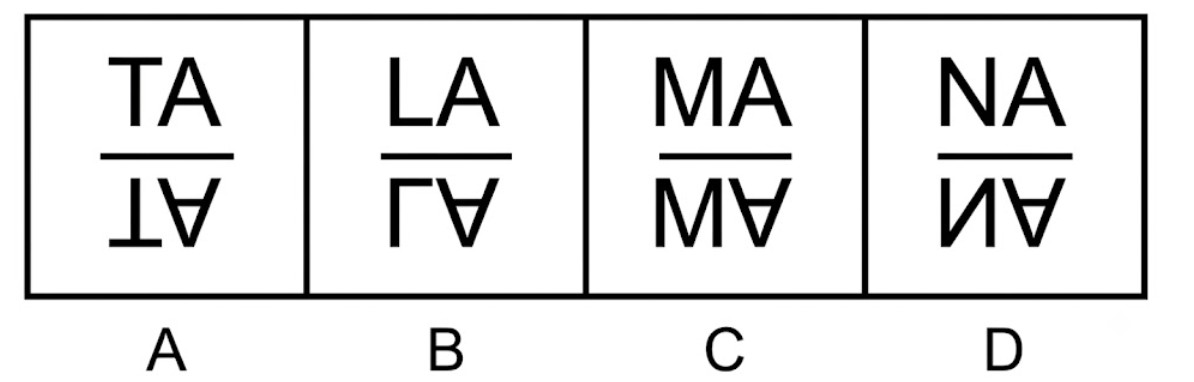
To identify the odd one out, examine the patterns or arrangements in each option. Look for consistency or deviation in the visual elements.
Correct Option: A) "TA" is reversed to "AT", not mirrored.
The question asks to identify which statement is NOT a property of a covalent compound. We need to recall the general characteristics of covalent compounds and compare them with the given options.
B) High melting point and boiling point
This statement is incorrect for covalent compounds. Covalent compounds are characterized by weak intermolecular forces, which means they require relatively little energy to break apart, leading to low melting and boiling points. High melting and boiling points are characteristic properties of ionic compounds or network solids (a special type of covalent compound, but generally, the term 'covalent compound' refers to molecular compounds).
The problem is a coding-decoding question. We need to identify the pattern or rule used to code the given words and then apply that rule to the word "TELEVISION" to find its code.
Correct Option: B) 9
This problem involves setting up an algebraic equation based on the given information about Manish's age at different points in time. We will define Manish's present age as a variable and then translate the conditions into an equation to solve for that variable.
Let Manish's present age be \(x\) years.
After 12 years, Manish's age will be \(x + 12\) years.
4 years ago, Manish's age was \(x - 4\) years.
According to the problem statement, after 12 years, Manish's age will be 3 times his age 4 years ago. So, we can write the equation:
\[ x + 12 = 3(x - 4) \]First, distribute the 3 on the right side of the equation:
\[ x + 12 = 3x - 12 \]Next, gather the \(x\) terms on one side and the constant terms on the other side. Subtract \(x\) from both sides:
\[ 12 = 3x - x - 12 \]\[ 12 = 2x - 12 \]Add 12 to both sides:
\[ 12 + 12 = 2x \]\[ 24 = 2x \]Divide by 2 to find \(x\):
\[ x = \frac{24}{2} \]\[ x = 12 \]Manish's present age is 12 years.
Correct Option: B) 12 Years
This is a work and time problem where two individuals, A and B, work on alternate days. We need to calculate their individual work rates, find their combined work over a two-day cycle, and then determine how many such cycles are needed to complete the work, accounting for any remaining work.
A can do a piece of work in 13 days. So, A's one day's work is:
\[ \text{A's 1 day work} = \frac{1}{13} \]B can do the same piece of work in 39 days. So, B's one day's work is:
\[ \text{B's 1 day work} = \frac{1}{39} \]A works on the first day, and B works on the second day. So, in 2 days, the total work done is:
\[ \text{Work in 2 days} = \text{A's 1 day work} + \text{B's 1 day work} = \frac{1}{13} + \frac{1}{39} \]To add these fractions, find a common denominator, which is 39:
\[ \text{Work in 2 days} = \frac{3}{39} + \frac{1}{39} = \frac{4}{39} \]Let \(N\) be the number of 2-day cycles. The total work done after \(N\) cycles will be \(N \times \frac{4}{39}\). We need this to be close to, but not exceeding, 1 (representing the full work). We want to find the largest integer \(N\) such that:
\[ N \times \frac{4}{39} < 1 \] \[ 4N < 39 \] \[ N < \frac{39}{4} \] \[ N < 9.75 \]So, the maximum number of full 2-day cycles is 9.
Work done in 9 cycles (18 days) is:
\[ \text{Work done in 18 days} = 9 \times \frac{4}{39} = \frac{36}{39} \]Remaining work is:
\[ \text{Remaining work} = 1 - \frac{36}{39} = \frac{39 - 36}{39} = \frac{3}{39} = \frac{1}{13} \]After 18 days (9 full cycles), it's the 19th day, and it's A's turn to work. A's daily work rate is \(\frac{1}{13}\). The remaining work is also \(\frac{1}{13}\). Therefore, A will complete the remaining work in 1 day.
Total days = Days in 9 cycles + Days for remaining work
\[ \text{Total days} = 18 + 1 = 19 \]C) 19
The question asks to identify the phylum whose animals are non-movable, also known as sessile. We need to recall the characteristics of each phylum listed in the options.
Based on these characteristics, Porifera is the phylum whose members are predominantly non-movable.
Correct Option: A) Porifera. Animals belonging to the phylum Porifera (sponges) are largely sessile, meaning they remain attached to a substrate and do not move from place to place.
To find the breadth of the rectangle, we will use the formula for the area of a rectangle, which is given by \( \text{Area} = \text{Length} \times \text{Breadth} \). We are given the area and the length, so we can rearrange the formula to solve for the breadth.
\[ \text{Area} = \text{Length} \times \text{Breadth} \]
\[ \text{Breadth} = \frac{\text{Area}}{\text{Length}} \]
\[ \text{Breadth} = \frac{12.46 \text{ m}^2}{3.5 \text{ m}} \]
\[ \text{Breadth} \approx 3.56 \text{ m} \]
Correct Option: A) 3.56
The breadth of the rectangle is approximately \( 3.56 \text{ m} \).
The question asks about the number of contrasting trait pairs involved in a dihybrid cross. Understanding the definition of a dihybrid cross is key to answering this question.
The second part of the statement, "The pairs of contrasting traits act independently, each pair assorts independently," refers to Mendel's Law of Independent Assortment, which is a fundamental principle observed in dihybrid crosses.
Correct Option: C) Two
To find Suman's total annual income, we need to calculate his annual income from agricultural land and add it to his annual salary. The problem provides information about his salary and the total income from agricultural land over five years, which is expressed as a percentage of his one-year salary.
Identify Suman's annual salary:
Suman's annual salary is given as Rs. 6,00,000.
Calculate the total income from agricultural land over five years:
The problem states that the total income from agricultural land over five years is 50% of his income from one year's salary.
Calculate the annual income from agricultural land:
Since the total agricultural income is for 5 years, divide it by 5 to find the annual agricultural income.
Calculate Suman's total annual income:
Suman's total annual income is the sum of his annual salary and his annual agricultural income.
Correct Option: B) Rs. 6,60,000
When two objects move towards each other, their relative speed is the sum of their individual speeds. This relative speed can then be used with the total distance to find the time taken to meet.
Since the cars are moving towards each other, their speeds add up to give the relative speed at which the distance between them is closing.
\[ \text{Relative Speed} = S_1 + S_2 \\ \text{Relative Speed} = 24 \text{ km/h} + 30 \text{ km/h} \\ \text{Relative Speed} = 54 \text{ km/h} \]The time taken for them to meet is the total distance divided by their relative speed.
\[ \text{Time} = \frac{\text{Distance}}{\text{Relative Speed}} \\ \text{Time} = \frac{86.4 \text{ km}}{54 \text{ km/h}} \\ \text{Time} = 1.6 \text{ hours} \]Correct Option: C) 1.6 Hours