
This problem involves calculating costs and profits in a chain of transactions. We need to work backward from the customer's payment to find the retailer's cost price, considering the profit margins at each step.
The customer pays Rs. 270. This is the selling price for the retailer.
The retailer sells the book to the customer at an 8% profit. Let the cost price for the retailer be \(C_R\). The selling price for the retailer (\(S_R\)) is given by:
\[ S_R = C_R + (0.08 \times C_R) \]\[ S_R = C_R (1 + 0.08) \]\[ S_R = 1.08 \times C_R \]We know \(S_R = \text{Rs. } 270\).
\[ 270 = 1.08 \times C_R \]\[ C_R = \frac{270}{1.08} \]\[ C_R = 250 \]D) Rs. 250 is the correct cost of the book for the retailer, as calculated by working backward from the customer's payment and accounting for the retailer's 8% profit margin.
When two items are sold at the same selling price, and one is sold at a certain percentage gain while the other is sold at the same percentage loss, there is always an overall loss. The formula for the overall loss percentage in such a scenario is \[\left(\frac{\text{common gain/loss percentage}}{10}\right)^2\]. Alternatively, we can calculate the cost price of each item and then find the total cost price and total selling price to determine the overall gain or loss.
Given Information:
Calculate Cost Price (CP) of the first power bank (with 20% gain):
If there is a gain of \( 20\% \), then \( \text{SP} = \text{CP} + 20\% \text{ of CP} = 1.20 \times \text{CP} \).
\[ \text{CP}_1 = \frac{\text{SP}}{1 + \frac{\text{Gain}\%}{100}} = \frac{2960}{1 + \frac{20}{100}} = \frac{2960}{1.20} = \frac{29600}{12} = \text{INR } 2466.67 \]Calculate Cost Price (CP) of the second power bank (with 20% loss):
If there is a loss of \( 20\% \), then \( \text{SP} = \text{CP} - 20\% \text{ of CP} = 0.80 \times \text{CP} \).
\[ \text{CP}_2 = \frac{\text{SP}}{1 - \frac{\text{Loss}\%}{100}} = \frac{2960}{1 - \frac{20}{100}} = \frac{2960}{0.80} = \frac{29600}{8} = \text{INR } 3700 \]Calculate Total Selling Price (Total SP):
\[ \text{Total SP} = \text{SP}_1 + \text{SP}_2 = 2960 + 2960 = \text{INR } 5920 \]Calculate Total Cost Price (Total CP):
\[ \text{Total CP} = \text{CP}_1 + \text{CP}_2 = 2466.67 + 3700 = \text{INR } 6166.67 \]Determine Overall Gain or Loss:
Since \( \text{Total CP} (6166.67) > \text{Total SP} (5920) \), there is an overall loss.
\[ \text{Overall Loss} = \text{Total CP} - \text{Total SP} = 6166.67 - 5920 = \text{INR } 246.67 \]Calculate Overall Loss Percentage:
\[ \text{Loss}\% = \frac{\text{Overall Loss}}{\text{Total CP}} \times 100 = \frac{246.67}{6166.67} \times 100 \approx 4\% \]Alternative Method using the direct formula:
When the selling price is the same and the gain percentage is equal to the loss percentage (say \( x\% \)), the overall transaction always results in a loss. The loss percentage is given by:
\[ \text{Loss}\% = \left(\frac{x}{10}\right)^2 \% \]Here, \( x = 20 \).
\[ \text{Loss}\% = \left(\frac{20}{10}\right)^2 \% = (2)^2 \% = 4\% \]The overall transaction results in a 4% loss.
Correct Option: C) 4% loss
This problem involves setting up and solving a system of linear equations based on the given age relationships. We will define variables for the current ages of Keong and Ryu, form equations from the provided information, and then solve for Ryu's current age.
Define variables for current ages:
Let Keong's current age be \(K\) years.
Let Ryu's current age be \(R\) years.
Formulate the first equation from the first statement:
"Keong is 25 years younger than Ryu" can be written as:
\[ K = R - 25 \quad \text{(Equation 1)} \]Determine their ages 12 years ago:
Keong's age 12 years ago \(= K - 12\)
Ryu's age 12 years ago \(= R - 12\)
Formulate the second equation from the second statement:
"12 years ago, Ryu’s age was 2.25 times that of Keong" can be written as:
\[ R - 12 = 2.25 \times (K - 12) \quad \text{(Equation 2)} \]Substitute Equation 1 into Equation 2:
Substitute \(K = R - 25\) into Equation 2:
\[ R - 12 = 2.25 \times ((R - 25) - 12) \]\[ R - 12 = 2.25 \times (R - 37) \]Solve for \(R\):
Distribute 2.25 on the right side:
\[ R - 12 = 2.25R - (2.25 \times 37) \]\[ R - 12 = 2.25R - 83.25 \]Rearrange the equation to isolate \(R\):
Subtract \(R\) from both sides:
\[ -12 = 1.25R - 83.25 \]Add 83.25 to both sides:
\[ 83.25 - 12 = 1.25R \]\[ 71.25 = 1.25R \]Divide by 1.25 to find \(R\):
\[ R = \frac{71.25}{1.25} \]\[ R = 57 \]Verify the answer (optional but recommended):
If Ryu's current age \(R = 57\), then Keong's current age \(K = 57 - 25 = 32\).
12 years ago:
Ryu's age \(= 57 - 12 = 45\)
Keong's age \(= 32 - 12 = 20\)
Check the condition: \(45 = 2.25 \times 20\)
\(45 = 45\). The condition holds true.
A) 57 is the correct age for Ryu now.
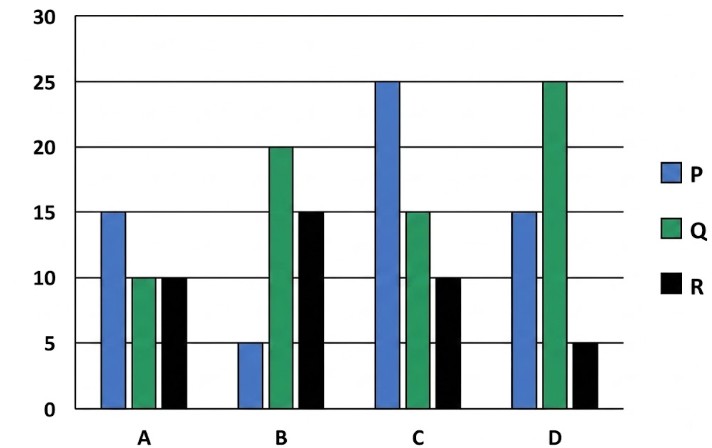
The above bar graph represents the production of three grains P, Q, R in four states A, B, C, D. The state that produced the minimum grains (all 3 combined) is∶
To determine which state produced the minimum total grains, we need to sum the production values of grains P, Q, and R for each state and compare them.
Correct Option: C) State C
This problem involves finding the square root of a number. We are given that the number of rows is equal to the number of chairs in each row, and the total number of chairs is 5184. If we let 'x' be the number of rows (and also the number of chairs per row), then the total number of chairs will be \(x \times x = x^2\). We need to find the value of 'x' by calculating the square root of 5184.
Let \(R\) be the number of rows.
Let \(C\) be the number of chairs in each row.
According to the problem, the number of rows is equal to the number of chairs in each row. So, \(R = C\).
The total number of chairs is given by the product of the number of rows and the number of chairs in each row:
\[ \text{Total Chairs} = R \times C \]Since \(R = C\), we can write:
\[ \text{Total Chairs} = R \times R = R^2 \]We are given that the total number of chairs is 5184. So,
\[ R^2 = 5184 \]To find \(R\), we need to take the square root of 5184:
\[ R = \sqrt{5184} \]We can find the square root by prime factorization or by estimation.
So, \(R = 72\).
Thus, there are 72 rows.
Correct Option: D) 72
Find the value of \(\frac{\sin45^\circ}{\sin30^\circ}\).
2
\(\sqrt{2}\)
2\(\sqrt{2}\)
\(\frac{1}{\sqrt{2}}\)
To find the value of the given trigonometric expression, we need to recall the standard values of sine for the angles \(45^\circ\) and \(30^\circ\). Once these values are known, we can substitute them into the expression and simplify.
Recall the standard trigonometric values:
Substitute these values into the given expression:
The expression is \(\frac{\sin45^\circ}{\sin30^\circ}\).
Substituting the values, we get:
\[ \frac{\frac{1}{\sqrt{2}}}{\frac{1}{2}} \]Simplify the complex fraction:
To divide by a fraction, we multiply by its reciprocal:
\[ \frac{1}{\sqrt{2}} \times \frac{2}{1} = \frac{2}{\sqrt{2}} \]Rationalize the denominator (optional but good practice, and often required for final answers):
Multiply the numerator and the denominator by \(\sqrt{2}\):
\[ \frac{2}{\sqrt{2}} \times \frac{\sqrt{2}}{\sqrt{2}} = \frac{2\sqrt{2}}{2} \]Cancel out the common factor:
The '2' in the numerator and denominator cancels out:
\[ \frac{2\sqrt{2}}{2} = \sqrt{2} \]Correct Option: B) The value of the expression is \(\sqrt{2}\).
We need to find Hari's current age. We are given three relationships between the ages of Damini, Hari, and Nipa at present and one relationship two years from now. We will set up a system of equations based on these relationships and solve for Hari's current age.
Correct Option: D) 5
The given number series is a classic example of the Fibonacci sequence. In a Fibonacci sequence, each number is the sum of the two preceding ones, starting from 0 and 1.
D) 21 is the correct answer because it follows the Fibonacci sequence rule where each number is the sum of the two preceding numbers.
Mr. X runs a marathon starting from point A. He runs 5 km towards north and reaches point B, then turns right, runs 6 km and reaches point C, then turns right, runs 8 km and reaches point D, then turns right, runs 10 km and reaches point E, then turns right, runs 6 km and reaches point F, then turns right, runs 1 km and reaches point G, then turns right, runs 3 km and reaches point H. The shortest distance between point D and G is?
This problem involves calculating the shortest distance between two points in a 2D plane, which can be found using the Pythagorean theorem. We need to track Mr. X's movements and determine the coordinates of points D and G relative to a starting point. Then, we can calculate the horizontal and vertical distances between D and G and apply the Pythagorean theorem.
Point D is at \((6, -3)\).
Point G is at \((-3, 3)\).
Horizontal distance (\(\Delta x\)) = \(|x_2 - x_1| = |-3 - 6| = |-9| = 9\) km.
Vertical distance (\(\Delta y\)) = \(|y_2 - y_1| = |3 - (-3)| = |3 + 3| = |6| = 6\) km.
Shortest distance \(d = \sqrt{(\Delta x)^2 + (\Delta y)^2}\)
\[ d = \sqrt{(9)^2 + (6)^2} \]
\[ d = \sqrt{81 + 36} \]
\[ d = \sqrt{117} \]
To simplify \(\sqrt{117}\), find its prime factors:
\[ 117 = 9 \times 13 = 3^2 \times 13 \]
So, \[ d = \sqrt{3^2 \times 13} = 3\sqrt{13} \text{ km} \]
C) \(3\sqrt{13}\) is the calculated shortest distance between point D and point G.
The question asks to identify a relationship between two terms and then apply the same relationship to find the missing term. The given analogy is "Beer : Fermentation : : ? : Decomposition". We need to find a term that undergoes decomposition, similar to how beer is produced through fermentation.
Correct Option: D) Vermicompost
Vermicompost is a product of the decomposition of organic matter by earthworms and microorganisms. This process is called vermicomposting, which is a form of decomposition. Therefore, Vermicompost is directly related to decomposition in the same way Beer is related to Fermentation (product of the process).