
This is a blood relation problem. To solve this, we need to break down the statement into smaller parts and identify the relationships step-by-step, starting from the end of the statement and working backwards to Neha.
D) Cousin — As derived from the step-by-step analysis, the person Neha is pointing at is her maternal uncle's daughter, which makes her Neha's cousin.
The given Venn diagram represents the sports preferences of a group of college students. There are three games: A - Basketball, B - Football and C - Volleyball. Based on the diagram, how many play exactly one game?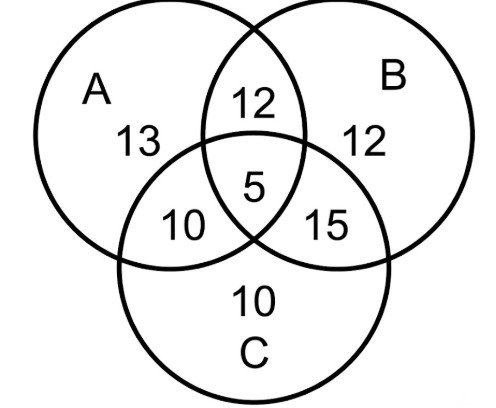
To find how many students play exactly one game, we need to identify the sections in the Venn diagram where only one circle is represented, excluding any overlap with other circles.
Correct Option: C) 38
What comes next in the given series?
6L, 9M, 14O, 21R,?
To solve this series, we need to identify the pattern in both the numbers and the letters separately. We will analyze the numerical sequence and the alphabetical sequence to find the rule governing each, and then apply these rules to find the next term.
The numbers in the series are 6, 9, 14, 21.
The differences are 3, 5, 7, which is a series of consecutive odd numbers. The next difference should be 9.
So, the next number in the series will be \(21 + 9 = 30\).
The letters in the series are L, M, O, R.
Let's look at the difference in their positions:
The differences are 1, 2, 3. The next difference should be 4.
So, the next letter will be 4 positions after R. The position of R is 18. Therefore, the next letter will be at position \(18 + 4 = 22\).
The letter at the 22nd position in the alphabet is V.
The next number is 30 and the next letter is V.
Therefore, the next term in the series is 30V.
C) 30V is the correct option as it follows both the numerical and alphabetical patterns identified.
The problem requires us to identify which assumption(s) are implicit in the given statement. An implicit assumption is something that is taken for granted or understood without being explicitly stated. We need to analyze the statement and each assumption to see if it logically follows from the statement.
C) Only assumption 2 implicit
The question asks to identify the odd one out from the given options. We need to analyze each option and find a common characteristic among three of them, while one option lacks that characteristic.
B) The Registrar is the odd one out because it refers to an administrative or judicial official, whereas MP, MLC, and MLA are all types of elected or nominated representatives in legislative bodies.
All these three (MP, MLC, MLA) are roles related to legislative representation, making 'The Registrar' the distinct option.
The question asks us to evaluate the strength of two arguments in response to a statement about using public transport to reduce air pollution. A strong argument directly supports or refutes the statement with a logical and generally accepted reason, while a weak argument might be based on personal convenience, exceptions, or an incomplete understanding of the issue.
Correct Option: A) Only argument I is strong. Argument I directly addresses the problem of air pollution by advocating for increased public transport use, which is a recognized method for reducing emissions. The exception for emergencies is practical and does not undermine the argument's strength.
What day of the week would it be on 30th March 2020?
To determine the day of the week for a specific date, we can use the concept of odd days. Odd days are the number of days remaining after dividing the total number of days by 7. We need a reference point, for which we'll use January 1, 2000, as a known day (Saturday). Then we calculate the total odd days from this reference to the target date, March 30, 2020.
Let's use another common method for clarity:
Let's re-verify the reference for Jan 1, 2000. It was indeed a Saturday.
So, if Dec 31, 2019 was Monday, then Jan 1, 2020 was Tuesday.
From Jan 1, 2020 (Tuesday) to March 30, 2020:
Total odd days = \(3 + 1 + 2 = 6\).
Starting from Tuesday, add 6 days: Tuesday + 6 days = Monday.
Correct Option: C) Monday
The question asks to identify which statement(s) are necessary/sufficient to explain why there was no major breakthrough in nuclear science study in Country X after 1975. We need to evaluate each statement individually and then in combination to determine if they provide a complete and satisfactory explanation for the lack of breakthroughs.
B) Both 1 and 2 together are not sufficient
Even if both statements are true, they do not provide a complete and exhaustive explanation for why there were no major breakthroughs. There could be numerous other factors at play, such as political decisions, lack of funding, brain drain, or a shift in research priorities, which are not covered by these two statements. Therefore, while they might be contributing factors, they are not jointly sufficient to fully answer the question.
This is a syllogism problem. We need to evaluate the given statements and determine which conclusions logically follow from them. We can use Venn diagrams or basic logical deduction to solve this.
Correct Option: A) Only conclusion 1 follows
The given Venn diagram represents the number of students in a class who study three languages, French, Spanish and Japanese.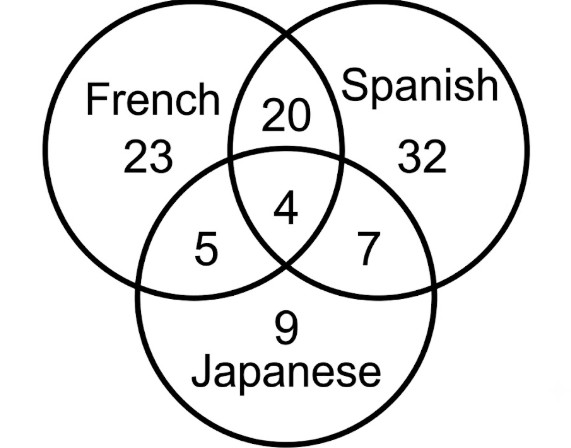
The number of students studying French, Spanish and Japanese is:
To determine the number of students studying all three languages, we need to identify the section of the Venn diagram where the circles representing French, Spanish, and Japanese overlap.
Correct Option: A) 4