
Find the value of 1\( \frac{7}{9} \) + \( \frac{5}{12} \) + \( \frac{7}{18} \)
\( \frac{32}{12} \)
\( \frac{31}{18} \)
\( \frac{31}{12} \)
\( \frac{31}{14} \)
To find the sum of the given fractions, we first convert the mixed fraction into an improper fraction. Then, we find the Least Common Multiple (LCM) of the denominators to express all fractions with a common denominator. Finally, we add the numerators and simplify the resulting fraction if possible.
The given mixed fraction is \(1 \frac{7}{9}\).
\[ 1 \frac{7}{9} = \frac{(1 \times 9) + 7}{9} = \frac{9 + 7}{9} = \frac{16}{9} \]The expression becomes:
\[ \frac{16}{9} + \frac{5}{12} + \frac{7}{18} \]The denominators are 9, 12, and 18.
Prime factorization of 9: \(3^2\)
Prime factorization of 12: \(2^2 \times 3\)
Prime factorization of 18: \(2 \times 3^2\)
LCM(\(9, 12, 18\)) = \(2^2 \times 3^2 = 4 \times 9 = 36\).
\[ \frac{16 \times 4}{9 \times 4} = \frac{64}{36} \]
\[ \frac{5 \times 3}{12 \times 3} = \frac{15}{36} \]
\[ \frac{7 \times 2}{18 \times 2} = \frac{14}{36} \]
Now, add the numerators while keeping the common denominator:
\[ \frac{64}{36} + \frac{15}{36} + \frac{14}{36} = \frac{64 + 15 + 14}{36} = \frac{93}{36} \]Both 93 and 36 are divisible by 3.
\[ \frac{93 \div 3}{36 \div 3} = \frac{31}{12} \]
C) \( \frac{31}{12} \) is the correct sum of the given fractions after converting to a common denominator and simplifying.
What is the minimum number of lines required to create the following figure?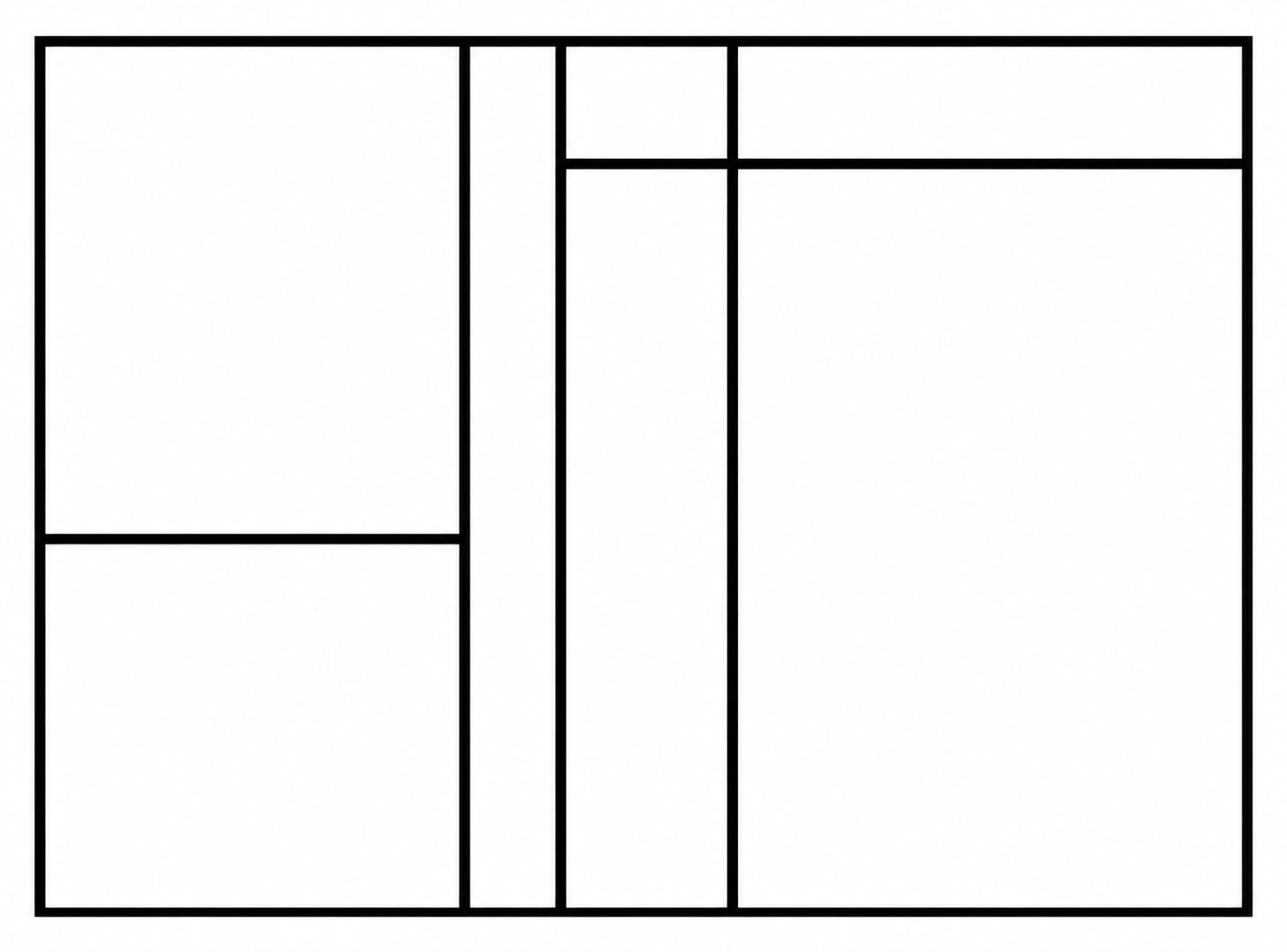
To determine the minimum number of lines required to create the given figure, we need to analyze the structure of the diagram and count the distinct lines that form the boundaries of the shapes within.
Correct Option: B) 9
This question tests knowledge about plant tissues, specifically identifying which types of simple permanent tissues consist of living cells. Plant tissues are broadly classified into meristematic and permanent tissues. Permanent tissues are further divided into simple and complex permanent tissues. Simple permanent tissues include parenchyma, collenchyma, and sclerenchyma, each with distinct characteristics regarding their cell walls, intercellular spaces, and whether their cells are living or dead.
Correct Option: D) Parenchyma and collenchyma
Cells of parenchyma and collenchyma tissues are living cells. Parenchyma cells are involved in storage, photosynthesis, and secretion, while collenchyma cells provide flexible support to growing parts of the plant. Both types retain their protoplast and metabolic activity.
To find the average speed, we need to determine the total distance covered and the total time taken. Average speed is defined as the total distance divided by the total time. The problem provides the length of the pool, the total distance covered, and the total time taken.
Since the options are in meters per second (\(\text{ms}^{-1}\)), we need to convert the time from minutes to seconds.
\[ 1 \text{ minute} = 60 \text{ seconds} \]Average speed is calculated as:
\[ \text{Average Speed} = \frac{\text{Total Distance}}{\text{Total Time}} \]Substitute the total distance and total time (in seconds) into the formula:
\[ \text{Average Speed} = \frac{150 \text{ m}}{60 \text{ s}} \]\[ \text{Average Speed} = 2.5 \text{ ms}^{-1} \]Correct Option: B) 2.5 ms⁻¹
The average speed of Ram is \(2.5 \text{ ms}^{-1}\).
To find the magnitude of the applied force, we need to first calculate the acceleration of the object. We can do this using the given initial velocity, final velocity, and time. Once the acceleration is known, we can use Newton's second law of motion, \(F = ma\), to determine the force.
Identify the given values:
Calculate the acceleration (\(a\)):
We use the first equation of motion: \(v = u + at\)
Calculate the force (\(F\)):
Using Newton's second law of motion: \(F = ma\)
Round to two decimal places:
\[ F \approx 11.67 \text{ N} \]B) 11.66 N is the closest value to our calculated force of approximately 11.67 N. The slight difference is due to rounding.
The question asks to identify the classification of Bronze. To answer this, one needs to recall the definition of an alloy and the composition of Bronze.
A) Alloy. Bronze is a well-known alloy, primarily consisting of copper and tin. Alloys are created to enhance specific properties like strength, hardness, or corrosion resistance, which is why bronze was historically important for tools and weapons.
Electron affinity is the energy released when an electron is added to a neutral atom in the gaseous state to form a negative ion. A higher (more negative) electron affinity indicates a greater tendency to accept an electron. We need to identify the element with the least electron affinity, which means it has the lowest tendency to accept an electron, or even requires energy to add an electron (positive electron affinity).
B) Mercury has the least electron affinity. Metals generally have low electron affinities, and mercury, with its stable electron configuration, is particularly reluctant to accept an additional electron, often exhibiting a positive electron affinity value.
The question asks to identify the correct statements regarding the Indus Valley Civilization. We need to evaluate each statement based on historical knowledge of the civilization.
D) Both 1 and 2 are correct. Both statements align with the established historical and archaeological understanding of the Indus Valley Civilization.
The problem involves decoding a pattern based on the positional values of letters in the English alphabet. We need to find the numerical code for each letter in the word "SOAP" and then apply the same logic to find the code for "OPTION".
Correct Option: D) 15162091514